University of Vienna
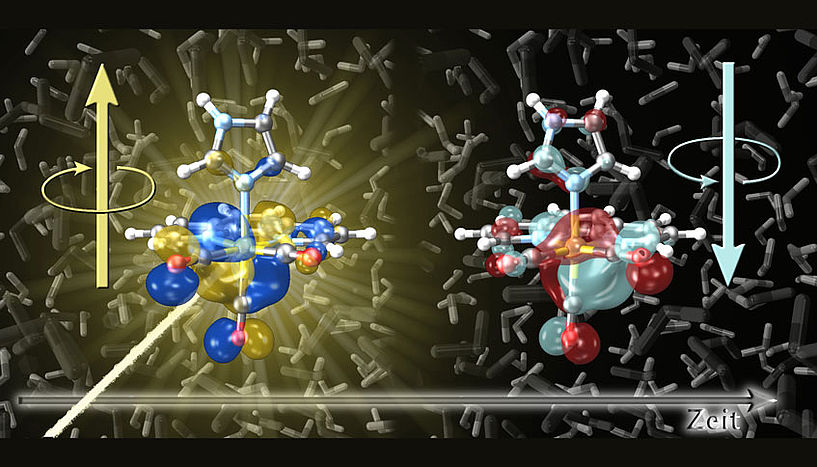
When a molecule is hit by light, in many cases a so-called "photoinduced" reaction is initiated. This can be thought of as the interplay of electron motion and nuclear motion. First, the absorption of light energetically "excites" the electrons, which for instance can weaken some of the bonds. Subsequently, the much heavier nuclei start moving. If at a later point in time the nuclei assume a favorable constellation with respect to each other, the electrons can switch from one orbit to another one. Controlled by the physical effect of "spin-orbit coupling" the electron spin can flip in the same moment.
This interplay of motion is the reason why spin-flip processes in molecules typically take quite long. However, computer simulations have shown that this is not the case in some metal complexes. For example, in the examined rhenium complex the spin-flip process already takes place within ten femtoseconds, even though in this short time the nuclei are virtually stationary -- even light moves only three thousandths of a millimeter within this time. This knowledge is particularly useful for the precise control of electron spins, as, e.g., in quantum computers.
Investigation is based on enormous computer power
One of the biggest difficulties during the investigation was the huge amount of computer power that was required for the simulations. Although for small organic molecules one can nowadays carry out very accurate simulations already with a modest amount of computational effort, metal complexes present a much bigger challenge. Among other reasons, this is due to the large number of atoms, electrons, and solvent molecules that need to be included in the simulations, but also because the electron spin can only be accurately described with equations from relativity theory. Altogether, the scientists from the Institute of Theoretical Chemistry spent almost one million computer hours at the Austrian super computer "Vienna Scientific Cluster" in the course of their study. This is equivalent to about 100 years of computer time on a typical personal computer.
Unconventional two-step spin relaxation dynamics of [Re(CO)3(im)(phen)] in aqueous solution
Sebastian Mai, Leticia González
Chemical Science, 2019
DOI: 10.1039/C9SC03671G
Contact information:
Leticia Gonzalez
Professor at Institute of Theoretical Chemistry, University of Vienna
leticia.gonzalez@univie.ac.at
Phone: +43-1-4277-527 50

Researchers led by Professor Jaeyune Ryu at Seoul National University identified local pH near electrodes as a decisive variable in organic electrosynthesis. By designing a reactor that narrows electrode spacing and flows electrolyte to counterbalance acidic and alkaline zones, they raised selectivity for lactones and epoxides, feedstocks for biodegradable plastics, polyurethanes, adhesives, and epoxy resins, from about 16% to 97% using only oxygen and electricity, eliminating added peroxide…

Silver nanoparticles with diameters of ~10 nm deliver the best performance as electrocatalysts. The silver particles are sprayed onto the electrode together with a conductive carbon powder. The ideal mixture consists of 20 per cent by mass silver and 80 per cent by mass carbon powder. This image was taken using a transmission electron microscope (TEM). © HZB Via electrolysis, CO₂ can be reduced to CO, a raw material for further chemical products such as fuels. Within the GreenQuest Project,...

A flexible metal–organic framework developed by researchers from Institute of Science Tokyo enables the structural determination of large "beyond rule of 5" molecules from microgram-scale samples. Using APF-40 as a crystalline sponge, the researchers determined the structures of 12 pharmaceutical-related molecules, including the 899 Da drug molecule doramectin and trace ivermectin derivatives. The method could aid drug discovery, natural products research, and the characterization of rare...






