Southwest Jiaotong University
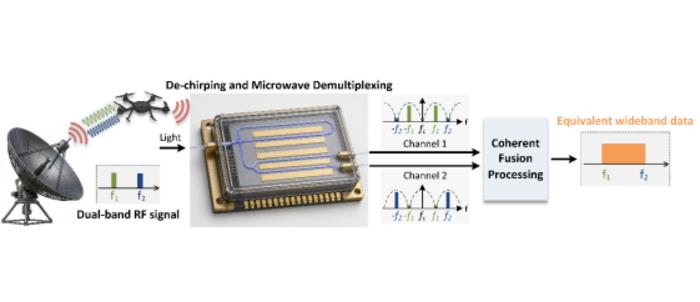
Researchers at Southwest Jiaotong University have developed a thin-film lithium niobate (TFLN) integrated photonic receiver for dual-band radar, designed to simplify the receiver front-end by integrating electro-optic modulation and microwave demultiplexing on a single chip. The work, published in PhotoniX Synergy, combines the integrated photonic receiver with coherent fusion processing to synthesize an equivalent bandwidth of 12 GHz and achieve a ranging resolution of 1.27 cm, providing a highly integrated approach for high-resolution dual-band radar.
As next-generation radar systems demand higher ranging resolution and greater flexibility in spectral resources, dual-band radar with coherent fusion provides an approach to synthesize a wider equivalent bandwidth from separated sub-bands. However, conventional dual-band radar receivers typically require multiple discrete components for modulation and demultiplexing, increasing system size, weight, power consumption, and inter-component loss. Integrating these functions into a compact photonic platform therefore remains challenging.
To address these challenges, the researchers developed a dual-channel TFLN integrated photonic receiver based on cascaded phase modulators. By introducing a fixed optical delay between the modulation stages and controlling the corresponding microwave delay, the device generates complementary electro-optic responses in the two channels, enabling frequency-selective modulation and microwave demultiplexing. The modulation period can be dynamically reconfigured by adjusting the inter-stage microwave delay, while the device maintains a maximum single-tone extinction ratio exceeding 33.2 dB.
“Our approach integrates electro-optic modulation and microwave demultiplexing within a single thin-film lithium niobate receiver, reducing the number of discrete components required in the radar front-end,” said Xihua Zou, corresponding author of the paper and professor at Southwest Jiaotong University. “The frequency-selective response can be configured through the inter-stage delay, allowing the same integrated receiver architecture to process separated radar sub-bands.”
The researchers experimentally demonstrated a dual-band microwave photonic radar system based on the integrated photonic receiver, using linear frequency-modulated signals centered at 3.55 GHz and 14.25 GHz, with a bandwidth of 1.3 GHz for each band. The received radar sub-bands were subsequently processed through coherent fusion to synthesize an equivalent bandwidth of 12 GHz. In a ranging experiment, two targets separated by 1.3 cm were clearly resolved, corresponding to a ranging resolution of 1.27 cm.
“By combining integrated microwave photonic chip with coherent fusion processing, this work provides a compact approach for dual-band radar system,” said Yongtao Du, first author of the paper. “The thin-film lithium niobate platform also provides consistent channel behavior, which is beneficial for the phase stability required in subsequent coherent fusion.”
Reference
Integrated photonic receiver with synergistic modulation and demultiplexing functions for dual-band radar
Yongtao Du, Ningyuan Zhong, Xihua Zou, Fang Zou, Wenlin Bai, Xiao Yu, Xiaojun Xie, Wei Pan, and Lianshan Yan
JEDEC has set the first silicon photonics AI network reliability standard, according to the feed headline.
ZEISS has agreed to acquire Ceres Holographics, a Scottish maker of thin-film holographic optical elements for automotive windshield displays. Ceres will join ZEISS Microoptics. The price was not disclosed.
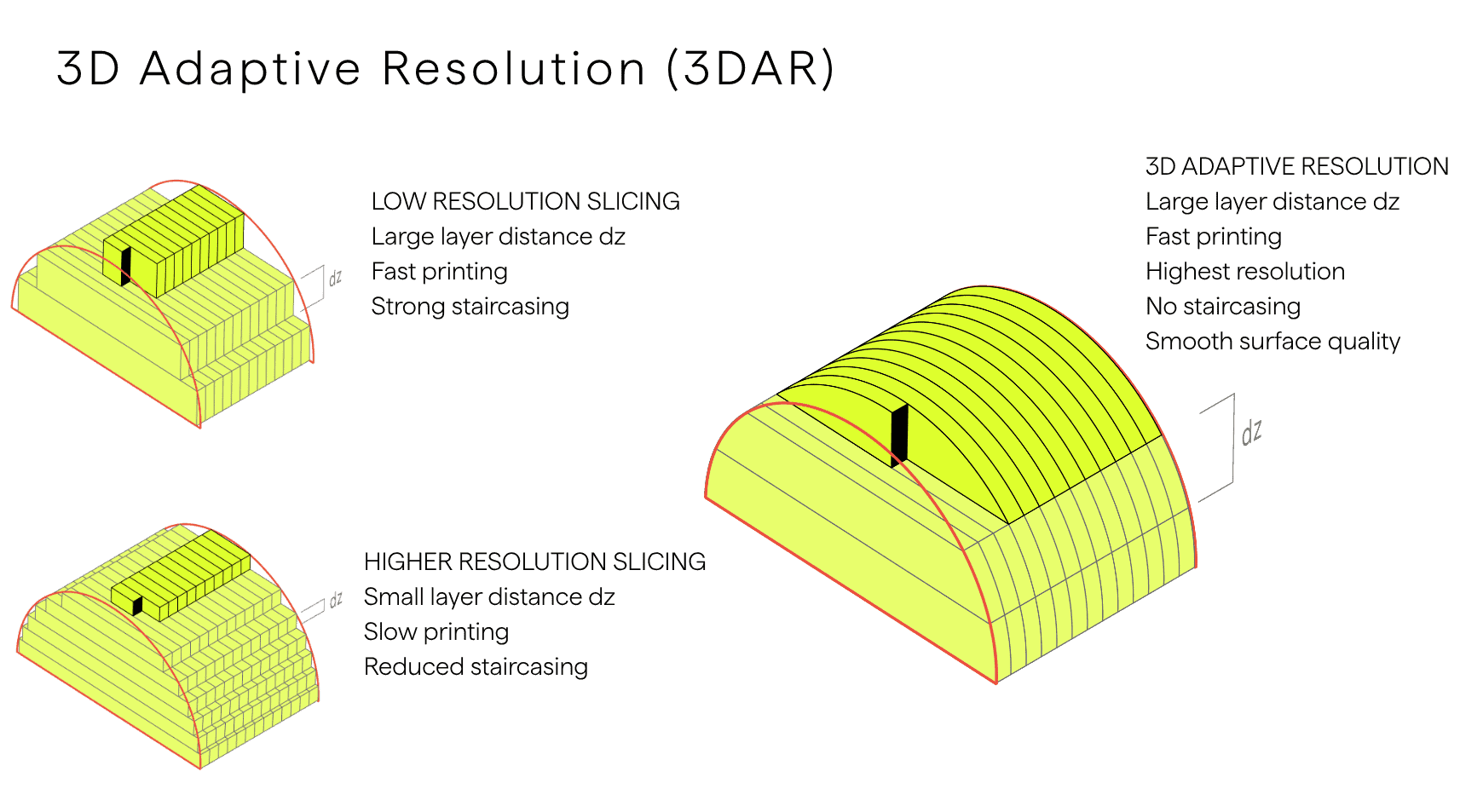
UpNano GmbH has developed 3D Adaptive Resolution (3DAR) technology, which enables dynamic control of the printing voxel in all three spatial dimensions during 2-photon polymerisation 3D printing. The first printers capable of 3DAR have been purchased by an Asian company.






