Okinawa Institute of Science and Technology (OIST)

Nanoparticles are tiny. At just 1/1000th of a millimeter, they're impossible to see with the naked eye. But, despite being small, they're extremely important in many ways. If scientists want to take a close look at DNA, proteins, or viruses, then being able to isolate and monitor nanoparticles is essential.
Trapping these particles involves tightly focusing a laser beam to a point that produces a strong electromagnetic field. This beam can hold particles just like a pair of tweezers but, unfortunately, there are natural restrictions to this technique. Most notable are the size restrictions - if the particle is too small, the technique won't work. To date, optical tweezers have been unable to hold particles like individual proteins, which are only a few nanometers in diameter.
Now, due to recent advances in nanotechnology, researchers in the Light-Matter Interactions for Quantum Technologies Unit at the Okinawa Institute of Science and Technology Graduate University (OIST) have developed a technique for precise nanoparticle trapping. In this study, they overcame the natural restrictions by developing optical tweezers based on metamaterials - a synthetic material with specific properties that do not occur naturally. This was the first time that this kind of metamaterial had been used for single nanoparticle trapping.
"Being able to manipulate or control these small particles is crucial for advances in biomedical science," explained Dr. Domna Kotsifaki, staff scientist in the OIST Unit and first author of the research paper published in Nano Letters. Dr. Kotsifaki went on to explain that trapping these nanoparticles could enable researchers to see the progression of cancer, to develop effective drugs, and to advance biomedical imaging. "The potential applications for society are far-reaching."
This novel technique has two sought after abilities - it can stably trap the nanoparticles using low intensity laser power and it can be used for a long period whilst avoiding light damage to the sample. The reason for this was the metamaterial that the researchers chose to use. This metamaterial is highly sensitive to changes in the surrounding environment and, therefore, allows for the use of low intensity laser power.
"Metamaterials have unusual properties due to their unique design and structure. But this makes them very useful. Over the last few years, a whole new era of devices with novel concepts and potential applications has been created from them," explained Dr. Kotsifaki. "From the metamaterial, we fabricated an array of asymmetric split rings using a beam of ions - tiny, charged particles - on a 50 nm gold film."
To test whether the technique worked, the research group illuminated the device with near infrared light and trapped 20 nm polystyrene particles at certain regions on it.
Dr. Kotsifaki and colleagues were looking for the trap stiffness, which is a measurement of trapping performance. "The achieved trapping performance was several times better than that of conventional optical tweezers and the highest reported to date as far as we know," she explained. "As the first group to use this device for precision nanoparticle trapping, it has been rewarding to contribute to such progress in this research area."
The research team now plans to tweak their device to see if these tweezers can be used in real-world applications. Specifically, in the future, this device could be utilized to create lab-on-chip technologies, which are hand-held, diagnostic tools that can provide results efficiently and economically. Alongside its applications in biomedical science, this research has provided new and fundamental insights into nanotechnology and light behavior at the nanoscale.
As well as Dr. Domna Kotsifaki, the research group consisted of Professor Síle Nic Chormaic, who leads the OIST Unit, and staff scientist, Dr. Viet Giang Truong.
Fano-Resonant, Asymmetric, Metamaterial-Assisted Tweezers for Single Nanoparticle Trapping
Domna G. Kotsifaki, Viet Giang Truong, and Síle Nic Chormaic
Nano Letters 20, 5, 3388–3395 (April 10, 2020)
DOI: 10.1021/acs.nanolett.0c00300
Contact information:
sile.nicchormaic@oist.jp
Light-Matter Interactions for Quantum Technologies (LMI-QT) Unit @ OIST
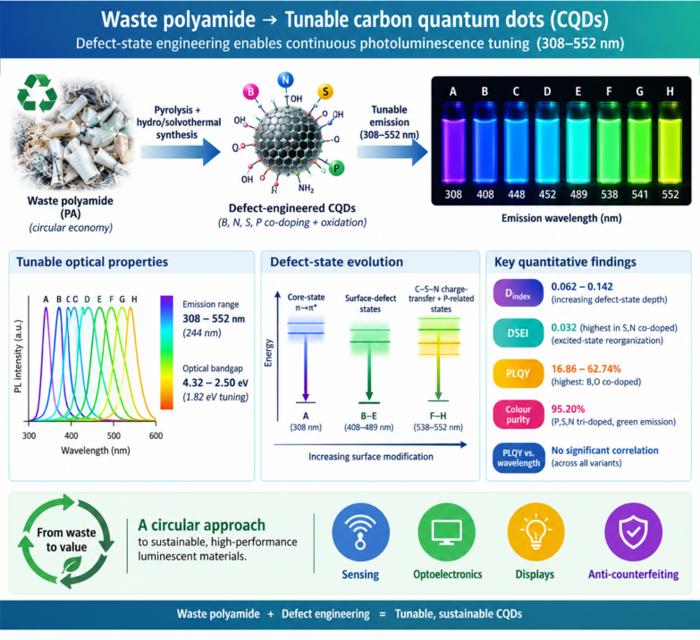
Waste polyamide-derived CQDs show continuous photoluminescence tuning from 308 to 552 nm through sequential defect-state engineering, with optical transition energies decreasing from 4.32 to 2.50 eV. @Christian Ebere Enyoh from Saitama University Carbon quantum dots (CQDs) are fluorescent carbon nanomaterials with potential applications in sensing, optoelectronics, displays, anti-counterfeiting, and environmental technologies. Their optical properties can be adjusted by modifying the carbon...
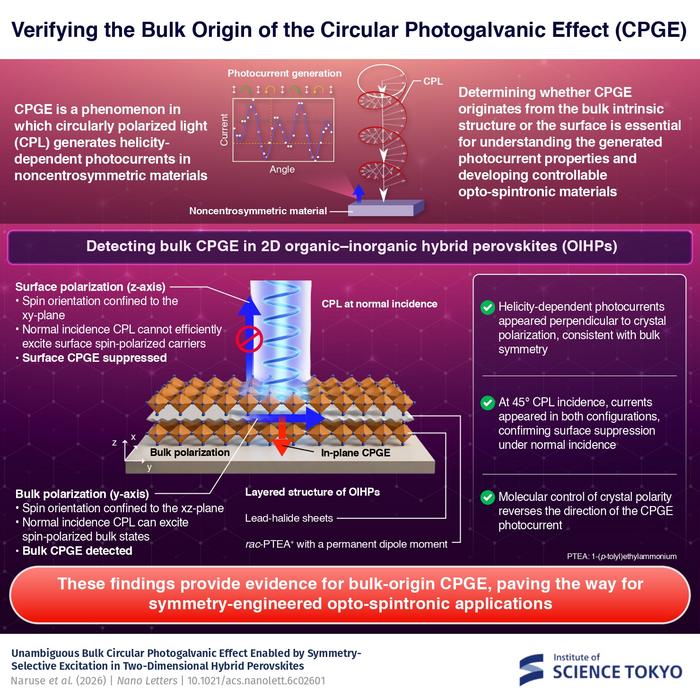
The researchers used circularly polarized light at normal incidence and found that helicity-dependent photocurrents appeared perpendicular to the crystal’s polarization but vanished when measured parallel to it, supporting a bulk origin of CPGE. @Institute of Science Tokyo The circular photogalvanic effect (CPGE), a phenomenon that generates helicity-dependent photocurrents in noncentrosymmetric materials, can originate purely from a crystal's internal structure without contribution from the...
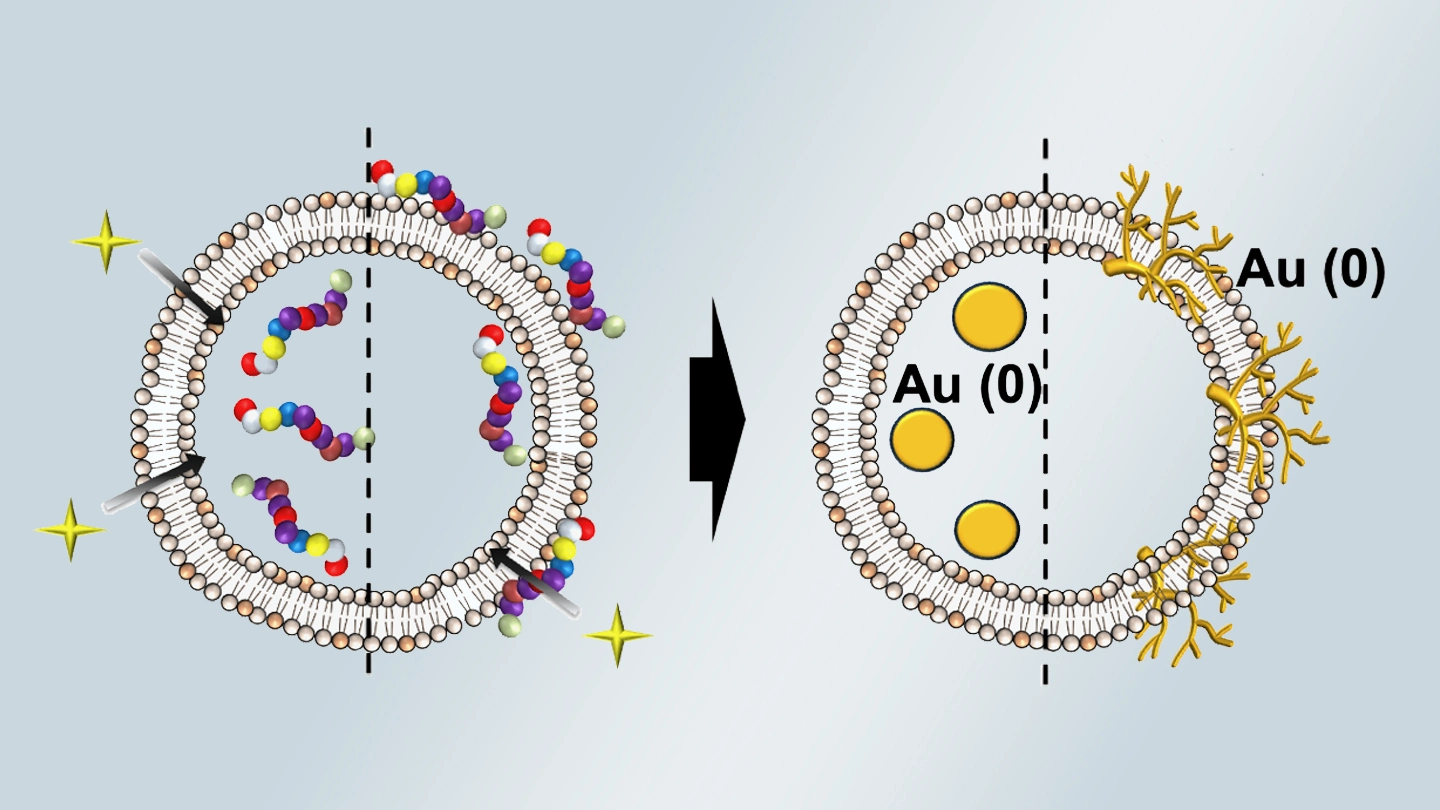
Summary of gold nanoparticle growth programming in liposome based on localization of biomineralization peptide The position of biomineralization peptides within liposomes can influence how gold nanoparticles grow, reports a research team from Institute of Science Tokyo. Peptides localized at the membrane interface promote branched structures, while those confined to the liposome interior favor spherical nanoparticles. The findings offer a new strategy for controlling nanoscale reaction...
