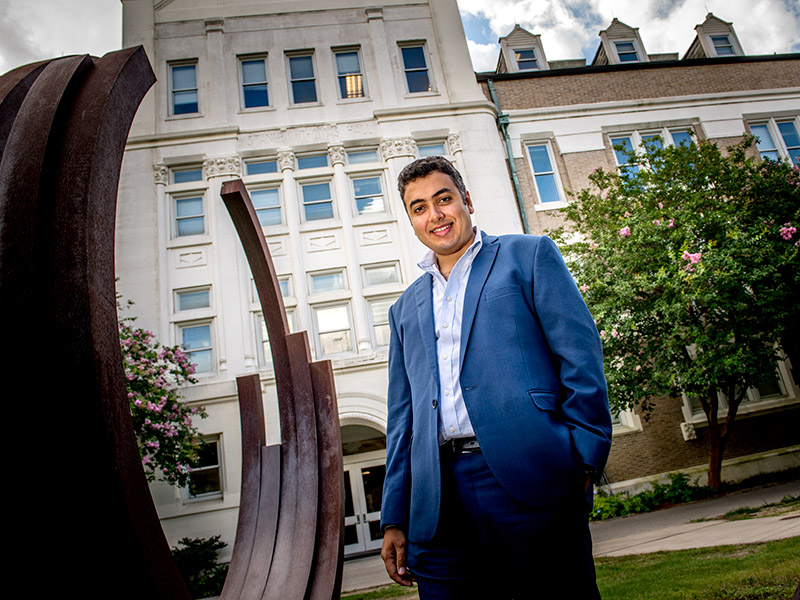
A team from the Tulane University School of Science and Engineering has developed a new family of two-dimensional materials that researchers say has promising applications, including in advanced electronics and high-capacity batteries.
Led by Michael Naguib, an assistant professor in the Department of Physics and Engineering Physics, the study has been published in the journal Advanced Materials.
“Two-dimensional materials are nanomaterials with thickness in the nanometer size (nanometer is one millionth of a millimeter) and lateral dimensions thousands of times the thickness,” Naguib said. “Their flatness offers unique set of properties compared to bulk materials.”
The name of the new family of 2D materials is transition metal carbo-chalcogenides, or TMCC. It combines the characteristics of two families of 2D materials — transition metal carbides and transition metal dichalcogenides.
Naguib, the Ken & Ruth Arnold Early Career Professor in Science and Engineering, said the latter is a large family of materials that has been explored extensively and found to be very promising, especially for electrochemical energy storage and conversion. But he said one of the challenges in utilizing them is their low electrical conductivity and stability.
On the other hand, he said, transition metal carbides are excellent electrical conductors with much more powerful conductivity. Merging the two families into one is anticipated to have great potential for many applications such as batteries and supercapacitors, catalysis, sensors and electronics.
“Instead of stacking the two different materials like Lego building blocks with many problematic interfaces, here we develop a new 2D material that has the combination of both compositions without any interface,” he said.
“We used an electrochemical-assisted exfoliation process by inserting lithium ions in-between the layers of bulk transition metals carbo-chalcogenides followed by agitation in water,” said Ahmad Majed, the first author of the article and a doctoral candidate in Materials Physics and Engineering at Tulane working in Naguib’s group.
Unlike other exotic nanomaterials, Majed said, the process of making these 2D TMCC nanomaterials is simple and scalable.
In addition to Naguib and Majed, the team includes Jiang Wei, an associate professor in physics and engineering physics; Jianwei Sun, an assistant professor in physics and engineering physics; PhD candidates Kaitlyn Prenger, Manish Kothakonda and Fei Wang at Tulane; and Dr Eric N. Tseng and professor Per O.A. Persson of Linkӧping University in Sweden.
Reference
Transition Metal Carbo-Chalcogenide “TMCC” a New Family of Two-dimensional Materials
Ahmad Majed, Manish Kothakonda, Fei Wang, Eric N. Tseng, Kaitlyn Prenger, Xiaodong Zhang, Per O.Å. Persson, Jiang Wei, Jianwei Sun, Michael Naguib
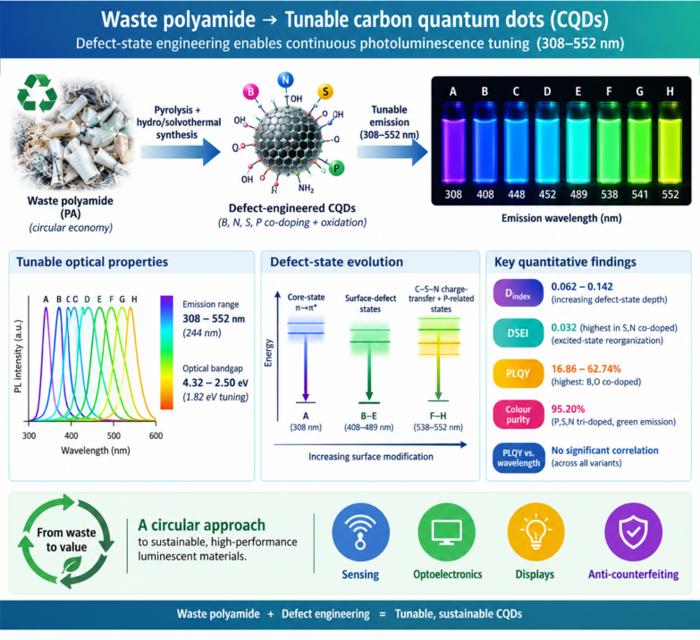
Waste polyamide-derived CQDs show continuous photoluminescence tuning from 308 to 552 nm through sequential defect-state engineering, with optical transition energies decreasing from 4.32 to 2.50 eV. @Christian Ebere Enyoh from Saitama University Carbon quantum dots (CQDs) are fluorescent carbon nanomaterials with potential applications in sensing, optoelectronics, displays, anti-counterfeiting, and environmental technologies. Their optical properties can be adjusted by modifying the carbon...
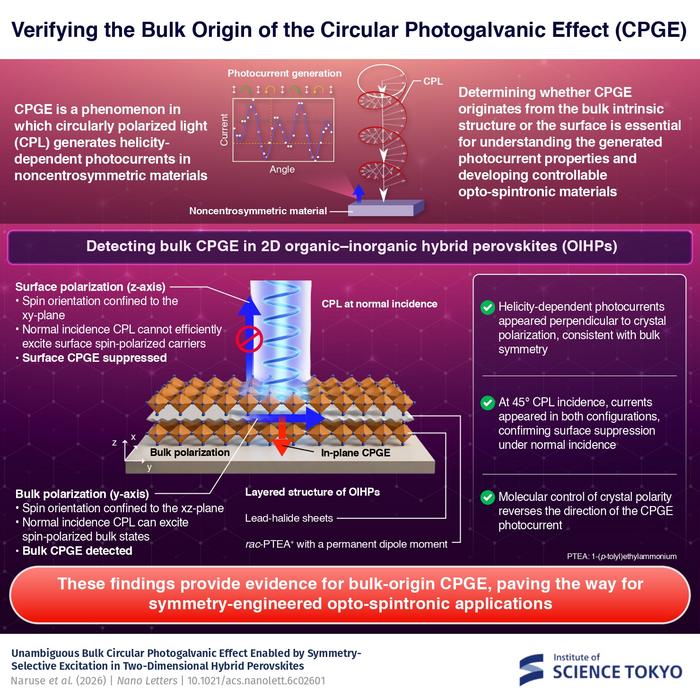
The researchers used circularly polarized light at normal incidence and found that helicity-dependent photocurrents appeared perpendicular to the crystal’s polarization but vanished when measured parallel to it, supporting a bulk origin of CPGE. @Institute of Science Tokyo The circular photogalvanic effect (CPGE), a phenomenon that generates helicity-dependent photocurrents in noncentrosymmetric materials, can originate purely from a crystal's internal structure without contribution from the...
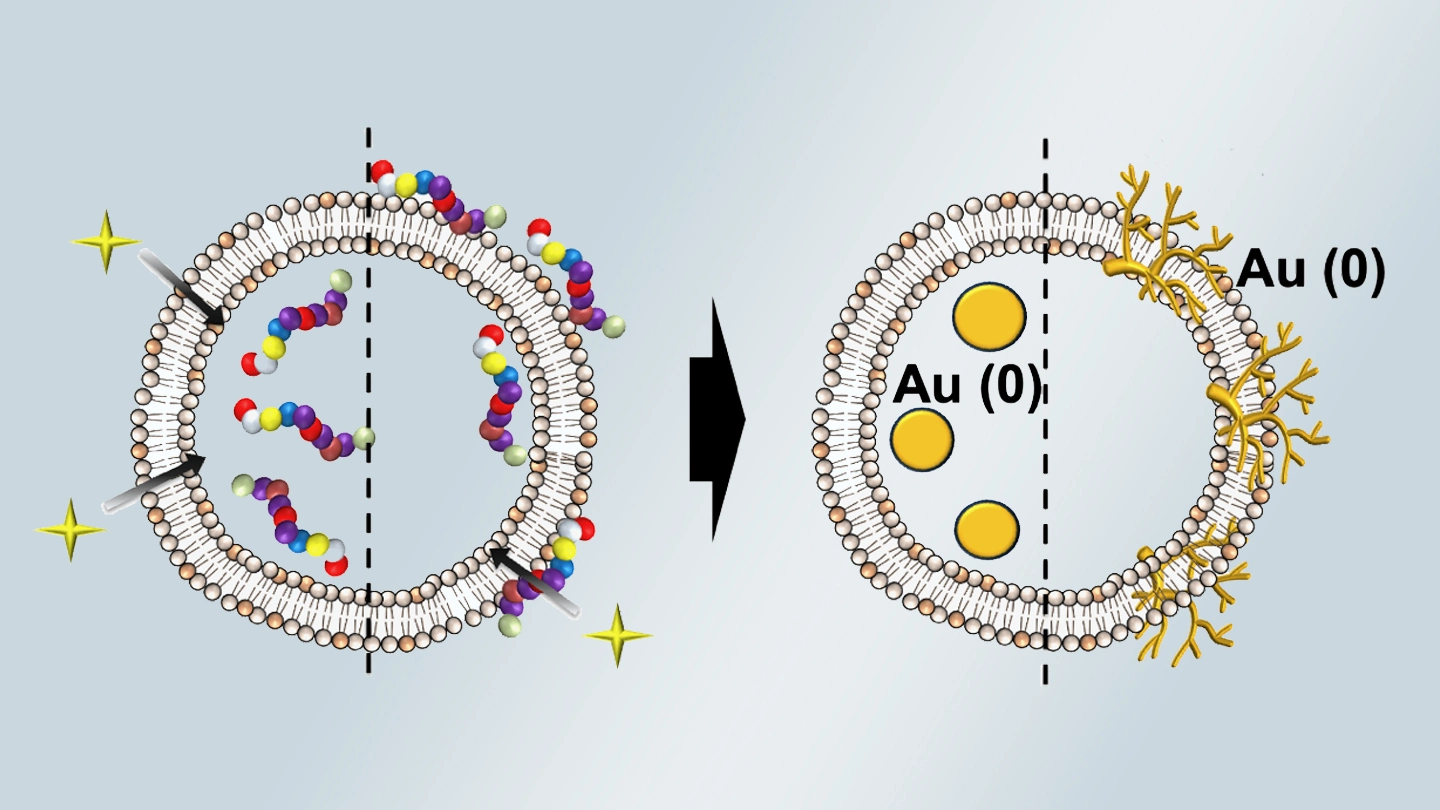
Summary of gold nanoparticle growth programming in liposome based on localization of biomineralization peptide The position of biomineralization peptides within liposomes can influence how gold nanoparticles grow, reports a research team from Institute of Science Tokyo. Peptides localized at the membrane interface promote branched structures, while those confined to the liposome interior favor spherical nanoparticles. The findings offer a new strategy for controlling nanoscale reaction...
