
A study carried out by researchers from the HZDR Institute of Radiation Physics, ICN2 Ultrafast Dynamics in Nanoscale Systems group, University of Exeter Centre for Graphene Science, and TU Eindhoven demonstrates that graphene-based materials can be used to efficiently convert high-frequency signals (in the terahertz regime) into visible light, and that this mechanism is tunable. These outcomes open the path to exciting applications in next-future information and communication technologies.
The ability to convert signals from one frequency regime to another is key to various technologies, in particular in telecommunications, where, for example, data processed by electronic devices are often transmitted as optical signals through fibres. To enable significantly higher data transmission rates, future 6G wireless communication systems will need to extend the carrier frequency above 100GHz up to the terahertz (THz) range. Therefore, a fast and controllable mechanism to convert THz waves into visible or telecom light will be required. Imaging and sensing technologies could also benefit from it.
What is missing is a material that is capable of upconverting photon energies by a factor of 1000 or so: from the milli-electronvolt (meV) range to around 1 eV. Researchers have recently identified the strong nonlinear response of so-called Dirac quantum materials, e.g. graphene and topological insulators, to THz light pulses. This manifests in the highly efficient generation of high harmonics upon excitation with THz pulses. These harmonics are still within the THz range, however, there were also first observations of visible light emission from graphene upon infrared and terahertz excitation. Up to now, this effect was extremely inefficient and the underlying physical mechanism was not understood.
A work published in Nano Letters demonstrates ultrafast and tunable conversion of THz light into visible light in graphene systems. The study was led by Dr Igor Ilyakov and Dr Sergey Kovalev–from the Helmholtz-Zentrum Dresden-Rossendorf (HZDR, Germany)— and by Prof Klaas-Jan Tielrooij –group leader at Catalan Institute of Nanoscience and Nanotechnology (ICN2, Spain) and Eindhoven University of Technology (The Netherlands). They provide a physical explanation for this mechanism and show how the light emission can be strongly enhanced by using highly doped graphene (so-called GraphExeter) and by using a grating-graphene metamaterial. They also observed that the conversion occurs very rapidly –on the sub-nanosecond time scale— and that it can be controlled by electrostatic gating.
The authors ascribe the light frequency conversion in graphene to a THz-induced thermal radiation mechanism: the charge carriers absorb electromagnetic energy from the incident THz field; the absorbed energy rapidly distributes in the material, resulting in carrier heating; finally, this leads to emission of photons in the visible spectrum as a result of black-body radiation.
The tunability and speed of the THz-to-visible light conversion achieved in graphene-based materials has great potential for application in information and communication technologies. The underlying ultrafast thermodynamic mechanism could certainly produce an impact on THz-to-telecom interconnects, as well as in any technology that requires ultrafast frequency conversion of signals.
Reference
Ultrafast Tunable Terahertz-to-Visible Light Conversion through Thermal Radiation from Graphene Metamaterials
Igor Ilyakov, Alexey Ponomaryov, David Saleta Reig, Conor Murphy, Jake Dudley Mehew, Thales V.A.G. de Oliveira, Gulloo Lal Prajapati, Atiqa Arshad, Jan-Christoph Deinert, Monica Felicia Craciun, Saverio Russo, Sergey Kovalev, and Klaas-Jan Tielrooij
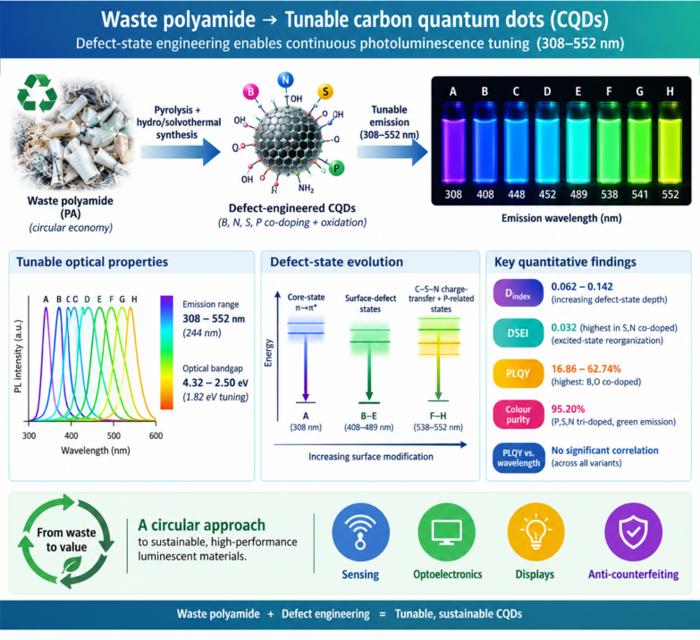
Waste polyamide-derived CQDs show continuous photoluminescence tuning from 308 to 552 nm through sequential defect-state engineering, with optical transition energies decreasing from 4.32 to 2.50 eV. @Christian Ebere Enyoh from Saitama University Carbon quantum dots (CQDs) are fluorescent carbon nanomaterials with potential applications in sensing, optoelectronics, displays, anti-counterfeiting, and environmental technologies. Their optical properties can be adjusted by modifying the carbon...
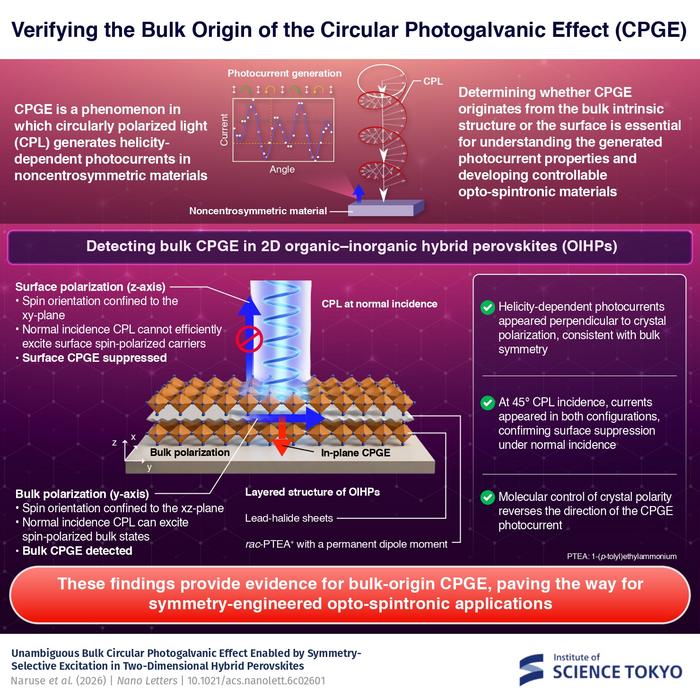
The researchers used circularly polarized light at normal incidence and found that helicity-dependent photocurrents appeared perpendicular to the crystal’s polarization but vanished when measured parallel to it, supporting a bulk origin of CPGE. @Institute of Science Tokyo The circular photogalvanic effect (CPGE), a phenomenon that generates helicity-dependent photocurrents in noncentrosymmetric materials, can originate purely from a crystal's internal structure without contribution from the...
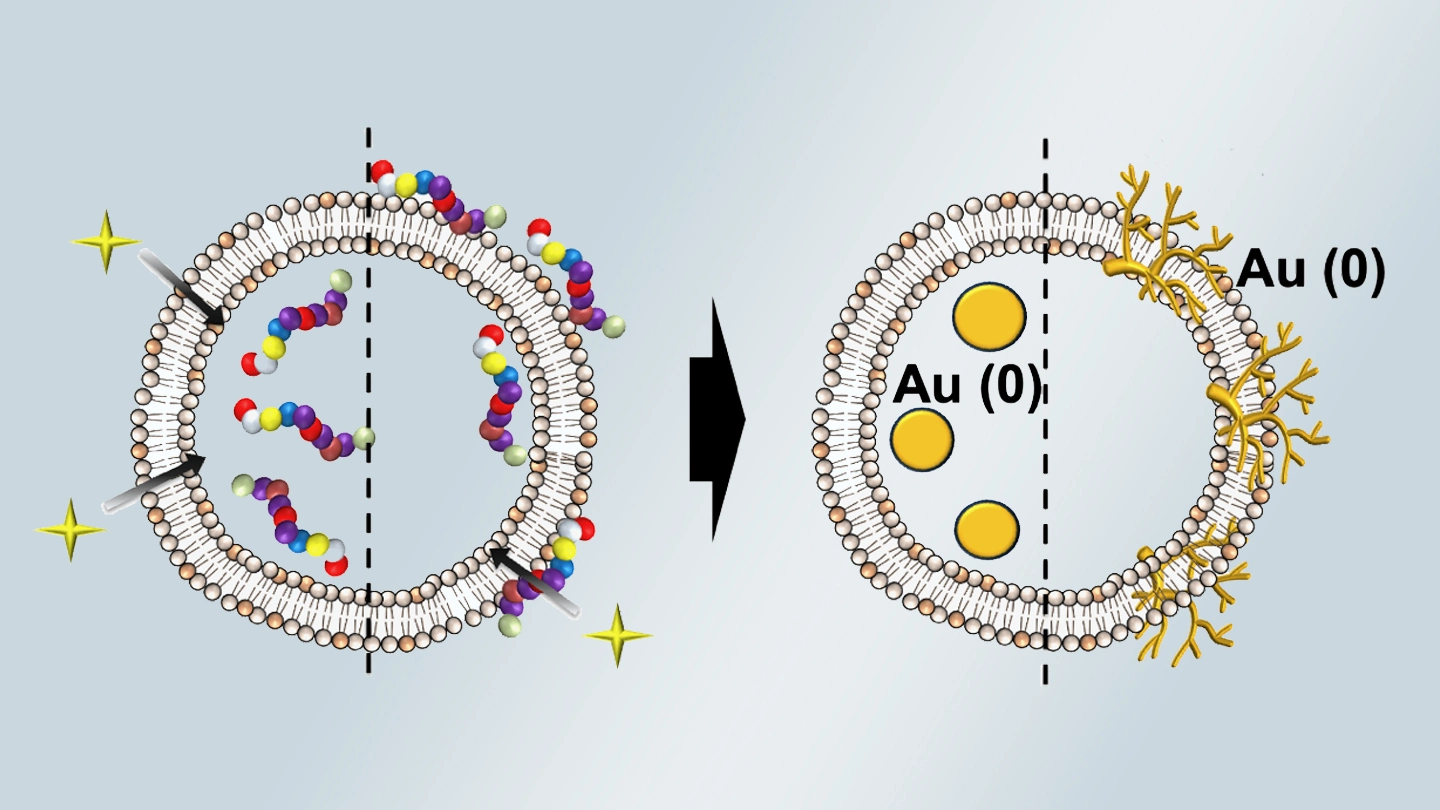
Summary of gold nanoparticle growth programming in liposome based on localization of biomineralization peptide The position of biomineralization peptides within liposomes can influence how gold nanoparticles grow, reports a research team from Institute of Science Tokyo. Peptides localized at the membrane interface promote branched structures, while those confined to the liposome interior favor spherical nanoparticles. The findings offer a new strategy for controlling nanoscale reaction...
