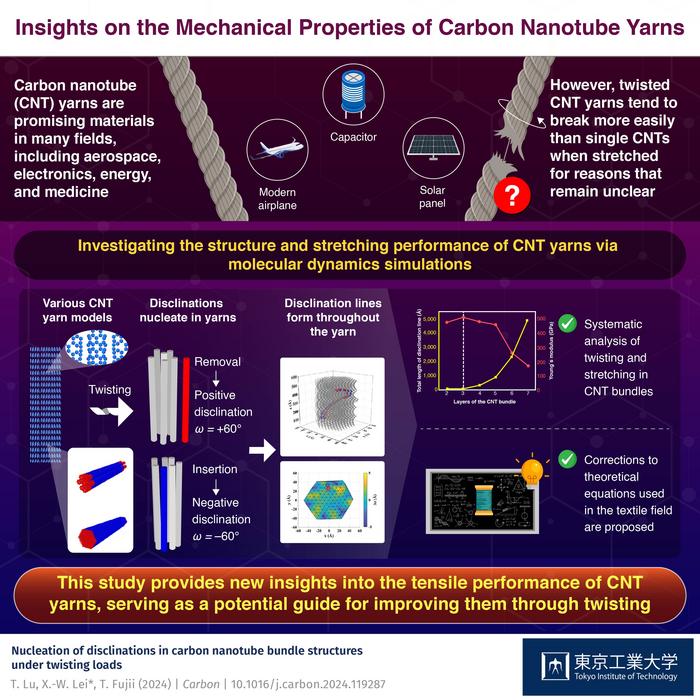
Aside from being an essential building block for life, carbon is being actively researched due to its versatility as an engineering material. Carbon nanotubes (CNTs), in particular, have demonstrated tremendous potential for aerospace, semiconductor, and medical applications, mostly owing to their high strength and low weight.
Since CNTs are typically short, they need to be weaved into bundles or yarns to expand their practical uses. However, scientists have noted that CNT bundles (CNTBs) and CNT yarns both exhibit a much lower tensile strength than single CNTs when they undergo twisting—this drop in stretching performance can even reach several orders of magnitude! The worst part is that, despite research efforts, the reasons behind this phenomenon remain unclear.
In a recent study published in Carbon on 30 May 2024, a research team led by Associate Professor Xiao-Wen Lei from Tokyo Institute of Technology, Japan, sought to solve this puzzle. By combining molecular dynamics (MD) simulations and the Delaunay triangulation algorithm, they shed light on what could be happening inside CNTBs as they are twisted.
The researchers designed several CTNB models and setups for the MD simulations, considering different numbers of CNT layers, CNT lengths, twisting angles, and twisting force profiles. After running the simulations, they carefully analyzed how the CNTBs reacted to the stretching before and after twisting.
By observing the cross-section of the twisted CNTBs, the team revealed that the poor mechanical performance of CNTBs and CNT yarns may be caused by what’s known as ‘wedge disclinations.’ To understand what these are, one should first know that CNTs naturally arrange themselves in hexagonal patterns when bundled. A disclination refers to a defect in this pattern, whereby either a CNT is missing from the group of six (positive disclination) or an additional CNT is inserted to form an arrangement of seven (negative disclination).
Based on the simulations, the researchers found that when the CNTBs were twisted, disclinations arose due to local CNT rearrangements. These disclinations formed long, curved disclination lines in CNTBs with more layers. Most importantly, these lines appeared to have a direct effect on the behavior of the CNTBs upon mechanical stretching. “We observed that the presence of disclination lines resulted in a decrease in the Young’s modulus of the CNTBs, with longer disclination lines corresponding to a lower Young’s modulus. The appearance of disclination lines in twisted CNTBs may thus be one of the key reasons for the decline in the mechanical properties of the CNT yarns,” explains Lei.
Taken together, the findings of this study help explain some of the current limitations of CNTBs and hint at potential solutions to realize high-performance CNT yarns through twisting. “Leveraging insights gained from understanding the correlation between microscopic internal stacking structural changes and mechanical properties caused by the introduction of lattice defects in materials could pioneer a new academic field related to computational materials science,” highlights Lei. “We ultimately aim for our research to contribute to the realization of a smart, sustainable, and prosperous society in the near future.”
With any luck, the current challenges associated with CNTs will soon be addressed so that these amazing materials help us push the state of the art further.
Reference
Nucleation of disclinations in carbon nanotube bundle structures under twisting loads
Tong Lu, Xiao-Wen Lei, Toshiyuki Fujii
https://www.sciencedirect.com/science/article/pii/S0008622324005062?via%3Dihub
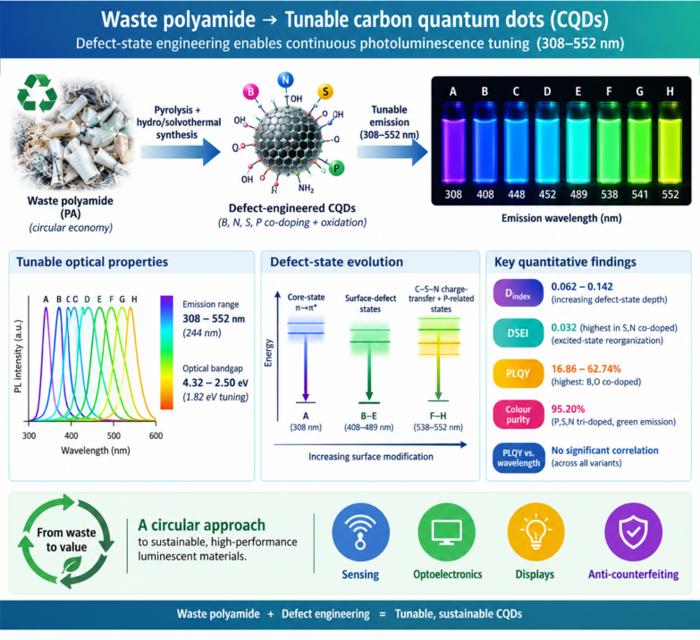
Waste polyamide-derived CQDs show continuous photoluminescence tuning from 308 to 552 nm through sequential defect-state engineering, with optical transition energies decreasing from 4.32 to 2.50 eV. @Christian Ebere Enyoh from Saitama University Carbon quantum dots (CQDs) are fluorescent carbon nanomaterials with potential applications in sensing, optoelectronics, displays, anti-counterfeiting, and environmental technologies. Their optical properties can be adjusted by modifying the carbon...

The researchers used circularly polarized light at normal incidence and found that helicity-dependent photocurrents appeared perpendicular to the crystal’s polarization but vanished when measured parallel to it, supporting a bulk origin of CPGE. @Institute of Science Tokyo The circular photogalvanic effect (CPGE), a phenomenon that generates helicity-dependent photocurrents in noncentrosymmetric materials, can originate purely from a crystal's internal structure without contribution from the...
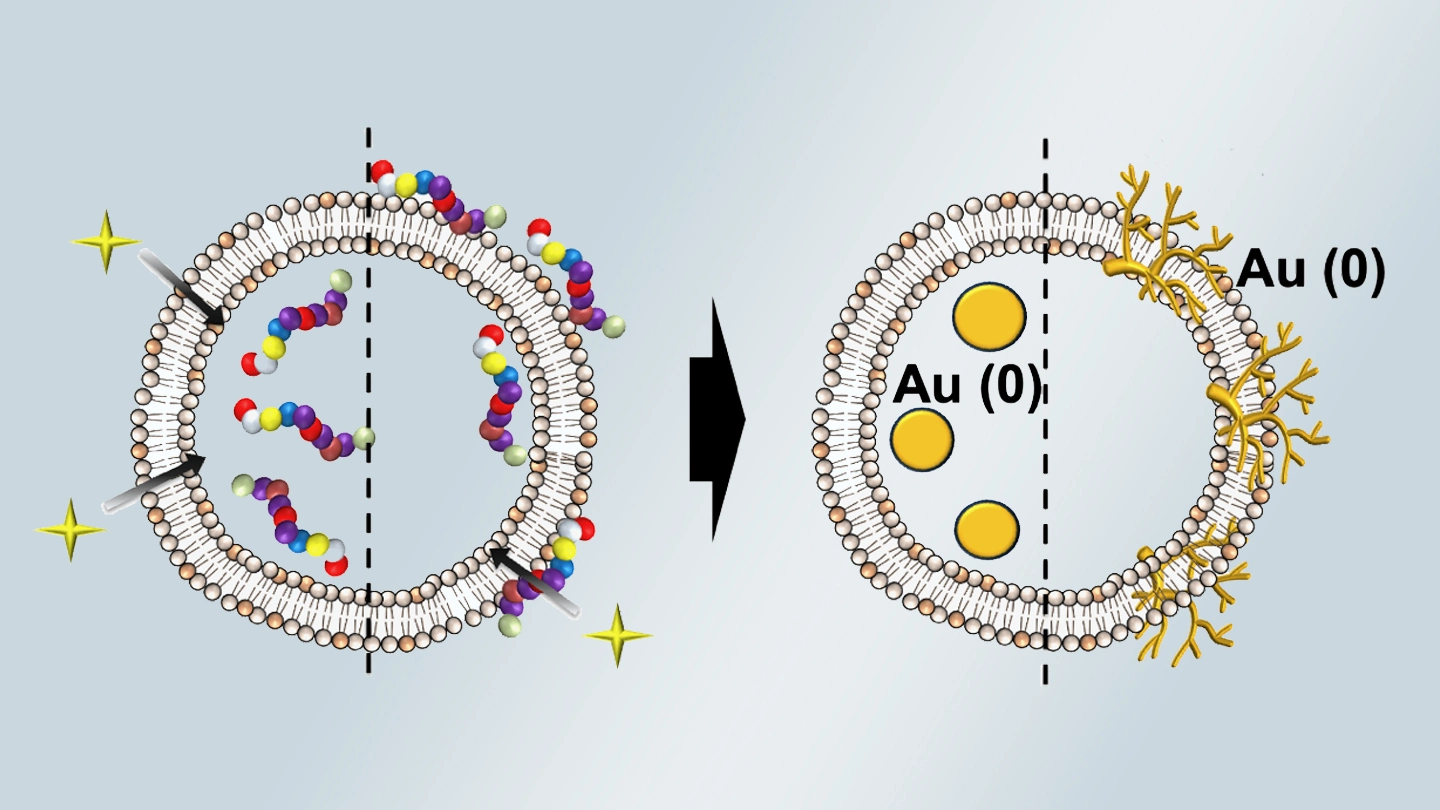
Summary of gold nanoparticle growth programming in liposome based on localization of biomineralization peptide The position of biomineralization peptides within liposomes can influence how gold nanoparticles grow, reports a research team from Institute of Science Tokyo. Peptides localized at the membrane interface promote branched structures, while those confined to the liposome interior favor spherical nanoparticles. The findings offer a new strategy for controlling nanoscale reaction...
