Playing a different sound track is, physically speaking, only a minute change of the vibration spectrum, yet its impact on a dance floor is dramatic. People long for this tiny trigger, and as a salsa changes to a tango completely different collective patterns emerge. For such a tiny stimulus to have an effect, the crowd needs to know more than just one dance. Electrons in metals tend to show only one behavior at zero temperature, when all kinetic energy is quenched. One needs to frustrate the electronic interaction to break the dominance of one particular electronic order and allow multiple possible configurations, which restores richness of their behavior and amplifies the signatures of quantum mechanics. Recent results on Kagome nets suggest that this triangular lattice is quite effective at doing so.
Named after the Japanese bamboo-basket woven pattern, a two-dimensional (2D) Kagome lattice is constructed by a series of corner-sharing triangles. When each corner is occupied with magnetic moments with antiferromagnetic correlations, the nearest-neighbor interactions favor anti-aligned spins. The system is therefore geometrically frustrated to reach a magnetically ordered state, normally referred as magnetic frustration. In the late 1980s, it was shown that the antiferromagnetic kagome lattice may be the most frustrated 2D magnetic system that one can construct.
A particular group of Kagome superconductors has recently attracted intense scientific debate, with a range of studies revealing apparently contradictory properties in these materials. Now an international research team led by scientists at the MPSD has managed to investigate a member of this group of Kagome materials without external perturbations – a crucial step in order to understand its intrinsic electronic ground state. The study has been published in Nature Physics.
When 2D Kagome nets are combined into 3D metals, these so-called Kagome metals become a rich testbed for exploring the interplay between non-trivial topological excitations and strong electronic correlations. Moreover, the strong geometrical frustration prevents the electronic orders from being established as multiple possible ground states are almost energetically degenerate, meaning that there exist two or more possible electronic ground states that are almost energetically equivalent. With the system’s energy scale further normalized by the electronic correlations, Kagome metals often display intertwined electronic order as even negligible perturbations drastically modify their physical properties.
Due to their structural make-up and magnetic frustrations, the properties of Kagome materials react very strongly to even seemingly minor perturbations. This extreme tunability has been strongly exemplified by the recent advances in a group of Kagome superconductors, AV3Sb5. These materials display electronic orderings at around 100 Kelvin Celsius and a superconducting ground state with a critical temperature at ~ 3 K.Beyond this, an impressive set of experiments has demonstrated that ``something else'' is happening in this material, often associated with an onset temperature of T'~ 30 K. Scientists are trying to understand the nature of these changes and why they occur. So far, the research results have been openly contradictory and heavily debated.
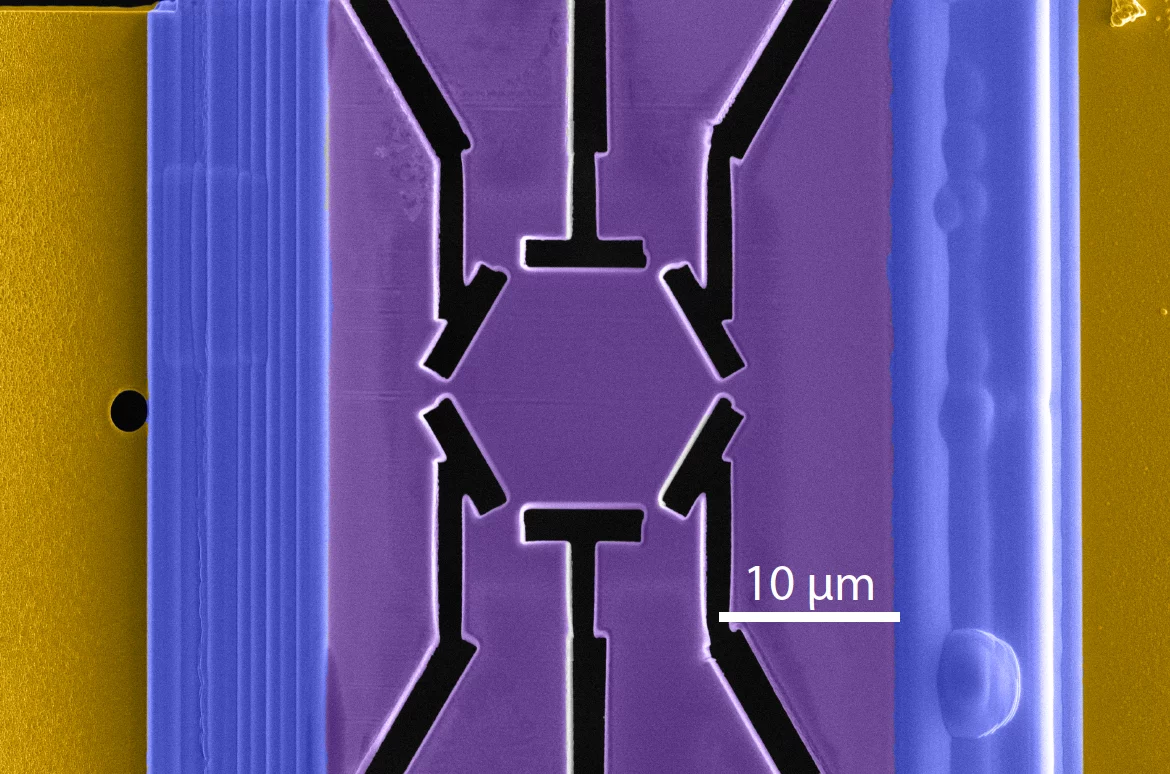
In their recently published work, the researchers have demonstrated that this, at first glance, contradictory state of the literature is a feature, not a bug. It is a direct consequence of the unconventional ground state of AV3Sb5, which features multiple intertwined electronic orders. Therefore, external perturbations such as strain or magnetic field may push the system out of its intrinsic ground state, leading to controversial experimental observations. To identify the inherent electronic ground state without perturbations, they developed a novel strain-free approach based on the focused-ion-beam technique to isolate AV3Sb5 from perturbations such as thermal differential strain. These technical advances allowed the team to reveal the intrinsic electronic ground state unambiguously, as well as its drastic response to external perturbations in these Kagome superconductors. Their work provides a unifying picture of the controversial charge order in Kagome metals.
The easy-to-manipulate electronic orders in Kagome metals highlight the need for material control at the microscopic scale to identify emergent symmetry breaking in quantum materials. They also point towards the exciting pathway toward future electronics. Since the perturbations required to alter the electronic ground state are exceedingly small, the study offers important insights for the long-standing proposals of non-trivial electronic applications based on electronic instabilities in quantum materials. Clearly, electrons learn to dance to many tunes in Kagome structures.
Reference
Correlated order at the tipping point in the kagome metal CsV3Sb5
Chunyu Guo, Glenn Wagner, Carsten Putzke, Dong Chen, Kaize Wang, Ling Zhang, Martin Gutierrez-Amigo, Ion Errea, Maia G. Vergniory, Claudia Felser, Mark H. Fischer, Titus Neupert & Philip J. W. Moll
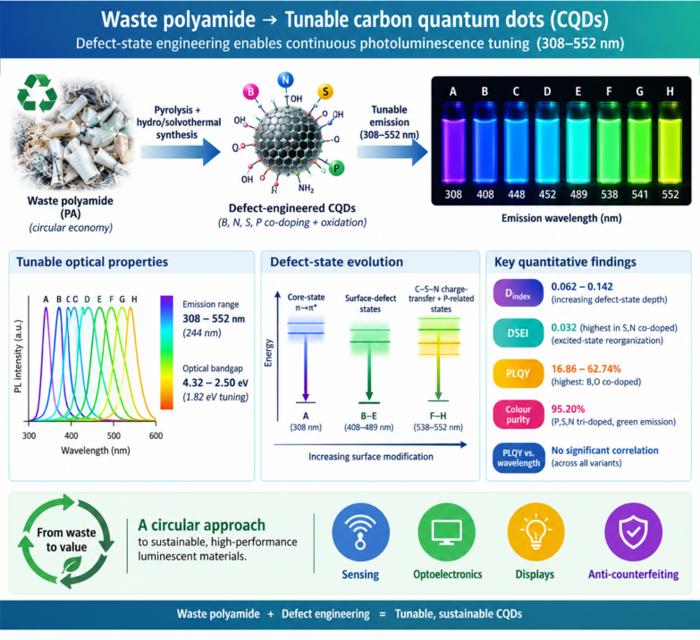
Waste polyamide-derived CQDs show continuous photoluminescence tuning from 308 to 552 nm through sequential defect-state engineering, with optical transition energies decreasing from 4.32 to 2.50 eV. @Christian Ebere Enyoh from Saitama University Carbon quantum dots (CQDs) are fluorescent carbon nanomaterials with potential applications in sensing, optoelectronics, displays, anti-counterfeiting, and environmental technologies. Their optical properties can be adjusted by modifying the carbon...

The researchers used circularly polarized light at normal incidence and found that helicity-dependent photocurrents appeared perpendicular to the crystal’s polarization but vanished when measured parallel to it, supporting a bulk origin of CPGE. @Institute of Science Tokyo The circular photogalvanic effect (CPGE), a phenomenon that generates helicity-dependent photocurrents in noncentrosymmetric materials, can originate purely from a crystal's internal structure without contribution from the...
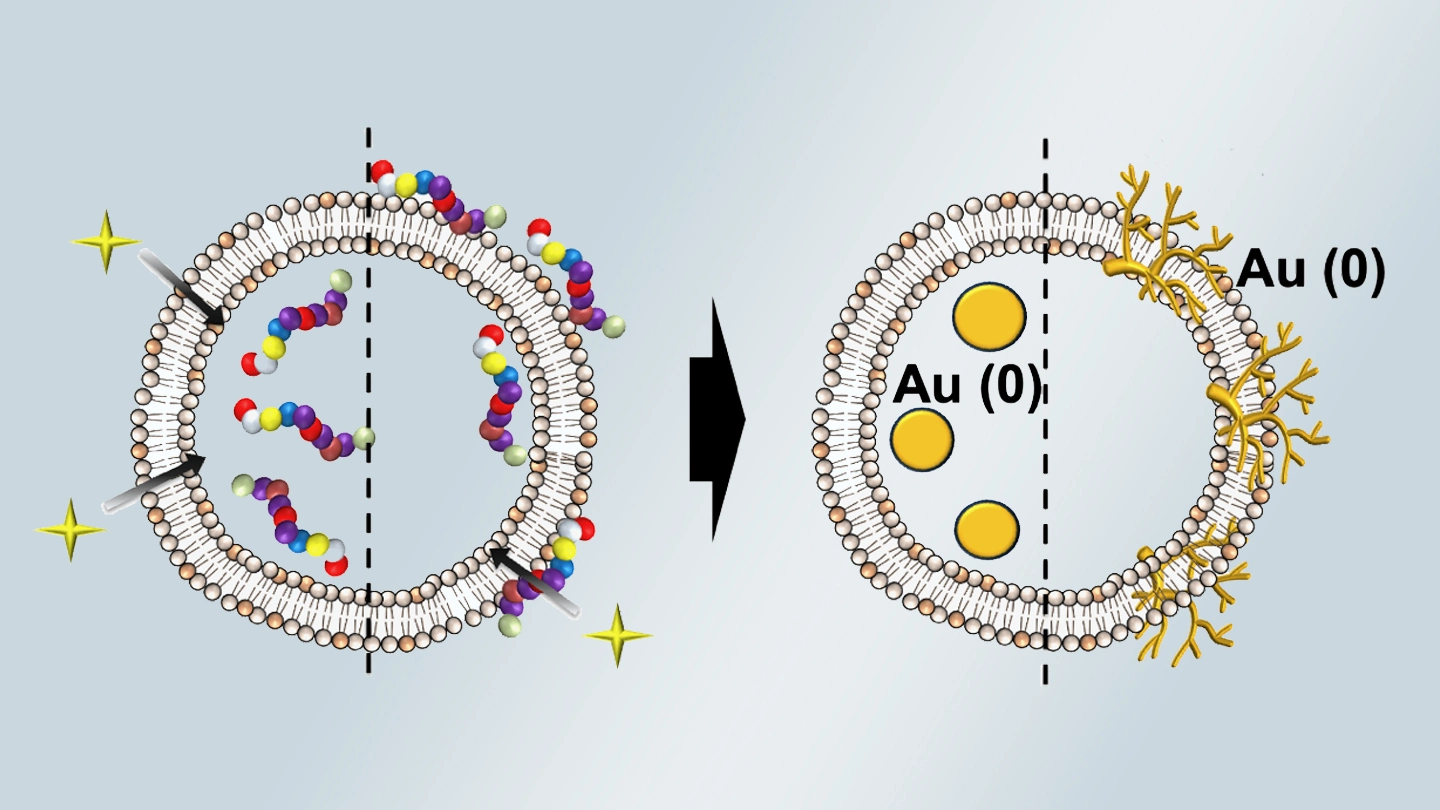
Summary of gold nanoparticle growth programming in liposome based on localization of biomineralization peptide The position of biomineralization peptides within liposomes can influence how gold nanoparticles grow, reports a research team from Institute of Science Tokyo. Peptides localized at the membrane interface promote branched structures, while those confined to the liposome interior favor spherical nanoparticles. The findings offer a new strategy for controlling nanoscale reaction...
