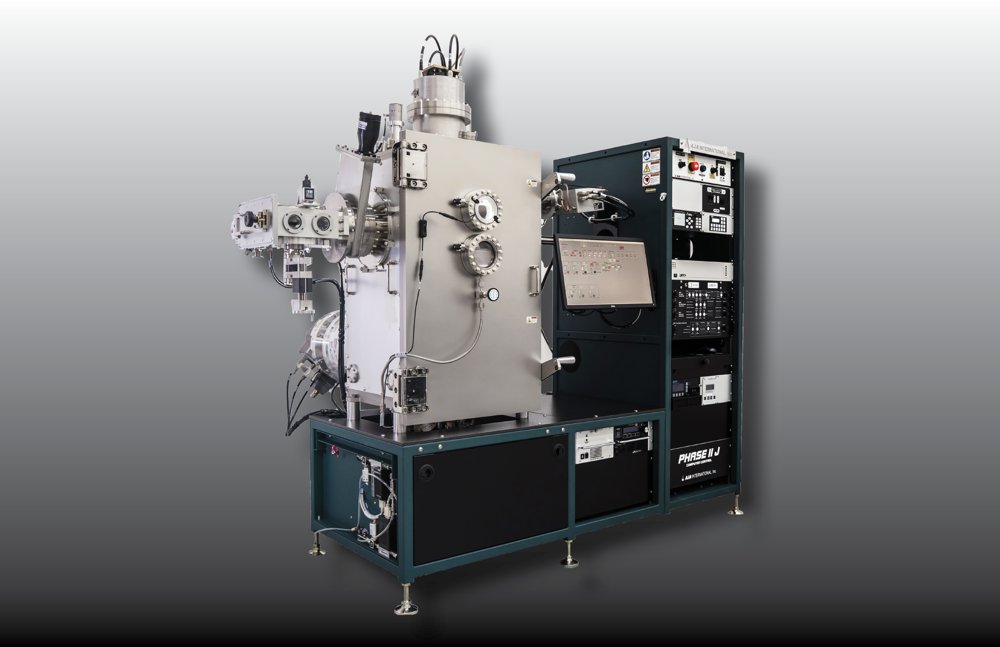
AJA International Inc. 2036 Ion Milling Systems are versatile tools which are built in a variety of configurations depending on the specific requirement. Chambers are box style in design utilizing a heavy duty double hinged front loading door for ease of access for operation and/or routine maintenance. System utilizes a substrate holder with up to 8”wafer handling with various capabilities including azimuthal rotation, motorized tilt adjustment, and cooling capabilities (H2O, LN2, Backside Gas Cooling) System can be equipped with gridded or gridless DC/RF ion source ranging from 8-22cm in size.SIMS endpoint detection is optional along with AJA's unique SIMS-IS isolation system which allows the SIMS head/detector to be kept under vacuum whenever the main chamber is vented. Additional features include computer control, load-lock, deposition sources for passivation layers, and glove box integration. Typical milling profile yielding +/- 2% uniformity with SiO2 on a 6"Ø Si wafer and using an angled, gridded Kaufman style ion source. This process also utilized a BSG200 rotating wafer table equipped with helium gas backside cooling and programmable working distance adjustment. The angle of incidence to the substrate affects the rate and uniformity. One of the many benefits to the eccentric, off axis milling configuration is the reduced ion source size necessary to achieve uniform etching of larger wafers which would typically require costly, larger sources to achieve similar uniformity results. Angular incidence also improves removal rates while reducing damage to the substrate. In addition to the milling angle, ion beam energies are a key component of milling rates. Depending on the ion source selected, ion energy can vary from 50-1200 eV allowing for a wide range of milling applications. For heavier milling requirements, higher ion energies are commonly desired. Lower ion energies are better suited for more sensitive substrates. During the milling process, an increase of the substrate temperature can affect the milling rate and composition of material. Stabilizing the substrate temperature during the milling process is desired in order to maintain a consistent rate and uniformity and prevent substrate damage or unwanted modification.
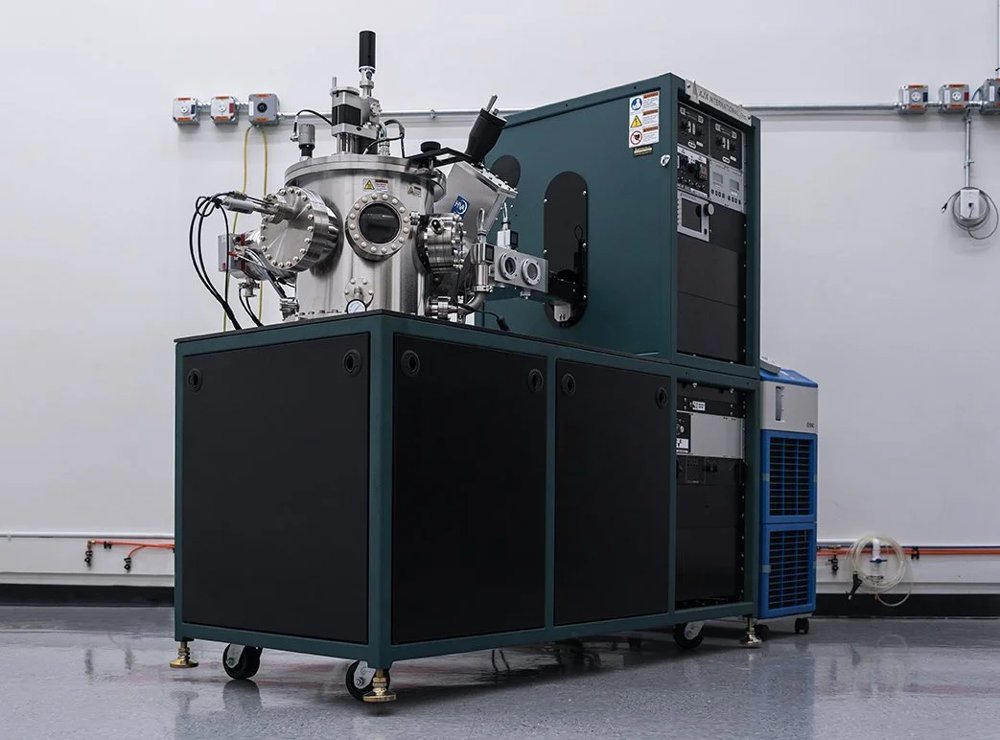
Orion and ATC Sputtering Deposition Systems Key Features of the Orion and ATC Sputtering Systems For Spintronics Magnetron Sputtering Sources: AJA International offers the best sputtering performance in the industry for magnetic materials used in spintronics devices. Each system offers configurations for mounting several magnetrons, in either sputter up or sputter down configurations. The ATC Series can support up to 13 guns in combinations of confocal, direct, and off-axis sputtering geometries for exploring large material spaces. The guns feature integral gas injection rings for local process gas delivery. Ultra-High Vacuum (UHV) Design: As film purity is critical in this application, the systems are engineered to achieve base pressures ranging from the low 10⁻⁷ Torr to the low 10⁻¹⁰ Torr regime. Systems can be constructed using all-metal seal vacuum chambers, and in-house manufactured bakeout jackets are available for thorough vacuum conditioning and system degassing. Power Supply Options: DC, pulsed DC, RF and HiPIMS supplies can all be configured into the system. AJA's standard Phase II-Au control system will accommodate up to (5) DC power supplies with integral 4-way switchboxes, (4) RF power supplies, and (1) 4-way RF switchbox. This allows maximum flexibility for sequential or co-deposition from a large selection of sputter guns so that new material systems can be rapidly developed. Substrate Holder: The substrate holder is highly configurable, supporting sample sizes ranging from small coupons to full wafers up to 6" (Orion) or 12" (ATC) diameter with excellent film thickness uniformity. Available functionalities include high-temperature substrate heating (up to 800–1,000 °C), cryogenic or water-based cooling (LN₂ or H₂O), azimuthal rotation for uniform film growth, motorized Z-axis motion, and RF/DC substrate biasing for advanced process control. Process Gas Delivery: The system supports up to four mass flow controllers (MFCs) for precise regulation of process gases. Typical gases used in epitaxial deposition include Ar, O₂, and N₂, allowing for a wide range of reactive and inert sputtering processes. A gas ring can be provided at the substrate for reactive deposition of oxides and nitrides. Deposition Recipe Generator: The software makes it simple to create and store up to 100+ recipes for depositing layer stacks. It is easy to write extensive recipes, and the Excel spreadsheet layout allows line by line layer stacking and review of recipes for accuracy and data extraction if needed. Recipe operation automates the entire deposition process, with auto-abort in case setpoints fail to be reached. Our AJA Excel Spread Sheet Software Emulator makes possible remote recipe creation offline from the system for later import and execution. Nanometer-Precision Film Thickness Control: An optional quartz crystal monitor and controller allows calibration of deposition rates. High-stability power supplies provide precise, repeatable deposition rates, while recipe-driven automation ensures accurate, repeatable process execution. Vertically Integrated System Design: AJA International manufactures many of the components in the systems. This ensures compatibility and quality, while controlling tool costs. This also speeds up service and provides long service life for the systems.
CATEGORY
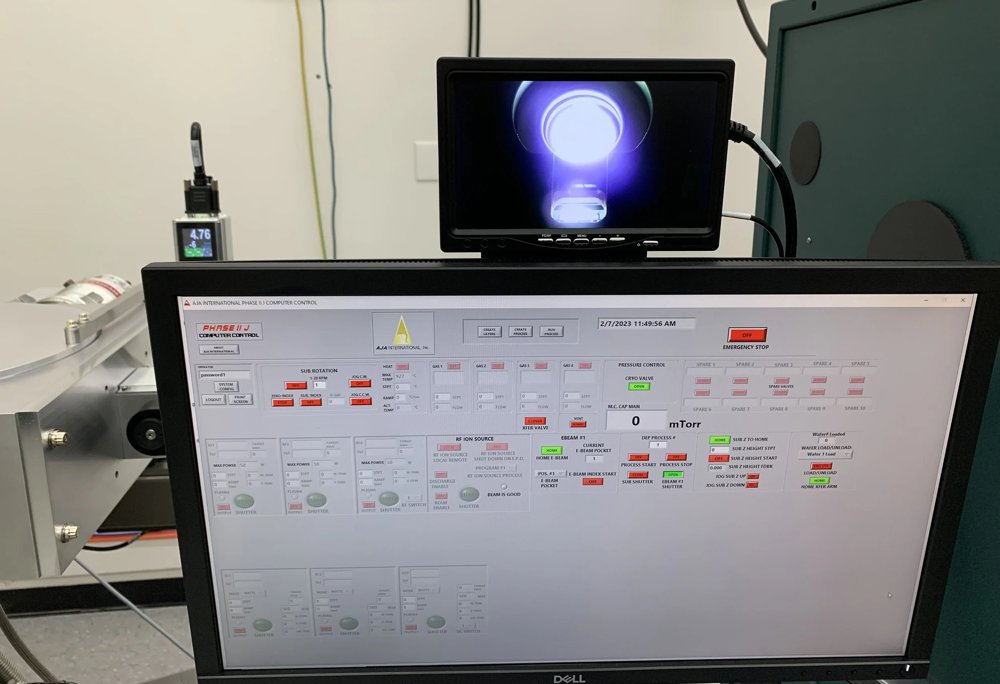
Phase II-Au Computer Control The AJA LabVIEW based Phase II-Au computer control system is used on all Evaporation Systems.This straightforward, user friendly control system utilizes a large 22” articulating screen with wireless keyboard and mouse. The back panel of the hardware module is populated with connectors to interface to all aspects of the sputtering system and to allow for easy future "plug and play" upgrades/expansions. The Phase II-Au control system allows the user to operate in either the “manual mode” or the “automated processing mode.” In the, “automated processing mode” the user designs "process layers” which are then compiled and saved as a “process” to be executed with a single command. The system allows up to 104 unique user entry points which are accessible only by password, limiting access to a user’s process layers and thereby preventing unexpected corruption of a user’s saved processes.Special “soak layers” can be easily incorporated into the process. Adjustable time base Data-logging to a Microsoft Excel spreadsheet is standard.Remote preparation of new processes in a Microsoft Excel spreadsheet emulator format is available as an option. The standard Phase II-Au control system will accommodate up to (3) DC power supplies, (3) RF power supplies, (1) 4-way DC switchbox, (1) 4-way RF switchbox,(1) DC Ion Source, (1) RF Ion Source, (1) Linear or Rotary Ebeam, (1) Deposition Controller,automatic selection of sweep pattern based on material, (4) process gases,(24) Valves/shutters, down stream closed loop automatic pressure control, substrate rotation,substrate tilting and indexing and substrate temperature control. Processes are aborted if plasma is not detected,substrate temperature, process gas or chamber pressure is out of range.
CATEGORY
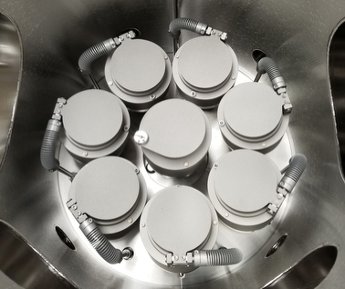
AJA International systems offer configurations for mounting several magnetrons, in either sputter up or sputter down orientation. The Orion series can mount up to 8 guns. Co-deposition with up to 9 power supplies gives access to an extensive compositional space in creating alloys. A central substrate-facing port can also house in-situ probes for real-time monitoring and analysis. Our guns feature integral gas injection rings for local process gas delivery. The substrate holder is highly configurable, supporting sample sizes ranging from small coupons to full wafers up to 6” (Orion) or 12” (ATC) diameter with excellent film thickness uniformity. Available functionalities include high-temperature substrate heating (up to 800–1,000° C), cryogenic or water-based cooling (LN₂ or H₂O), substrate rotation for uniform film growth, motorized Z-axis motion, and RF/DC substrate biasing for advanced process control. We also offer a combinatorial chemistry deposition retrofit for Orion systems, which mounts on the central sample-facing port of the gun flange. The upgrade adds high-throughput experimentation capability to existing tools. Our systems are engineered to achieve base pressures ranging from the low 10⁻⁷ Torr to the low 10⁻¹⁰ Torr regime. Systems can be constructed using all-metal seal vacuum chambers, and in-house manufactured bakeout jackets are available for thorough vacuum conditioning and system degassing.
CATEGORY
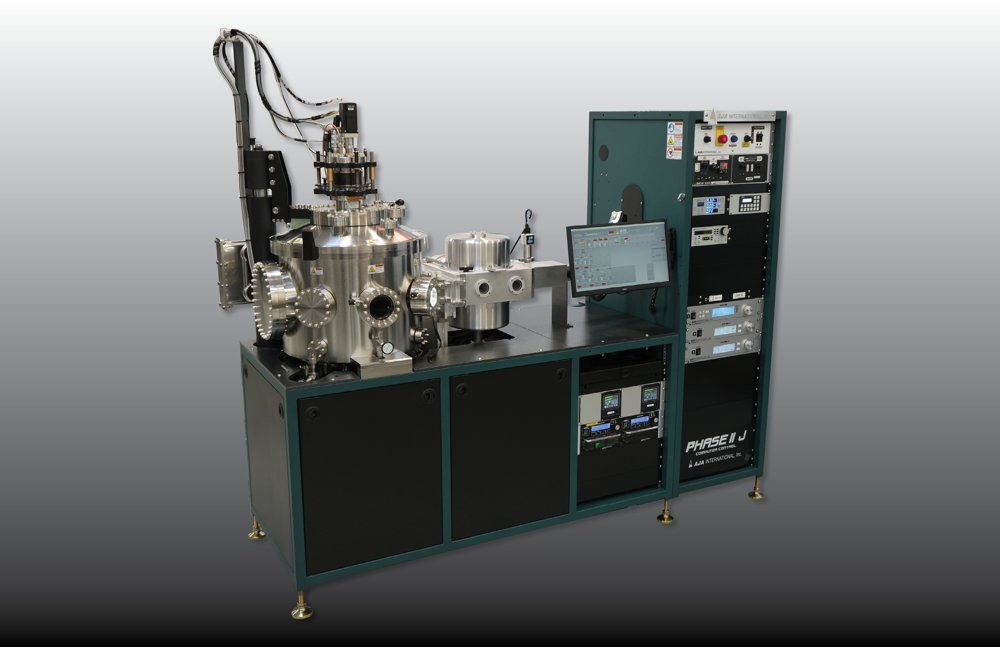
AJA International systems offer configurations for mounting several magnetrons, in either sputter up or sputter down orientation. The ATC Series can support up to 13 guns in combinations of confocal, direct, and off-axis sputtering geometries for exploring large material spaces. Co-deposition with up to 9 power supplies gives access to an extensive compositional space in creating alloys. A central substrate-facing port can also house in-situ probes for real-time monitoring and analysis. Our guns feature integral gas injection rings for local process gas delivery. The substrate holder is highly configurable, supporting sample sizes ranging from small coupons to full wafers up to 6” (Orion) or 12” (ATC) diameter with excellent film thickness uniformity. Available functionalities include high-temperature substrate heating (up to 800–1,000° C), cryogenic or water-based cooling (LN₂ or H₂O), substrate rotation for uniform film growth, motorized Z-axis motion, and RF/DC substrate biasing for advanced process control. Our systems are engineered to achieve base pressures ranging from the low 10⁻⁷ Torr to the low 10⁻¹⁰ Torr regime. Systems can be constructed using all-metal seal vacuum chambers, and in-house manufactured bakeout jackets are available for thorough vacuum conditioning and system degassing.
CATEGORY
