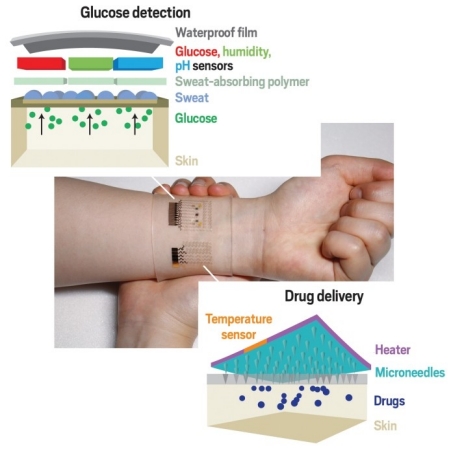
A wearable, graphene-based patch could one day maintain healthy blood glucose levels in people by measuring the sugar in sweat and then delivering the necessary dose of a diabetes drug through the skin (Nat. Nanotech. 2016, DOI:10.1038/nnano.2016.38).
The device takes scientists a step closer to the “coveted prize” in diabetes care: a noninvasive method to monitor and control blood glucose levels, writes Richard Guyof the University of Bath in a commentary about the new work.
Currently, most diabetic patients keep track of their blood glucose levels by pricking their fingers and testing a resulting droplet of blood. For people who must monitor their levels regularly, this can be a literal pain. “There are a lot of people who don’t like sticking things in their skin,” Guy says.
About 15 years ago, the Food & Drug Administration approved a noninvasive glucose-monitoring device called the GlucoWatch Biographer. Patients wore it on their wrists, and it extracted glucose from interstitial fluid in the skin using a small current. It didn’t catch on, in part because it wasn’t user friendly, Guy tells C&EN.
For the new patch, the researchers, led by Dae-Hyeong Kim of Seoul National University, decided to detect glucose in sweat because previous studies had shown that levels of the sugar in perspiration match those in blood. Other groups have also developed devices that can analyze biomolecules in sweat (C&EN, Feb. 1, 2016, page 11).
The new device uses layers of the fluoropolymer Nafion to absorb sweat and carry it toward the device’s sensors, which are built on modified graphene. The team doped the graphene with gold atoms and functionalized it with electrochemically active materials to enable reactions needed to detect glucose.
In the patch’s glucose sensors, the enzyme glucose oxidase reacts with the sugar and produces hydrogen peroxide, which, through an electrochemical reaction, extracts current from the doped graphene. This produces an electrical signal proportional to the amount of glucose present. The patch also contains pH and temperature sensors that help ensure that the glucose sensor’s signals accurately reflect the sugar’s concentration in sweat.
When two healthy volunteers wore the patch, the measured glucose levels—including spikes after meals—matched those from a commercial glucose meter. To monitor the levels, the patch sent its sensor signals to a device that analyzed them and then wirelessly relayed the data to a smartphone.
The drug delivery half of the patch consists of an array of 1-mm-tall polymer microneedles that pierce the skin. Each needle is made from a mixture of the diabetes drug metformin and a dissolvable polymer, polyvinyl pyrrolidone. And the needles are coated with a layer of tridecanoic acid. A gold and graphene mesh sits on top of the needle array and serves as a heater that can melt the coatings.
Once the tridecanoic acid melts, the needle dissolves in the skin and releases its drug payload.
When researchers applied just the drug-delivery component to the stomachs of diabetic mice, they could deliver enough metformin to lower the animal’s elevated blood glucose levels by more than 50% in 6 hours.
Guy thinks the sensor portion of the patch is closer to real-world use than the drug-delivery component. To make the drug-delivery system practical, he says, the researchers must make the microneedle array as small as possible. That means they must find a drug that’s effective at low doses.
As for the glucose-detection half of the device, Guy wonders how often a user would have to calibrate the sensors to ensure accurate readings.
Still, he calls the patch an impressive proof of concept.
University of Bath
#Graphene #Nanomedicine
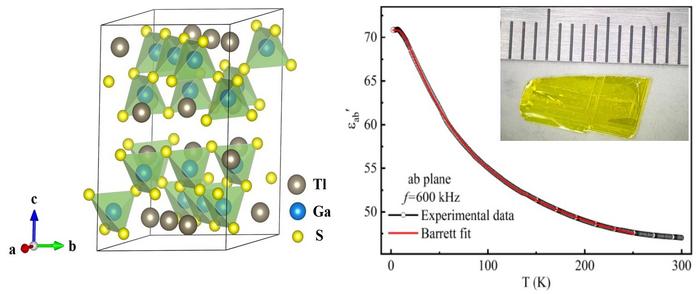
TlGaS2 single crystals show both in-plane and out-of-plane polarization, a rare combination in two-dimensional ferroelectrics that could widen options for ferroelectric transistors and non-volatile memory. Infrared spectroscopy revealed a soft phonon mode below 75 K, a signature tied to quantum ferroelectricity, along with weak structural changes across temperatures that lack clear heat-capacity signals, hinting at local rearrangements rather than conventional phase transitions.
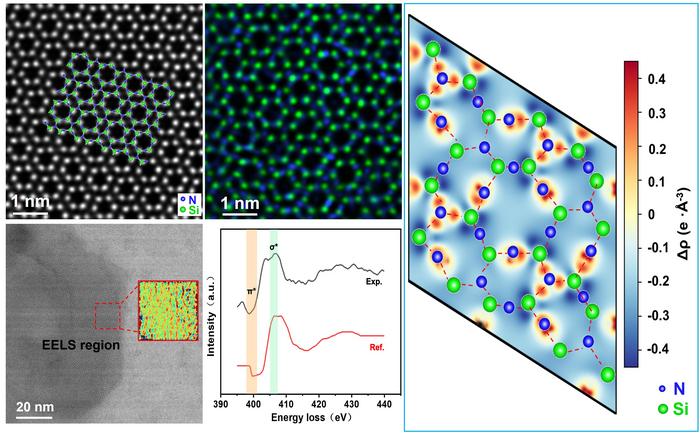
A β-Si3N4 nanolayer about 20 nm thick and continuous over several micrometers has been formed between carbon and silicon carbide without conventional oxide sintering additives, using a porous carbon framework infiltrated with molten silicon. Complementary atomic-resolution imaging resolved both silicon and nitrogen sublattices, confirming the ABAB stacking and corner-sharing tetrahedral network, while electron energy-loss spectroscopy and first-principles calculations linked the spectra to…
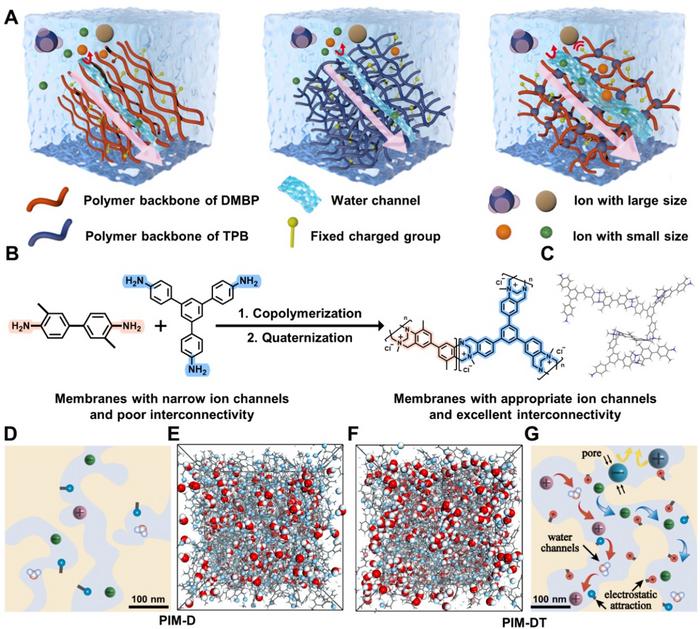
A polymer membrane with interconnected water-filled channels just 0.5 to 0.7 nanometers wide separates singly charged ions from multiply charged ones in both cationic and anionic systems. Built from Tröger's base-derived porous organic polymers, it cut the magnesium-to-lithium ratio in salt-lake brine roughly 500-fold across three electrodialysis stages, yielding 99.5 percent pure lithium carbonate, and enriched sodium chloride to 99.4 percent of ion mass from simulated seawater.
This week in nanotech
$740.7M raised
5 funding rounds · 36 deals tracked
New products
 Ti-WCMBN Nanomaterialia Featured
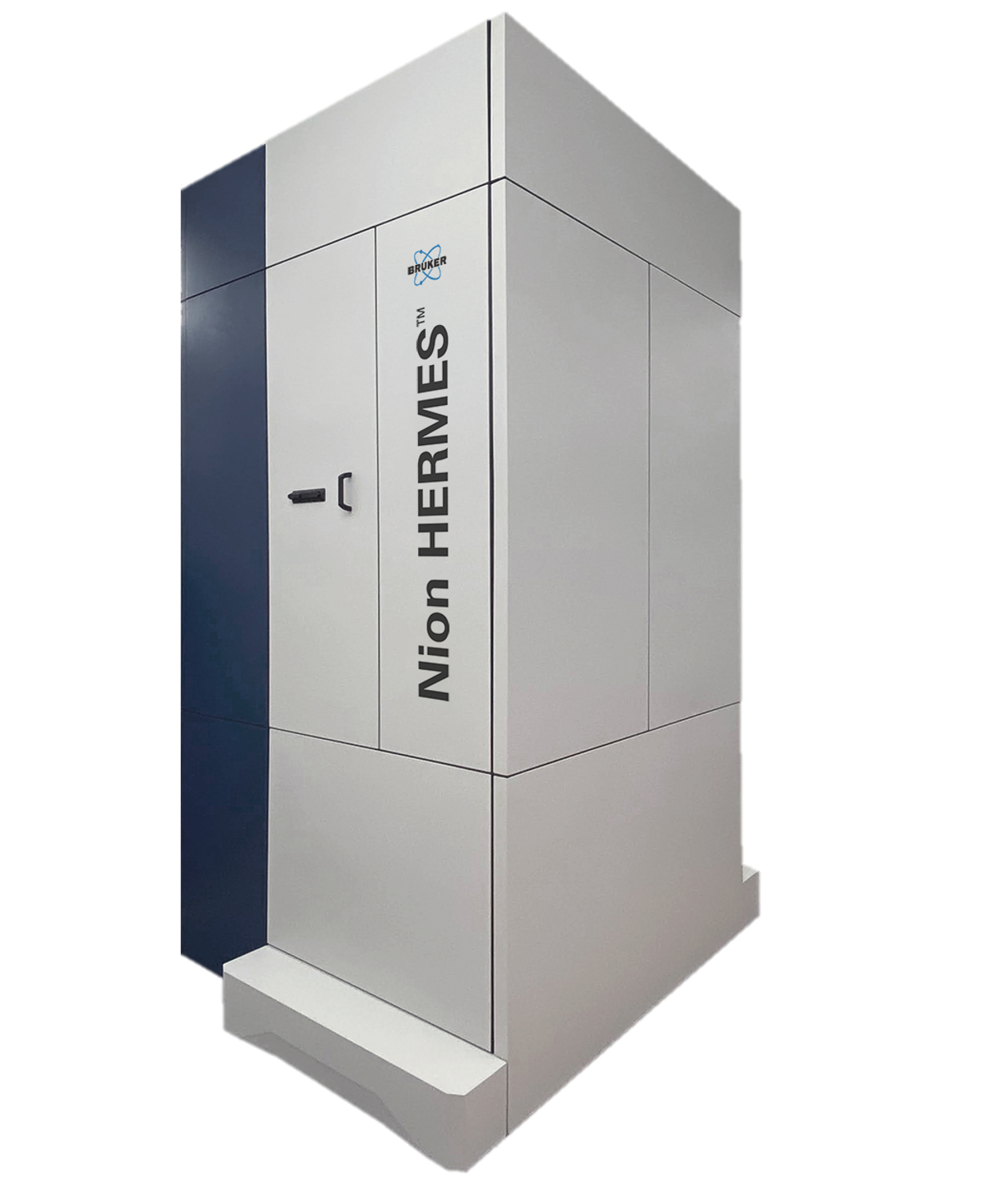 Nion-compatible In Situ STEM Holders for Electrical BiasingHummingbird Scientific Featured
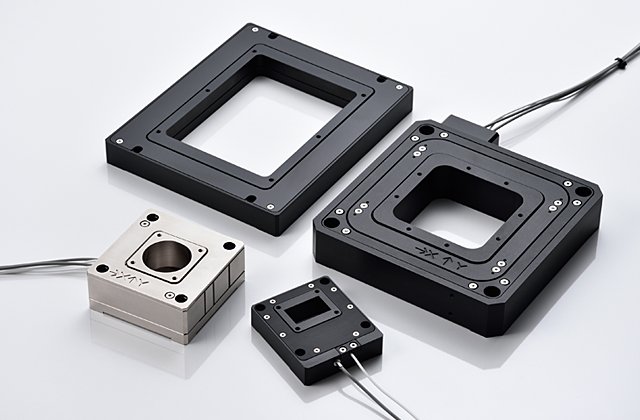 PKVH / PKVL ZAxis With an opening modelTHK PRECISION CO.,LTD.
Market insights
Last 30 days: Quantum Technologies drew the most money: $3.18B.
Money raised per month
Behind the deal
Who invested in Photon Bridge’s $11.2M Series A?
See the investors with Insights Pro →