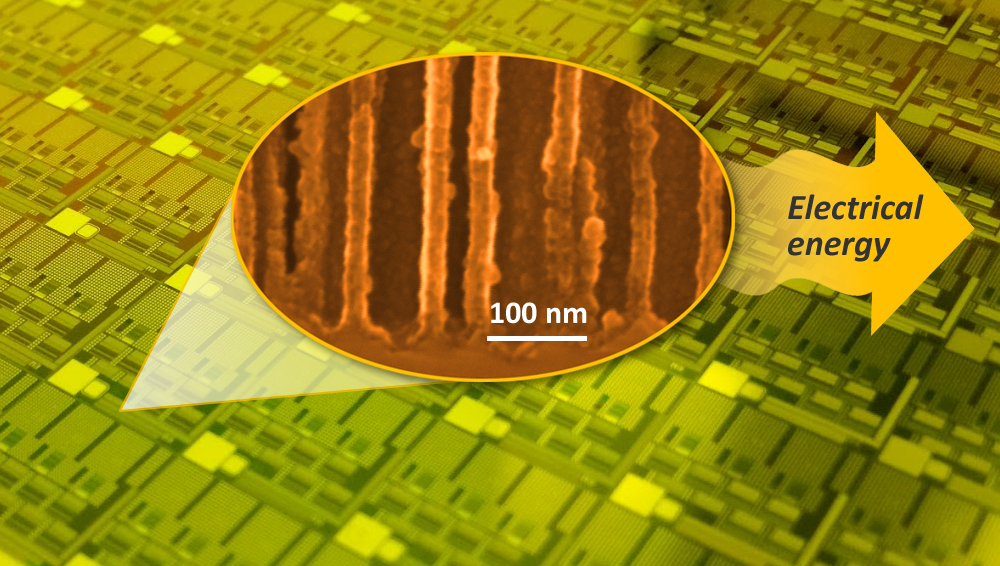
VTT Technical Research Centre of Finland developed an extremely efficient small-size energy storage, a micro-supercapacitor, which can be integrated directly inside a silicon microcircuit chip. The high energy and power density of the miniaturized energy storage relies on the new hybrid nanomaterial developed recently at VTT. This technology opens new possibilities for integrated mobile devices and paves the way for zero-power autonomous devices required for the future Internet of Things (IoT).
Supercapacitors resemble electrochemical batteries. However, in contrast to for example mobile phone lithium ion batteries, which utilize chemical reactions to store energy, supercapacitors store mainly electrostatic energy that is bound at the interface between liquid and solid electrodes. Similarly to batteries supercapacitors are typically discrete devices with large variety of use cases from small electronic gadgets to the large energy storages of electrical vehicles.
The energy and power density of a supercapacitor depends on the surface area and conductivity of the solid electrodes. VTT's research group has developed a hybrid nanomaterial electrode, which consists of porous silicon coated with a few nanometre thick titanium nitride layer by atomic layer deposition (ALD). This approach leads to a record large conductive surface in a small volume. Inclusion of ionic liquid in a micro channel formed in between two hybrid electrodes results in extremely small and efficient energy storage.
The new supercapacitor has excellent performance. For the first time, silicon based micro-supercapacitor competes with the leading carbon and graphene based devices in power, energy and durability.
Micro-supercapacitors can be integrated directly with active microelectronic devices to store electrical energy generated by different thermal, light and vibration energy harvesters and to supply the electrical energy when needed. This is important for autonomous sensor networks, wearable electronics and mobile electronics of the IoT.
VTT's research group takes the integration to the extreme by integrating the new nanomaterial micro-supercapacitor energy storage directly inside a silicon chip. The demonstrated in-chip supercapacitor technology enables storing energy of as much as 0.2 joule and impressive power generation of 2 watts on a one square centimetre silicon chip. At the same time it leaves the surface of the chip available for active integrated microcircuits and sensors.
VTT is currently seeking a party interested in commercializing the technique.
VTT's article on integrated energy storage will be published in Nano Energy magazine (Volume 26, August 2016, pages 340-345). The article can be read online: http://dx.doi.org/10.1016/j.nanoen.2016.04.029
VTT Technical Research Centre of Finland
#Energy #Nanoelectronics
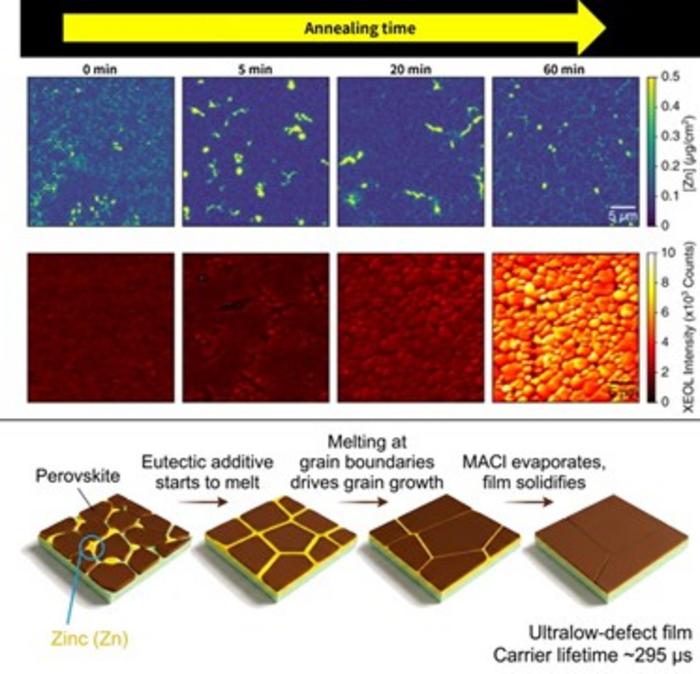
A eutectic mixture of methylammonium chloride and a zinc halide melts at about 100 degrees Celsius, forming a transient liquid layer at perovskite grain boundaries that lets crystals merge into larger, cleaner grains. The resulting films reached a carrier lifetime of roughly 295 microseconds and a surface recombination velocity of 0.3 cm/s, the lowest reported for lead halide perovskites.
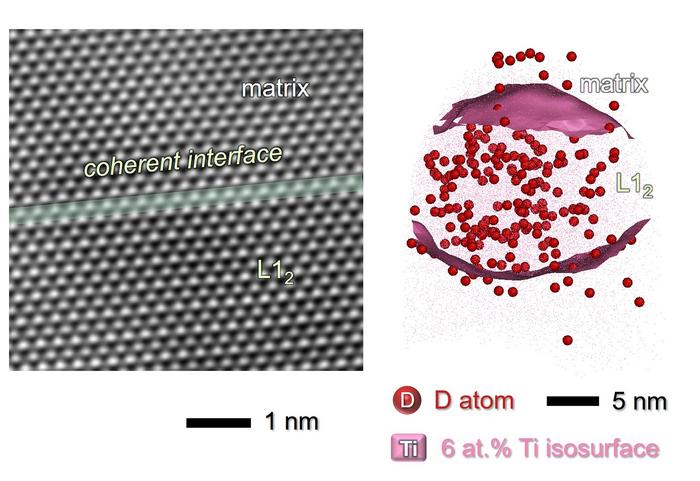
Researchers at the University of Sydney have directly observed hydrogen dissolved in the interstitial spaces between metal atoms in alloys, a world first. Using cryogenic atom probe tomography with deuterium tracers, electron microscopy and theoretical calculations, the team showed hydrogen occupies sites between atoms rather than only collecting at defects, and that local atomic arrangement and chemistry dictate where it prefers to reside.

Researchers have developed carbon dots whose fluorescence shifts across the visible spectrum, from blue to red, depending on concentration, liquid environment and acidity. By tuning the particles' surfaces, the team produced versions that change color reversibly as pH shifts, then incorporated them into polymer powders, molded shapes and flexible films.
This week in nanotech
$10.2M raised
2 funding rounds · 19 deals tracked
New products
 Nion-compatible In Situ STEM Holders for Electrical BiasingHummingbird Scientific Featured
 Ti-WCMBN Nanomaterialia Featured
 Discover Mapping SuiteOnto Innovation
Market insights
Last 30 days: Quantum Technologies was the busiest vertical: 61 of 192 events (32%).
Money raised per month