Optical frequency combs are laser sources whose spectrum consists of a series of discrete, equally spaced frequency lines that can be used for precise measurements. In the last two decades, they have become a major tool for applications such as precise distance measurement, spectroscopy, and telecommunications.
Most of the commercially available optical frequency comb sources based on mode-lock lasers are large and expensive, limiting their potential for use in large volumes and portable applications. Although chip-scale versions of optical frequency combs using microresonators were first demonstrated in 2007, a fully integrated form has been hindered by high material losses and complex excitation mechanisms.
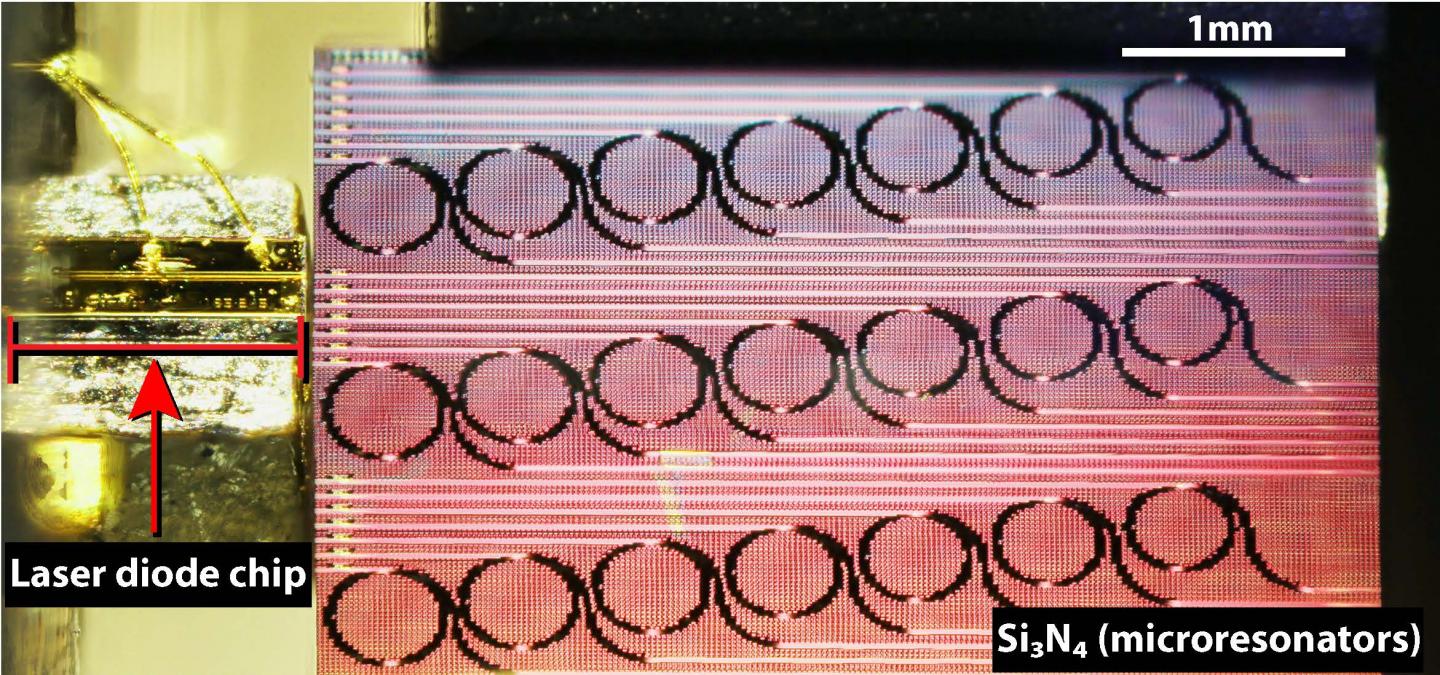
Research teams led by Tobias J. Kippenberg at EPFL and Michael L. Gorodetsky at the Russian Quantum Center have now built an integrated soliton microcomb operating at a repetition rate of 88 GHz using a chip-scale indium phosphide laser diode and the silicon nitride (Si3N4) microresonator. At only 1 cm3 in size, the device is the smallest of its kind to-date.
The silicon nitride (Si3N4) microresonator is fabricated using a patented photonic Damascene reflow process that yields unprecedentedly low losses in integrated photonics. These ultra-low loss waveguides bridge the gap between the chip-based laser diode and the power levels required to excite the dissipative Kerr soliton states, which underly the generation of optical frequency combs.
The method uses commercially available chip-based indium phosphide lasers as opposed to conventional bulk laser modules. In the reported work, a small portion of the laser light is reflected back to the laser due to intrinsic scattering from the microresonator. This direct feedback helps to both stabilize the laser and generate the soliton comb. This shows that both resonator and laser can be integrated on a single chip offering a unique improvement over past technology.
"There is a significant interest in optical frequency comb sources that are electrically driven and can be fully photonically integrated to meet the demands of next-generation applications, especially LIDAR and information processing in data-centers," says Kippenberg. "This not only represents a technological advancement in the field of dissipative Kerr solitons, but also provides an insight into their nonlinear dynamics, along with fast feedback from the cavity."
The whole system can fit in a volume of less than 1cm3 and can be controlled electrically. "The compactness, easy tuning method, low cost and low repetition rate operation make this microcomb system interesting for mass-manufacturable applications," says PhD student Arslan Sajid, the lead author of the study. "Its main advantage is fast optical feedback, which eliminates the need for active electronic or any other on-chip tuning mechanism."
The scientists now aim to demonstrate an integrated spectrometer and multi-wavelength source and to improve the fabrication process and the integration method further to push the microcomb source at a microwave repetition rate.
Electrically pumped photonic integrated soliton microcomb.
A. S. Raja, A. S. Voloshin, H. Guo, S. E. Agafonova, J. Liu, A. S. Gorodnitskiy, M. Karpov, N. G Pavlov, E. Lucas, R. R Galiev, A. E Shitikov, J. D. Jost, M. L. Gorodetsky, T. J. Kippenberg.
Nature Communications 10, 680 (2019).
DOI: 10.1038/s41467-019-08498-2
Contact information:
Tobias Kippenberg
Professor at EPFL
tobias.kippenberg@epfl.ch
Tel: +41 21 69 34428
Web: Laboratory of Photonics & Quantum Measurements
Swiss Federal Institute of Technology Lausanne (EPFL)
Teledyne DALSA has launched the Rad-icon 2329HS X-ray detector, featuring a 27 Mp CMOS sensor, 10X faster frame rate and 3X higher sensitivity than the previous model. It was shown at the NDTMA conference.
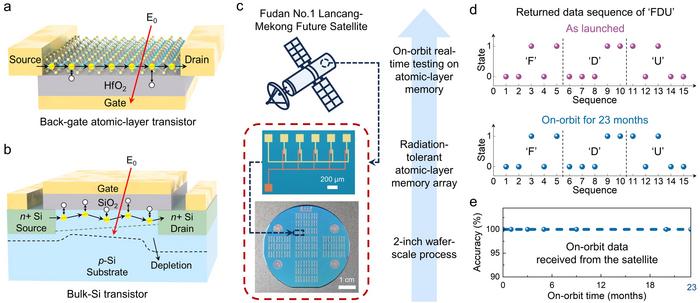
A monolayer MoS2 memory array fabricated at wafer scale on the Fudan No.1 satellite has returned stored data with 100% accuracy after 23 months in low Earth orbit, marking the first on-orbit real-time test of atomic-layer memory. Ground Co-60 gamma irradiation up to 20 Mrad left on/off current ratios stable across roughly eight orders of magnitude and preserved low-noise readout at picoampere levels.
GE HealthCare expanded global clinical and research collaborations to evaluate Photonova Spectra, its photon-counting CT system, across institutions in North America, Europe and Asia.
This week in nanotech
$18.9M raised
4 funding rounds · 31 deals tracked
New products
 DLS-1 Mass Spectrometer for Fusion Gas AnalysisHiden Analytical Featured
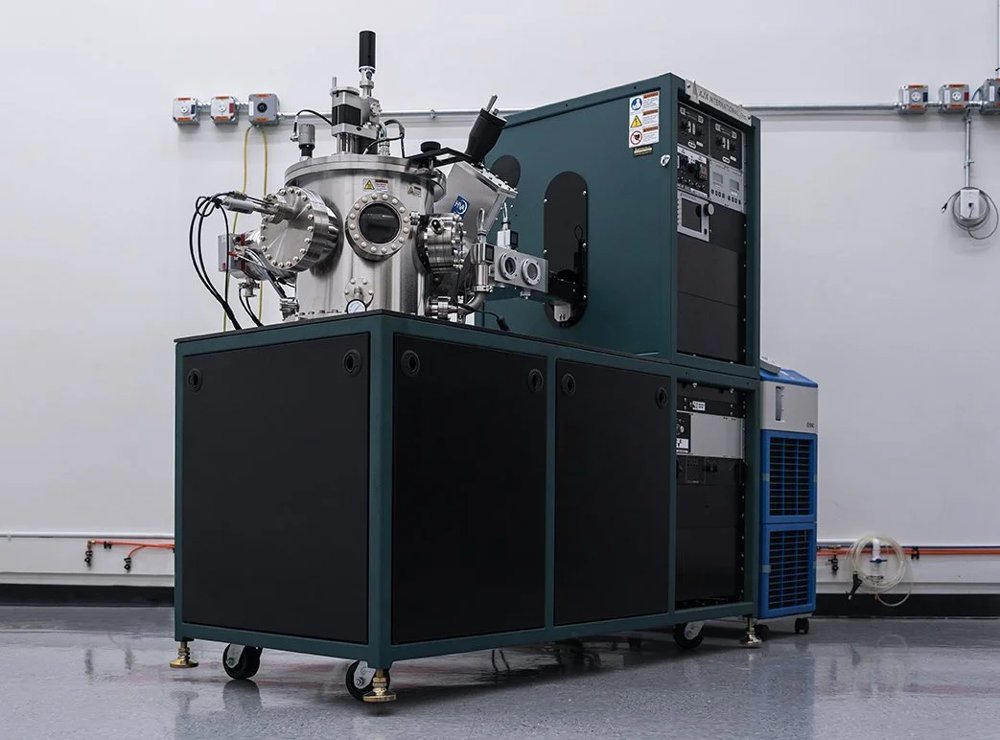 Orion Sputtering Deposition SystemsAJA International Featured
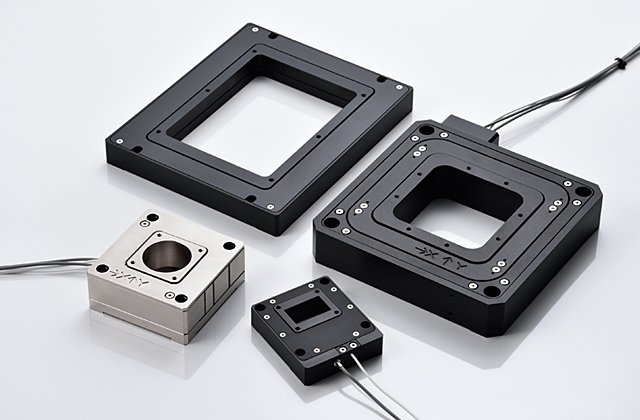 PKVH / PKVL ZAxis With an opening modelTHK PRECISION CO.,LTD.
Market insights
Last 30 days: Semiconductors & Electronics was the busiest vertical: 52 of 170 events (31%).
Money raised per month