
Switching magnetic domains in magnetic memories requires normally magnetic fields which are generated by electrical currents, hence requiring large amounts of electrical power. Now, teams from France, Spain and Germany have demonstrated the feasibility of another approach at the nanoscale: "We can induce magnetic order on a small region of our sample by employing a small electric field instead of using magnetic fields," Dr. Sergio Valencia, HZB, points out.
The samples consist of a wedge-shaped polycrystalline iron thin film deposited on top of a BaTiO3 substrate. BaTiO3 is a well-known ferroelectric and ferroelastic material: An electric field is able to distort the BaTiO3 lattice and induce mechanical strain. Analysis by electron microscopy revealed that the iron film consists of tiny nanograins (diameter 2,5 nm). At its thin end, the iron film is less than 0,5 nm thick, allowing for "low dimensionality" of the nanograins. Given their small size, the magnetic moments of the iron nanograins are disordered with respect to each other, this state is known as superparamagnetism.
At the X-PEEM-Beamline at BESSY II, the scientists analysed what happens with the magnetic order of this nanograins under a small electric field. "With X-PEEM we can map the magnetic order of the iron grains on a microscopic level and observe how their orientation changes while in-situ applying an electric field," Dr. Ashima Arora explains, who did most of the experiments during her PhD Thesis. Their results show: the electrical field induced a strain on BaTiO3, this strain was transmitted to the iron nanograins on top of it and formerly superparamagnetic regions of the sample switched to a new state. In this new state the magnetic moments of the iron grains are all aligned along the same direction, i.e. a collective long-range ferromagnetic order known as superferromagnetism.
The experiments were performed at a temperature slightly above room temperature. "This lets us hope that the phenomenon can be used for the design of new composite materials (consisting of ferroelectric and magnetic nanoparticles) for low-power spin-based storage and logic architectures operating at ambient conditions," Valencia says.
Controlling nanoscale magnetic bits in magnetic random access memory devices by electric field induced strain alone, is known also as straintronics. It could offer a new, scalable, fast and energy efficient alternative to nowadays magnetic memories.
Switching on superferromagnetism
A. Arora, L. C. Phillips, P. Nukala, M. Ben Hassine, A. A. Ünal, B. Dkhil, Ll. Balcells, O. Iglesias, A. Barthélémy, F. Kronast, M. Bibes, S. Valencia.
Physical Review Materials, 2019; 3 (2)
DOI: 10.1103/PhysRevMaterials.3.024403
Contact information:
Sergio Valencia Molina
sergio.valencia@helmholtz-berlin.de
Tel: (030) 8062 - 15619
Fax: (030) 8062 - 14673
Web: Department Materials for Green Spintronics
Helmholtz-Zentrum Berlin für Materialien und Energie (HZB)
#Magnetism #Spintronics
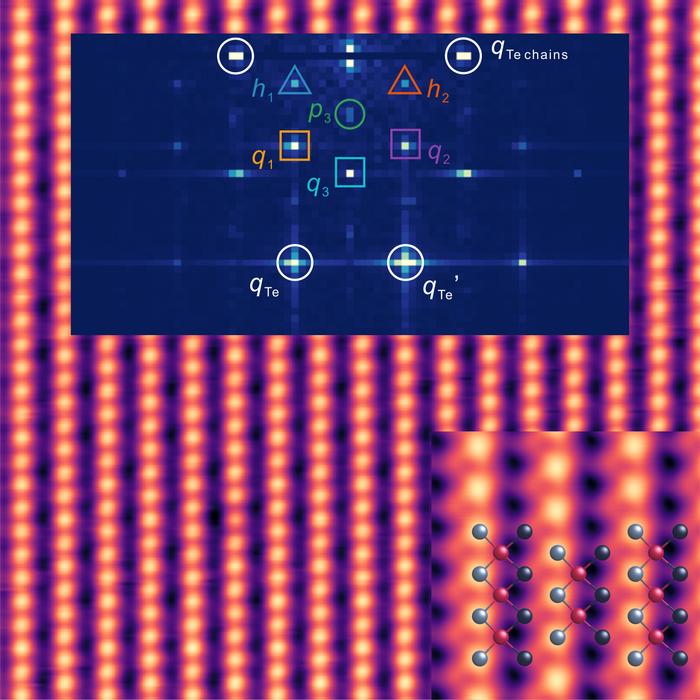
A Fourier transform revealing spatial patterns on the surface at 300 millikelvins. A charge density wave signals the presence of the pair density wave. The background is tellurium atoms on the surface of uranium ditelluride. @University of Illinois Urbana-Champaign’s Grainger College of Engineering Physicists with the University of Illinois Urbana-Champaign’s Grainger College of Engineering have identified a new form of superconducting behavior. Experiments on the metal uranium ditelluride...
Stack two atomically thin layers, rotate one slightly against the other, and a new material emerges. The resulting moiré pattern can slow electrons down so much that their interactions take over. This produces superconductivity, magnetism and exotic fractional quantum states that neither layer shows on its own. This field, known as twistronics, has become one of the most active frontiers in condensed matter physics. So far, however, it has been built on only a handful of materials, mainly...
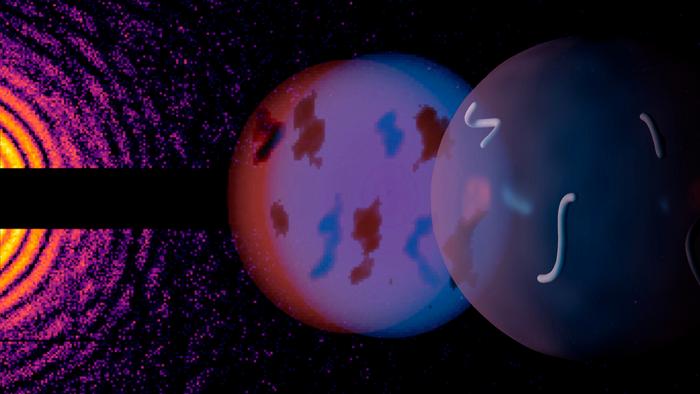
From a two-colour diffraction pattern (left), two snapshots of a helium droplet doped with xenon nanoparticles can be reconstructed (centre). These images can inform a potential 3D rendering of a xenon-doped helium nanodroplet (right). An overarching goal of ultrafast science is to enable researchers to watch structural changes in matter on their natural timescale. Experimentally, this translates into taking two snapshots of the same nanoscale object that are only femtoseconds apart to...