
Quantum computers of the future hold promise in solving all sorts of problems. For example, they could lead to more sustainable materials, new medicines, and even crack the hardest problems in fundamental physics. But compared to classical computers in use today, rudimentary quantum computers are more prone to errors. Wouldn't it be nice if researchers could just take out a special quantum eraser and get rid of the mistakes?
Reporting in the journal Nature, a group of researchers led by Caltech is among the first to demonstrate a type of quantum eraser. The physicists show that they can pinpoint and correct for mistakes in quantum computing systems known as "erasure" errors.
"It's normally very hard to detect errors in quantum computers, because just the act of looking for errors causes more to occur," says Adam Shaw, co-lead author of the new study and a graduate student in the laboratory of Manuel Endres, a professor of physics at Caltech. "But we show that with some careful control, we can precisely locate and erase certain errors without consequence, which is where the name erasure comes from."
Quantum computers are based on the laws of physics that govern the subatomic realm, such as entanglement, a phenomenon in which particles remain connected to and mimic each other without being in direct contact. In the new study, the researchers focused on a type of quantum-computing platform that uses arrays of neutral atoms, or atoms without a charge. Specifically, they manipulated individual alkaline-earth neutral atoms confined inside "tweezers" made of laser light. The atoms were excited to high-energy states—or "Rydberg" states—in which neighboring atoms start interacting.
"The atoms in our quantum system talk to each other and generate entanglement," explains Pascal Scholl, the other co-lead author of the study and a former postdoctoral scholar at Caltech now working at a quantum computing company in France called PASQAL.
Entanglement is what allows quantum computers to outperform classical computers. "However, nature doesn't like to remain in these quantum entangled states," Scholl explains. "Eventually, an error happens, which breaks the entire quantum state. These entangled states can be thought of as baskets full of apples, where the atoms are the apples. With time, some apples will start to rot, and if these apples are not removed from the basket and replaced by fresh ones, all the apples will rapidly become rotten. It is not clear how to fully prevent these errors from happening, so the only viable option nowadays is to detect and correct them."
The new error-catching system is designed in such a way that erroneous atoms fluoresce, or light up, when hit with a laser. "We have images of the glowing atoms that tell us where the errors are, so we can either leave them out of the final statistics or apply additional laser pulses to actively correct them," Scholl says.
The theory for implementing erasure detection in neutral atom systems was first developed by Jeff Thompson, a professor of electrical and computer engineering at Princeton University, and his colleagues. That team also recently reported demonstrating the technique in Nature.
By removing and locating errors in their Rydberg atom system, the Caltech team says that they can improve the overall rate of entanglement, or fidelity. In the new study, the team reports that only one in 1,000 pairs of atoms failed to become entangled. That's a factor-of-10 improvement over what was achieved previously and is the highest-ever observed entanglement rate in this type of system.
Ultimately, these results bode well for quantum computing platforms that use Rydberg neutral atom arrays. "Neutral atoms are the most scalable type of quantum computer, but they didn't have high-entanglement fidelities until now," says Shaw.
Reference
Erasure conversion in a high-fidelity Rydberg quantum simulator
Pascal Scholl, Adam L. Shaw, Richard Bing-Shiun Tsai, Ran Finkelstein, Joonhee Choi & Manuel Endres
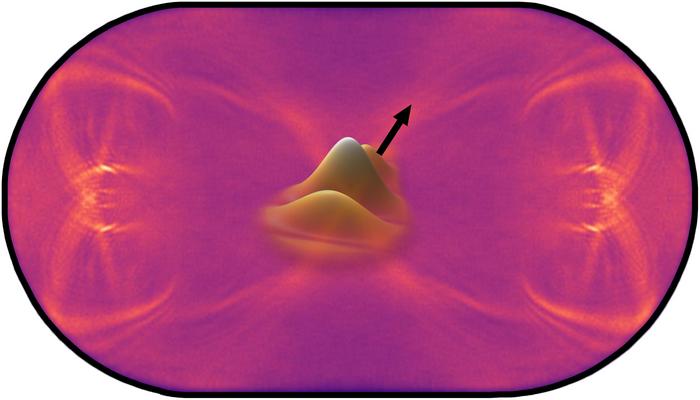
A quantum "wave packet" (in the middle) launched from the same kind of starting point behaves differently. Even after bouncing around for a very long time, faint filament-like patterns (bright glow) are still visible, a tattoo tracing back to its early history. This lingering imprint is the "quantum birthmark" described in the study. Credit: Joonas Keski-Rahkonen, Tampere University Even the most chaotic quantum systems keep a permanent mark of their own past – a "quantum birthmark" – that...
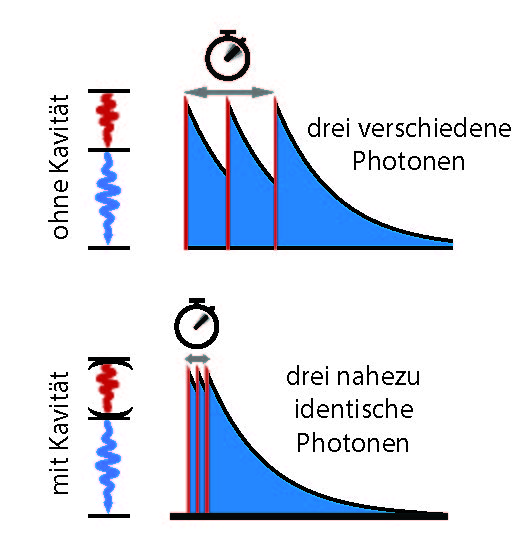
Illustration (University of Basel, Timon Baltisberger): Biexziton decay can generate photons of very high quality if the system is specifically controlled using an optical cavity. Under these conditions, 90 per cent of the photons are indistinguishable. Working in close collaboration, researchers from Paderborn University, the University of Basel and Ruhr University Bochum have made a significant breakthrough in the field of quantum communication. In their recently published paper in the...
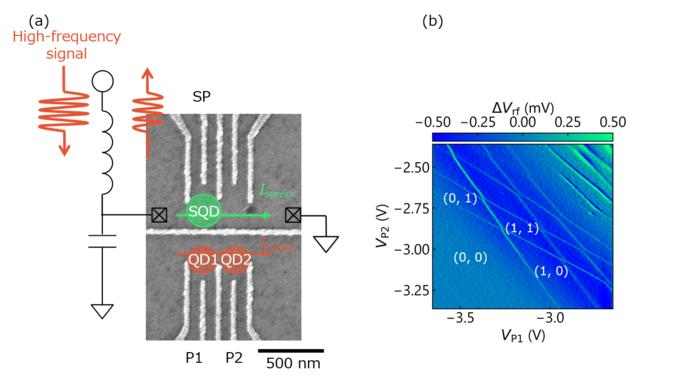
(a) The structure of the gate electrodes on the ZnO device used in the experiment in this paper. (b) The charge stability diagram indicating the formation of ZnO double quantum dot in few-electron regime. Researchers at Tohoku University, in collaboration with the National Institute for Materials Science (NIMS) and the University of Tokyo, have taken an important step toward semiconductor quantum computing using zinc oxide (ZnO). The team successfully demonstrated charge sensing,...
