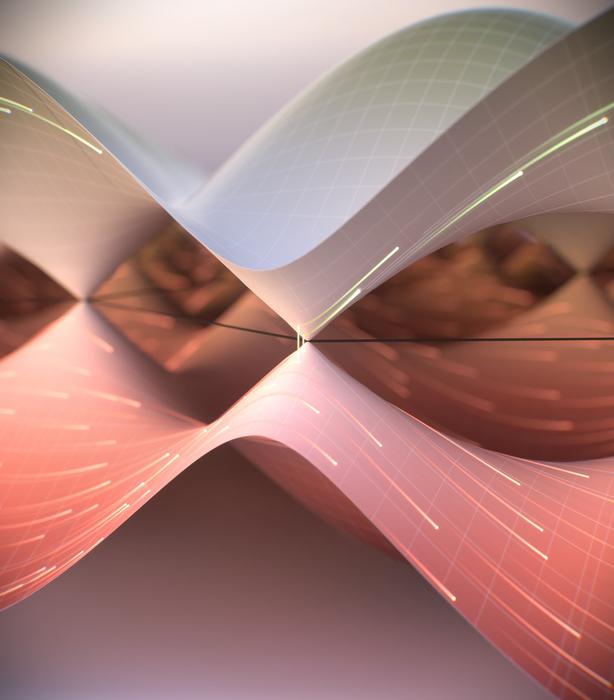
Using a new slow-motion electron camera, physicists from Regensburg, Marburg, and Jülich revealed how intense electric fields drive electrons in graphene, causing them to jump across energy gaps in a seemingly paradoxical manner. This was made possible by a novel combination of laser technology and electron microscopy.
The electrons' astonishing behavior is roughly equivalent to riding an elevator where the floor indicator suddenly jumps from “1,” “2,” and “3” to “20.” You never passed through the seventeen floors in between, yet you arrive on the twentieth floor. What sounds like an impossible leap is actually possible in the quantum world. Such processes are called Landau-Zener-Majorana transitions. It has long been suspected that these transitions could play an increasingly important role in high-speed semiconductor electronics.
A research team from the University of Regensburg, Philipps-Universität Marburg and the Forschungszentrum Jülich has succeeded in visualizing the ultrafast dynamics of such transitions in the material graphene. The team reports on this achievement in its latest study, published in the renowned international journal Nature (DOI: 10.1038/s41586-026-11214-y).
The researchers observed how electrons are accelerated by the electric field of a light pulse and switch between energy bands as they move. In semiconductors and related materials, electrons can only occupy certain energy ranges, known as bands, which are separated by a forbidden energy gap. Typically, electrons remain firmly trapped in their respective bands. However, during a Landau-Zener-Majorana transition, electrons appear to overcome this forbidden zone with ease.
A Slow-Motion Camera for Electrons
In order to observe such extremely fast processes, the team developed a novel combination of laser technology and electron microscopy. "If you want to know who has won a race, you have watch all participants," explains Vincent Eggers, first author of the study. "Likewise, we must observe as many electrons as possible at one time to catch those that undergo a quantum mechanical transition while moving." This is made possible by a so-called photoemission momentum microscope. Unlike a conventional microscope, it does not show magnified images of objects. Instead, it records the energies and states of motion of the electrons and uses them to create a map of their distribution.
The special challenge was to combine electron spectroscopy with strong, extremely fast oscillating light fields that set the electrons in motion in a targeted manner. " Our team worked on this experiment for many years. Now, we can track electrons moving across the entire energy landscape of a solid in real time" says Rupert Huber. His cooperation partner Ulrich Höfer – one of the pioneers of ultrafast electron spectroscopy – adds enthusiastically: "Being able to observe such a fundamental quantum mechanical process during our first measurement campaign was a very special moment for us – it was also made possible by the samples we used."
The measurements were based on tailor-made, atomically thin carbon layers of the highest purity, which were produced at Forschungszentrum Jülich. "These precision experiments require material that is nearly perfect at the atomic level. This ensures that impurities do not obscure the delicate quantum dynamics of the electrons. Another important factor for the study was the use of “rotated” graphene, a specialty from Jülich, which allows the quantum dynamics to emerge particularly clearly," emphasizes Stefan Tautz from Forschungszentrum Jülich.
The slow-motion images revealed a surprising result: Under the influence of the strong light fields, the electrons overcome the band gap with a tunneling probability of up to one hundred percent. The fascinating thing about Landau-Zener-Majorana transitions is that they can occur with a high probability even if the energy states involved are clearly separated from each other. The decisive factor is how fast the electrons approach the band gap. In this respect, these dynamic transitions differ fundamentally from standard quantum mechanical tunneling through a spatial energy barrier.
A Panoramic View of the Quantum World
The new method can be used to investigate not only fundamental quantum mechanical transitions, but also the processes that limit the targeted control of the electrons. The measurements on graphene already show how interactions with the crystal lattice disrupt the initially orderly movement of the electrons. Such findings are particularly important for the development of future technologies in which electrons are no longer controlled only by electrical voltages, but directly by the extremely fast oscillations of light.
Or as Giacomo Inzani from the University of Regensburg sums it up: "Our experiment opens a panoramic window into the quantum world. Now, we can follow in real time how electrons move through the energy landscape of a material. And this is just the beginning. Our method can be applied to many other quantum materials, opening up completely new possibilities for controlling their electronic properties selectively with light."
Reference
Subcycle videography of Landau-Zener-Majorana transitions in graphene
V. Eggers, G. Inzani, M. Meierhofer, L. Münster, J. Helml, R. Wallauer, S. Zajusch, S. Ito, L. Machtl, H. Yin, C. Kumpf, F. C. Bocquet, C. Bao, J. Güdde, F. S. Tautz, R. Huber, and U. Höfer
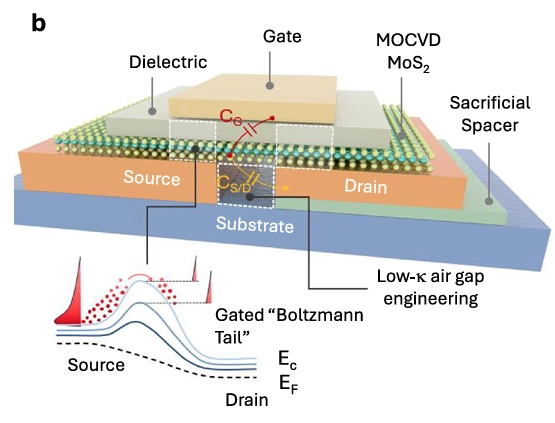
Researchers have fabricated transistors from molybdenum disulfide, an atomically thin two dimensional semiconductor, with channel lengths below five nanometers. An air gap beneath the channel lets the gate keep tighter control of current and curb leakage, delivering switching performance beyond silicon's theoretical limit at comparable size. The devices were built across a four inch wafer, pointing to manufacturability.
IMB-CNM-CSIC is a partner in POLARIS, an EIC Pathfinder Open 2026 project led by ICN2 to develop graphene-based brain implants. Researcher Anton Guimerà leads the institute's contribution.
California Nanotechnologies has amended its Santa Ana lease to add 15,500 square feet, an approximate 80% increase to its existing 19,500 square feet footprint. The new lease takes effect November 1, 2026, at approximately US$22,500 per month.
This week in nanotech
$751.8M raised
6 funding rounds · 37 deals tracked
New products
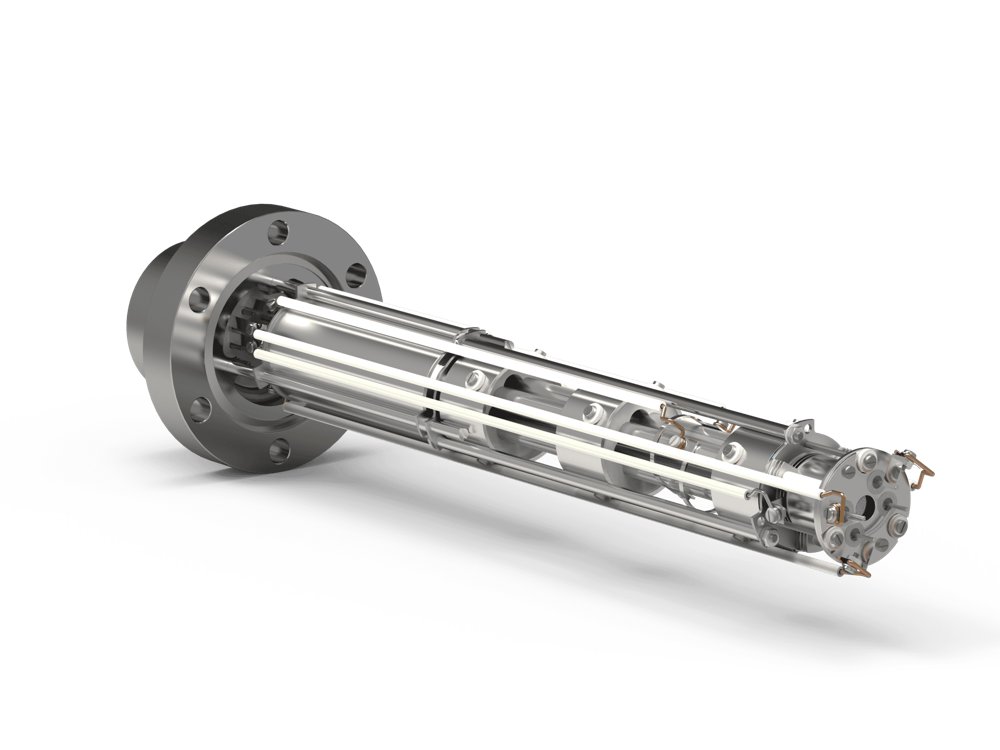 DLS-1 Mass Spectrometer for Fusion Gas AnalysisHiden Analytical Featured
 Ti-WCMBN Nanomaterialia Featured
 GHK-CuPeoples Peps
Market insights
Last 30 days: Quantum Technologies drew the most money: $3.18B.
Money raised per month
Behind the deal
Who led Xanadu Quantum Technologies Limited’s $10M Grant?
See the investors with Insights Pro →