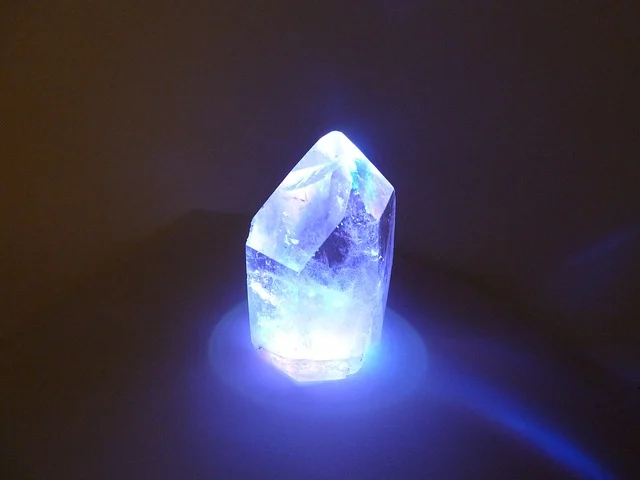
Breakthrough in neutron physics: A team from TU Vienna, INRIM Turin and ILL Grenoble has succeeded for the first time in building a neutron interferometer from two separate crystals.
Particles can move as waves along different paths at the same time—this is one of the most important findings of quantum physics. A particularly impressive example is the neutron interferometer: neutrons are fired at a crystal, the neutron wave is split into two portions, which are then superimposed on each other again. A characteristic interference pattern can be observed, which proves the wave properties of matter.
Such neutron interferometers have played an important role for precision measurements and fundamental physics research for decades. However, their size has been limited so far because they worked only if carved from a single piece of crystal. Since the 1990s, attempts have also been made to produce interferometers from two separate crystals—but without success. Now a team from TU Wien, INRIM Turin and ILL Grenoble has achieved precisely this feat, using a high-precision tip-tilt platform for the crystal alignment. This opens up completely new possibilities for quantum measurements, including research on quantum effects in a gravitational field.
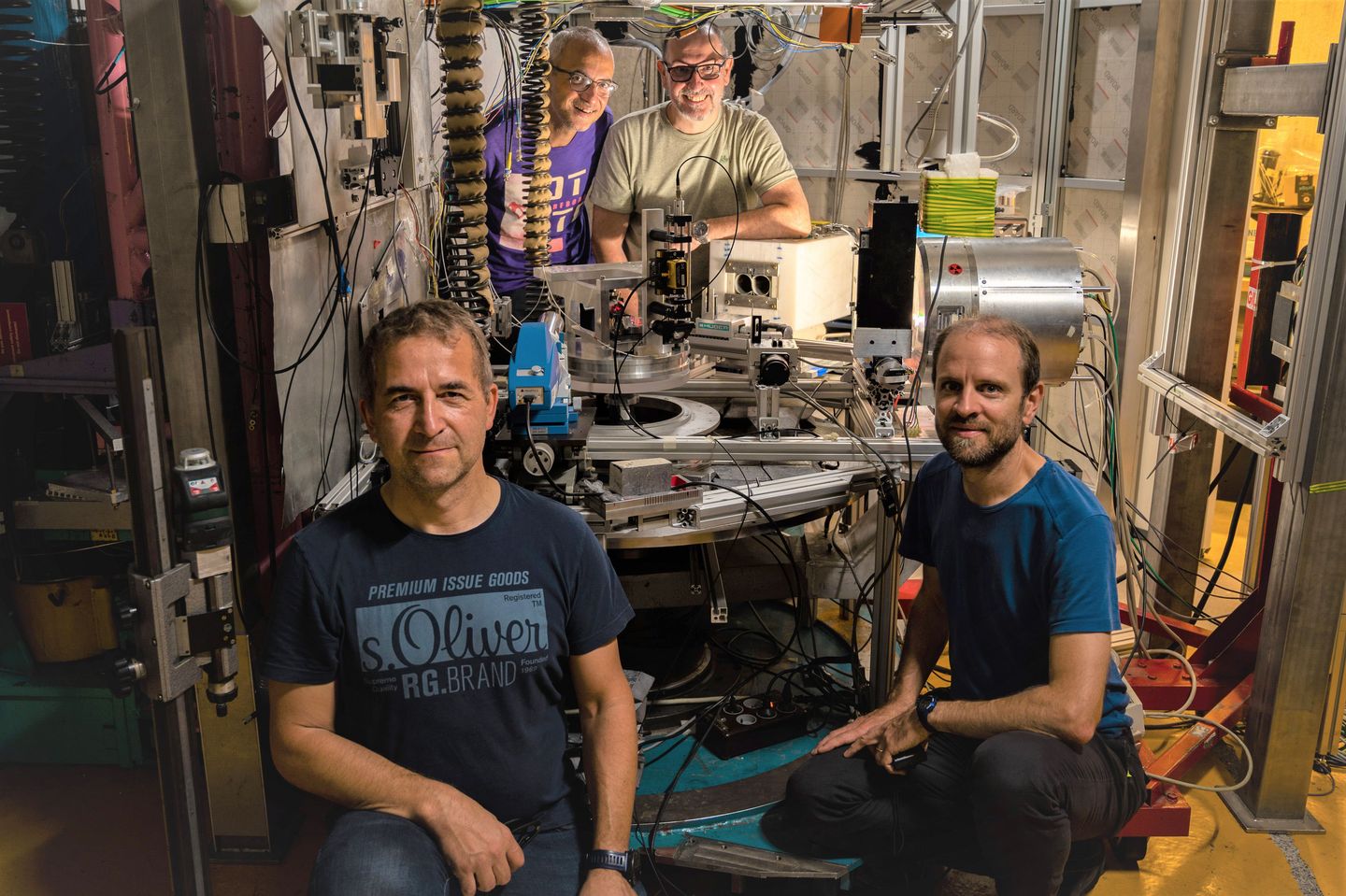
The first step in 1974
The history of neutron interferometry began in 1974 in Vienna. Helmut Rauch, for many years professor at the Atomic Institute of TU Wien, created the first neutron interferometer from a silicon crystal and was able to observe the first interference of neutrons at the Vienna TRIGA reactor. A few years later, the TU Wien set up a permanent interferometry station, the S18, at the world's most powerful neutron source, the Institut Laue-Langevin (ILL) in Grenoble. This setup is operational up to the present day.
"The principle of the interferometer is similar to the famous double-slit experiment, in which a particle is shot at a double slit in a wave-like manner, passes through both slits simultaneously as a wave and then superimposes on itself, so that afterwards a characteristic wave pattern is created at the detector," says Hartmut Lemmel (TU Wien).
But while in the double-slit experiment the two slits are only a minimal distance apart, in the neutron interferometer the particles are split into two different paths with several centimeters in between. The particle wave reaches a macroscopic size—nevertheless, by superimposing the two paths, a wave pattern is created that clearly proves that the particle did not choose one of the two paths, it used both paths simultaneously.
Any inaccuracy can destroy the result
The quantum superpositions in a neutron interferometer are extremely fragile. "Tiny inaccuracies, vibrations, displacements or rotations of the crystal destroy the effect," says Hartmut Lemmel. "That is why you usually mill the entire interferometer out of a single crystal." In a crystal, all atoms are connected to each other and have a fixed spatial relationship to each other—so you can minimize the influence of external disturbances on the neutron wave.
But this monolithic design limits the possibilities, because crystals cannot be made in any size. "Back in the 1990s, people therefore tried to create neutron interferometers out of two crystals that could then be positioned at a greater distance from each other," says Lemmel, "but it was not successful. The alignment of the two crystals against each other did not reach the required accuracy."
Extreme demands on accuracy
The demands on accuracy are extreme. When a crystal of the interferometer is displaced by a single atom the interference pattern shifts by a full period. If one of the crystals is rotated by an angle in the order of one hundred millionth of a degree, the interference pattern is destroyed. The required angular precision corresponds roughly to shooting a particle from Vienna to Grenoble and aiming at a pinhead, 900 kilometers apart—or aiming at a drain cover on the Moon.
The Istituto Nazionale di Ricerca Metrologica (INRIM) in Turin provided the necessary technologies, which it had developed over decades in the field of combined optical and X-ray interferometry. Scanning X-ray interferometers also consist of separate silicon crystals and are similarly sensitive. The sensitivity to the spatial displacement of a crystal was used in Turin to determine the lattice constant of silicon with unprecedented accuracy. This result allows for the possibility of counting the atoms of a macroscopic silicon sphere, determining the Avogadro and Planck constants and redefining the kilogram.
"Although the required accuracy is even more severe for neutrons, what worked with separate crystal X-ray interferometers should also work with separate crystal neutron interferometers," says Enrico Massa from INRIM. With an additional built-in laser interferometer, vibration damping, temperature stabilization and INRIM's overseeing of the crystals' assembly and alignment, the collaboration has finally succeeded in detecting neutron interference in a system of two separate crystals.
Important for fundamental research
"This is an important breakthrough for neutron interferometry," says Michael Jentschel from the ILL. "Because if you can control two crystals well enough that interferometry is possible, you can also increase the distance and expand the size of the overall system quite easily."
For many experiments, this total size determines the accuracy that can be achieved in the measurement. It will become possible to investigate fundamental interactions with unprecedented accuracy—for example, the sensitivity of neutrons to gravity in the quantum regime and to hypothetical new forces.
The research was published in the Journal of Applied Crystallography.
Vienna University of Technology
Reference
Neutron interference from a split-crystal interferometer
H. Lemmel, M. Jentschel, H. Abele, F. Lafont, B. Guerard, C. P. Sasso, G. Mana and E. Massa
Journal of Applied Crystallography (2022)
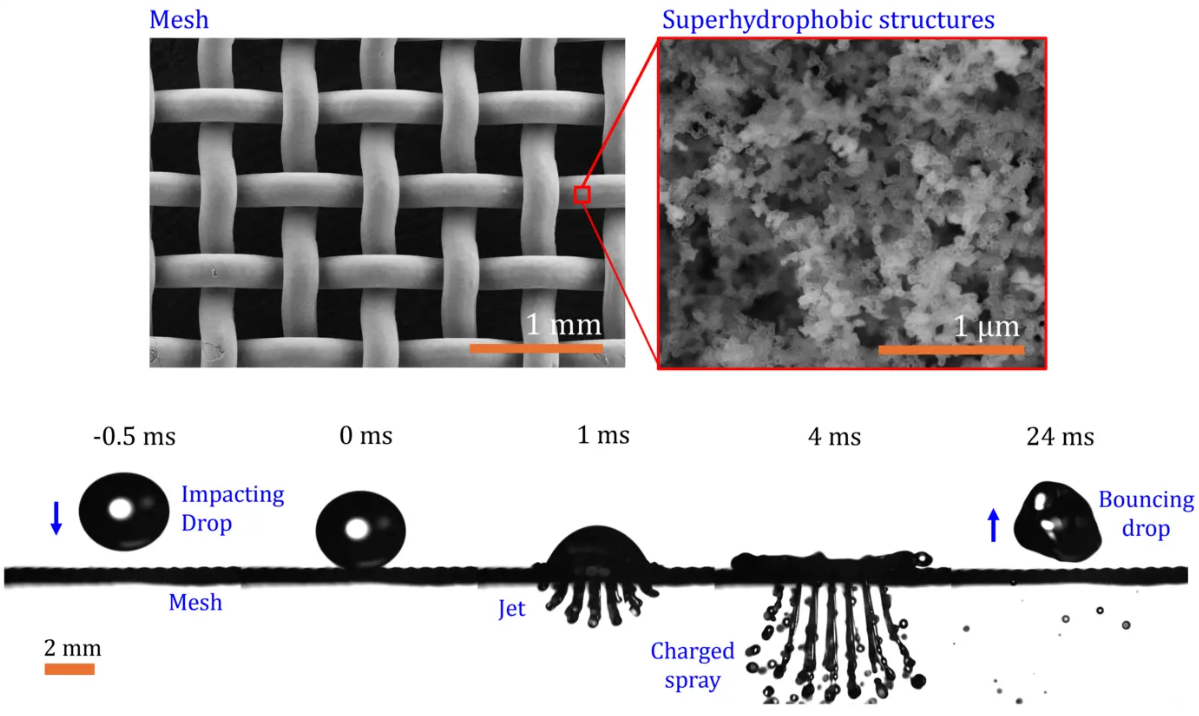
Water droplets shattering on superhydrophobic nets can generate usable electric charge, and a team from Tohoku University and the Max Planck Institute for Polymer Research has mapped how to maximise it. Combining charge measurements with high-speed imaging, the researchers tracked droplet breakup into fine secondary spray and showed that charge-to-mass ratios rise as mesh size and wire diameter shrink. The findings offer a design basis for sustainable rain-powered electricity generation.
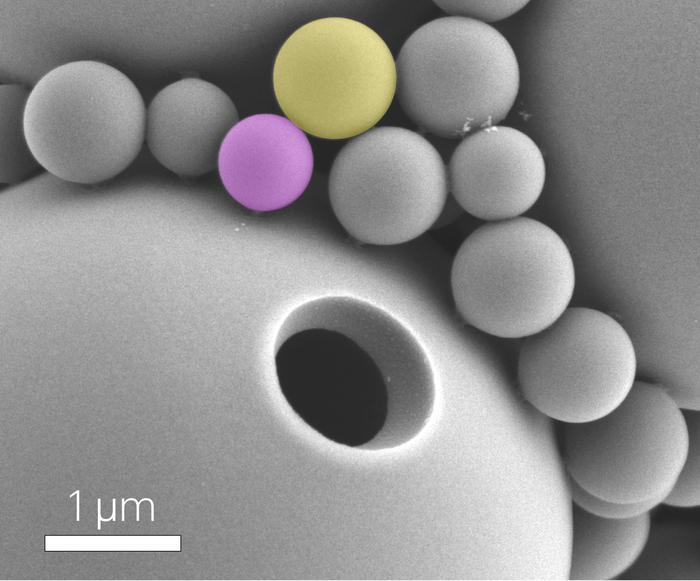
Researchers have fabricated hollow polymer capsules with single openings that use surrounding turbulence, not chemistry, to selectively take in or expel particles, an effect they call the PAC-MAN effect. The shell shields its interior to create a calm pocket, and only swirls smaller than the hole enter, so hole geometry decides which particles are captured or excluded.
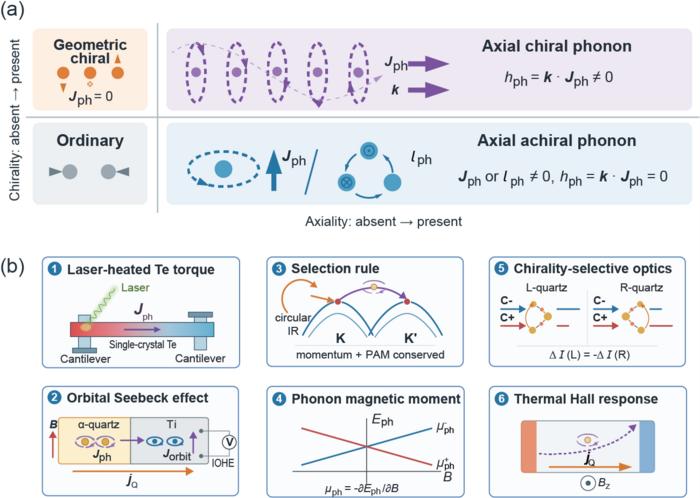
Chiral phonons, lattice vibrations whose atoms move along circular or elliptical paths and carry angular momentum, are the subject of a new perspective in National Science Review. The authors summarize a symmetry-based classification that separates axiality from chirality, offering a framework for the varied phenomena these vibrations produce.
This week in nanotech
25 deals tracked
New products
 Nion-compatible In Situ STEM Holders for Electrical BiasingHummingbird Scientific Featured
 DLS-1 Mass Spectrometer for Fusion Gas AnalysisHiden Analytical Featured
 GiiiGii
Market insights
Last 30 days: Semiconductors & Electronics was the busiest vertical: 55 of 176 events (31%).
Money raised per month