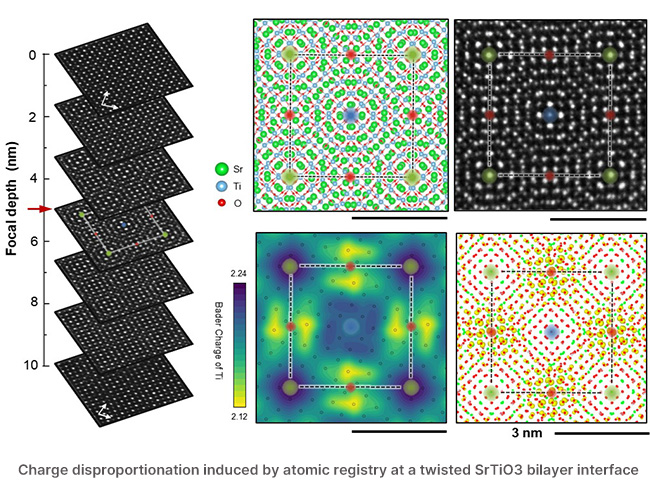
It has been revealed that simply twisting and stacking two layers of oxide crystals can allow the atomic arrangement itself to control the behavior of electrons. Much like the new patterns that emerge when two meshes are overlapped and rotated, a twisted oxide interface forms specific atomic configurations that act as an “invisible fence,” either trapping or repelling electrons.
A research team led by Prof. Si-Young Choi in the Department of Materials Science and Engineering and the Department of Semiconductor Engineering at POSTECH, in collaboration with Prof. Chang-Beom Eom and postdoctoral researcher Kyoungjun Lee at the University of Wisconsin–Madison, and Prof. Ryo Ishikawa at the University of Tokyo, has elucidated the mechanism underlying this phenomenon in twisted oxide interfaces formed at specific rotation angles. This work was published as a cover article in the international journal ACS Nano.
The key concept of the study is the moiré pattern). When two lattices are stacked and one layer is slightly rotated, a new pattern with a much larger periodicity emerges. To date, research on such twisted bilayer structures) has largely focused on two-dimensional materials such as graphene. In contrast, oxides are rigid three-dimensional crystals, making it challenging to fabricate twisted interfaces and selectively analyze interfacial structures.
The research team solved this problem by utilizing the ‘coincidence site lattice (CSL)’ condition, in which atoms periodically coincide when two crystals are aligned at a specific angle. Applying this strategy to the oxide crystal strontium titanate (SrTiO3), the researchers discovered that the twisted oxide interface forms a moiré superlattice consisting of four distinct atomic configurations that repeat periodically.
Even more strikingly, pronounced differences in electron distribution were observed only in specific atomic configurations. Subtle distortions in the oxygen octahedra, where six oxygen atoms surround a titanium atom, altered the number of oxygen atoms bonded to titanium. This change in local coordination dramatically modified electron behavior much like how the arrangement of furniture in a room influences people’s movement paths. In other words, differences in atomic arrangement alone led to completely different electron accumulation or depletion patterns, a phenomenon described by the researchers as charge disproportionation.
To directly identify where and how this charge disproportionation occurs, the team employed an advanced depth-sectioning microscopy technique capable of adjusting the focal depth with angstrom-scale precision (1 Å = 10-10 m). This approach enabled experimental visualization of how atomic configurations and electronic behavior are correlated across the entire interface.
Prof. Si-Young Choi of POSTECH remarked, “This work represents a significant advance by extending the field of twisted bilayer research which was previously confined to two-dimensional materials into three-dimensional oxide systems,” adding, “In the future, the twist angle itself may become a key design parameter for controlling atomic and electronic structures in electronic devices and functional materials.”
Reference
Charge Disproportionation at Twisted SrTiO3 Bilayer Interface Driven by Local Atomic Registry
Min-Su Kim, Kyoungjun Lee, Ryo Ishikawa, Kyung Song, Naafis Ahnaf Shahed, Ki-Tae Eom, Mark S. Rzchowski, Evgeny Y. Tsymbal, Naoya Shibata, Teruyasu Mizoguchi, Chang-Beom Eom, Si-Young Choi
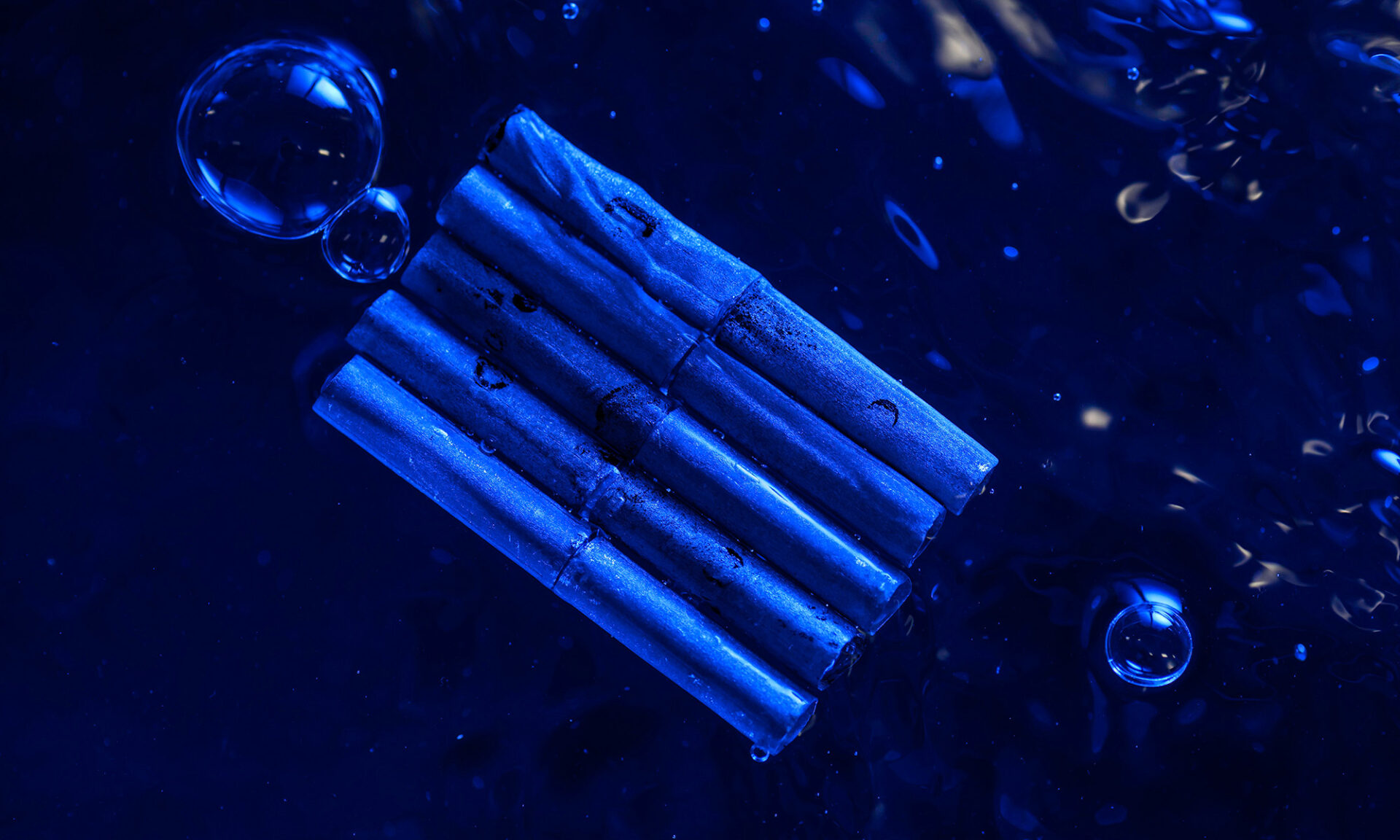
More than a century after the Titanic sank, engineers still have hopes of someday creating “unsinkable” ships. In a step toward reaching that lofty goal, researchers at the University of Rochester’s Institute of Optics have developed a new process that turns ordinary metal tubes unsinkable—meaning they will stay afloat no matter how long they are forced into water or how heavily they are damaged.
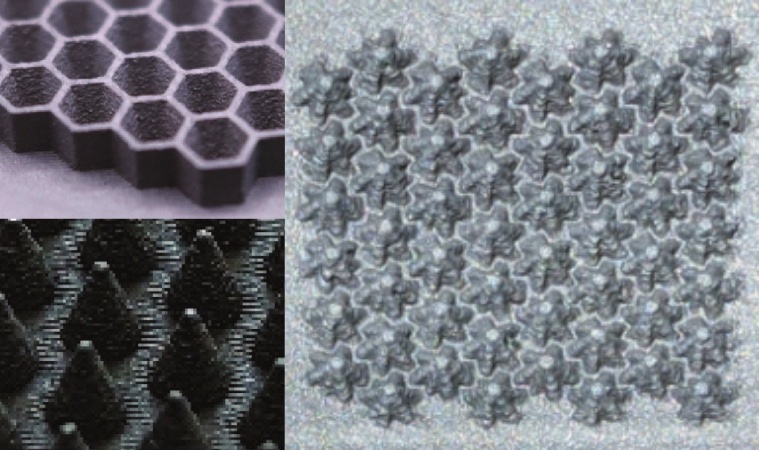
Scientists have created 3D printed surfaces featuring intricate textures that can be used to bounce unwanted gas particles away from quantum sensors, allowing useful particles like atoms to be delivered more efficiently, which could help improve measurement accuracy. The researchers from the University of Nottingham’s School of Physics and Astronomy created intricate, fine-scale surface textures that preferentially bounce incident particles in particular directions. This can help to keep unwa...
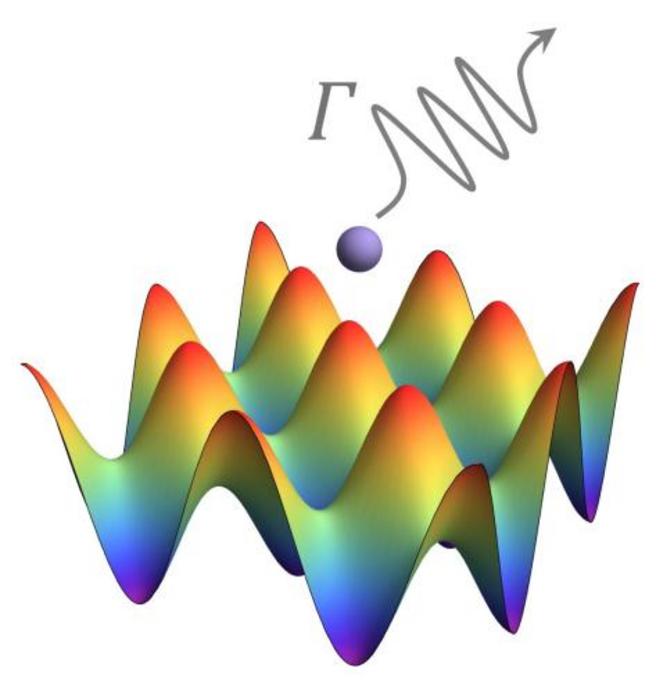
In a landmark achievement at the confluence of artificial intelligence and fundamental physics, a team of researchers from Tongji University, the Chinese university of Hong Kong and Nanyang Technological University has developed an AI algorithm capable of classifying complex topological phases of matter without relying on the mathematical tools that have limited human scientists for decades. This breakthrough, which tackles the notoriously difficult realm of non-Hermitian systems, suggests th...
This week in nanotech
$816M raised
7 funding rounds · 34 deals tracked
New products
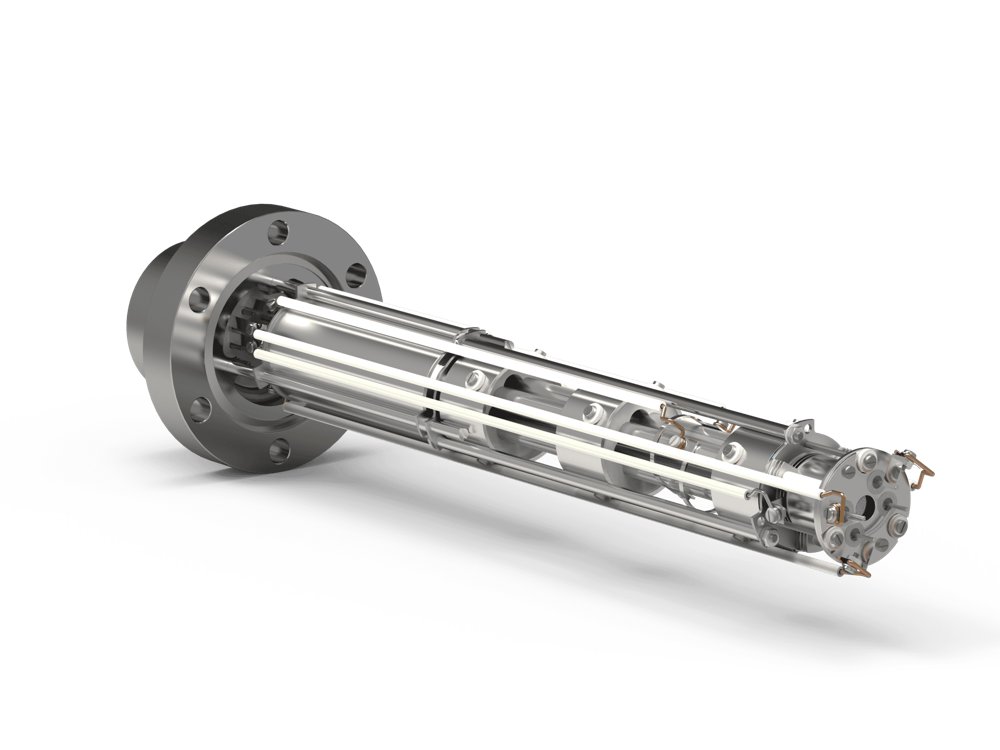 DLS-1 Mass Spectrometer for Fusion Gas AnalysisHiden Analytical Featured
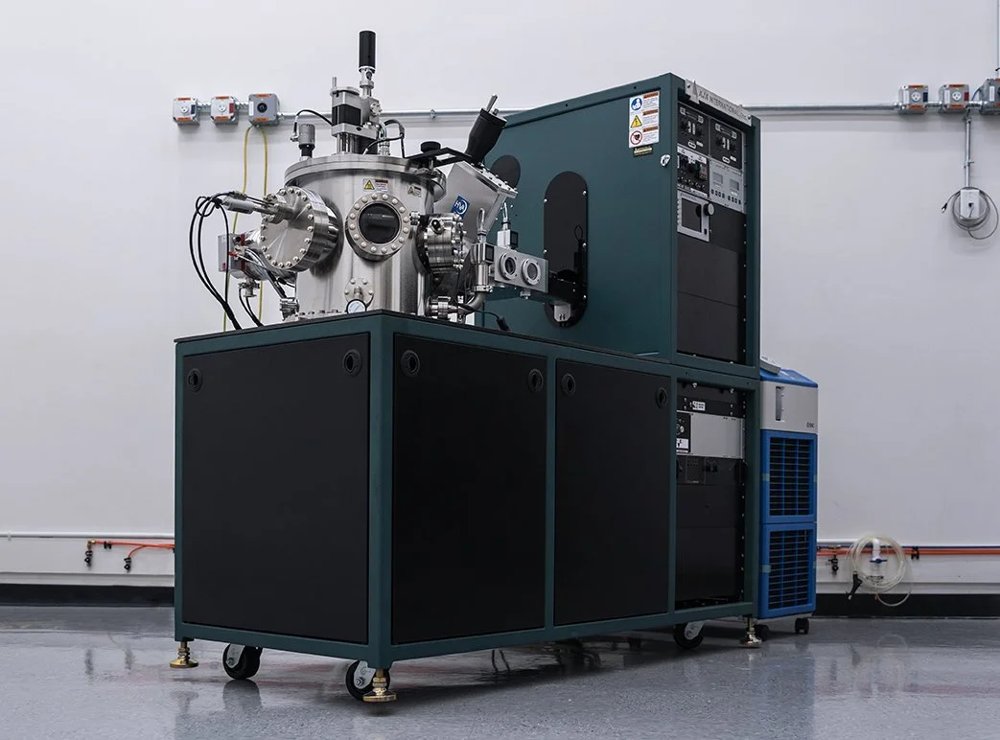 Orion Sputtering Deposition SystemsAJA International Featured
 Ionic® Purification SystemBionano Genomics, Inc.
Market insights
Last 30 days: Quantum Technologies drew the most money: $3.17B.
Money raised per month
Behind the deal
Who led Institut de Microelectronica de Barcelona (IMB-CNM, CSIC)’s $185.7M Grant?
See the investors with Insights Pro →