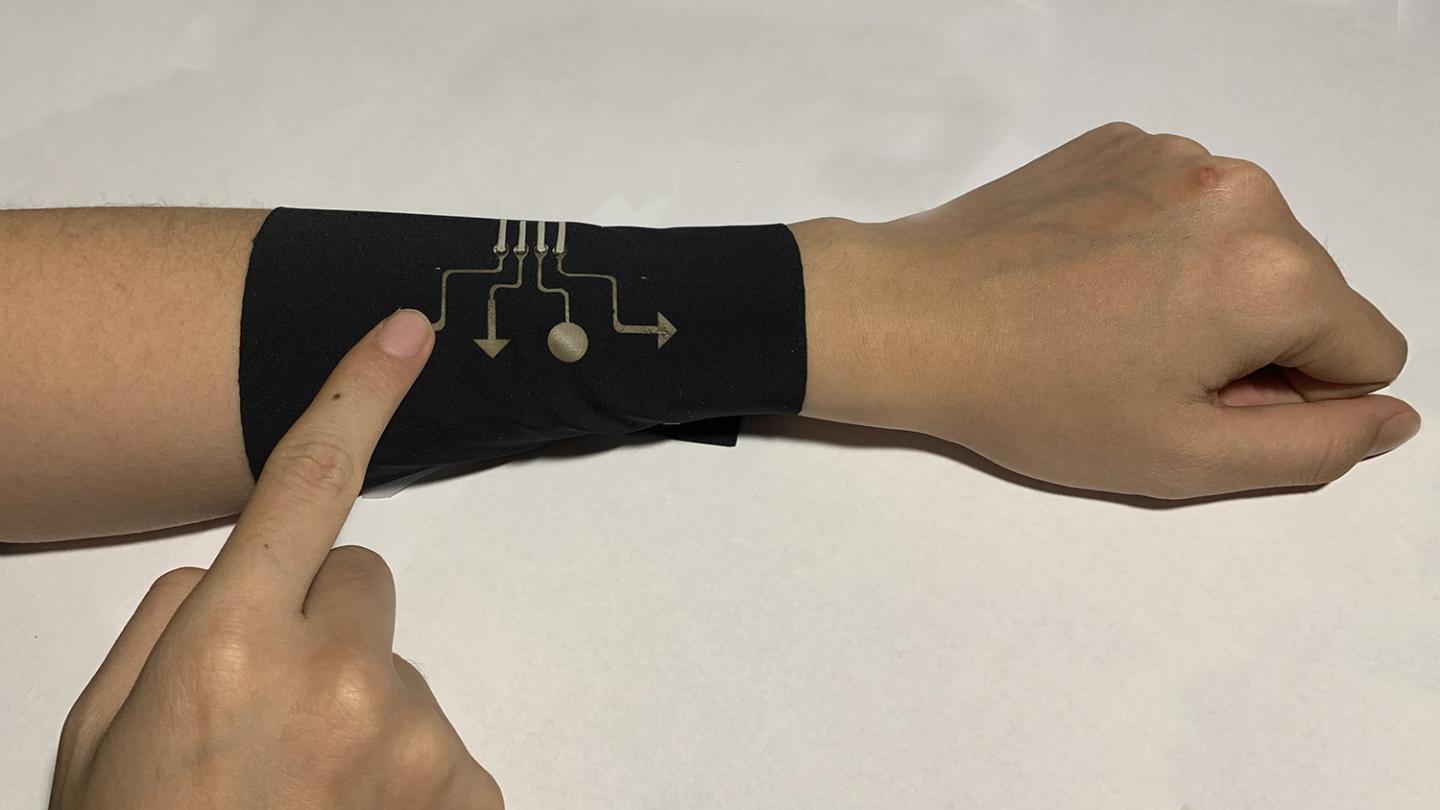
Engineering researchers have created ultrathin, stretchable electronic material that is gas permeable, allowing the material to "breathe." The material was designed specifically for use in biomedical or wearable technologies, since the gas permeability allows sweat and volatile organic compounds to evaporate away from the skin, making it more comfortable for users - especially for long-term wear.
"The gas permeability is the big advance over earlier stretchable electronics," says Yong Zhu, co-corresponding author of a paper on the work and a professor of mechanical and aerospace engineering at North Carolina State University. "But the method we used for creating the material is also important because it's a simple process that would be easy to scale up."
Specifically, the researchers used a technique called the breath figure method to create a stretchable polymer film featuring an even distribution of holes. The film is coated by dipping it in a solution that contains silver nanowires. The researchers then heat-press the material to seal the nanowires in place.
"The resulting film shows an excellent combination of electric conductivity, optical transmittance and water-vapor permeability," Zhu says. "And because the silver nanowires are embedded just below the surface of the polymer, the material also exhibits excellent stability in the presence of sweat and after long-term wear."
"The end result is extremely thin - only a few micrometers thick," says Shanshan Yao, co-author of the paper and a former postdoctoral researcher at NC State who is now on faculty at Stony Brook University. "This allows for better contact with the skin, giving the electronics a better signal-to-noise ratio.
"And gas permeability of wearable electronics is important for more than just comfort," Yao says. "If a wearable device is not gas permeable, it can also cause skin irritation."
To demonstrate the material's potential for use in wearable electronics, the researchers developed and tested prototypes for two representative applications.
The first prototype consisted of skin-mountable, dry electrodes for use as electrophysiologic sensors. These have multiple potential applications, such as measuring electrocardiography (ECG) and electromyography (EMG) signals.
"These sensors were able to record signals with excellent quality, on par with commercially available electrodes," Zhu says.
The second prototype demonstrated textile-integrated touch sensing for human-machine interfaces. The authors used a wearable textile sleeve integrated with the porous electrodes to play computer games such as Tetris.
"If we want to develop wearable sensors or user interfaces that can be worn for a significant period of time, we need gas-permeable electronic materials," Zhu says. "So this is a significant step forward."
Gas-permeable, Uultrathin, stretchable epidermal electronics with porous electrodes
Weixin Zhou, Qingchuan Du, Yanwen Ma, Shanshan Yao,and Hongyu Wang and Yong Zhu
ACS Nano (2020)
DOI: 10.1021/acsnano.0c00906
Contact information:
Yong Zhu
NC State Professor of Mechanical and Aerospace Engineering
yzhu7@ncsu.edu
Phone: 919-513-7735
Zhu Group - Nanomechanics and Nanoengineering Laboratory
North Carolina State University
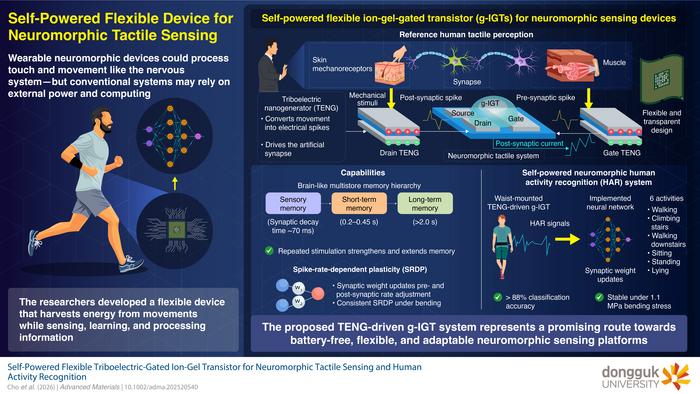
The proposed TENG-driven g-IGT is a flexible, self-powered neuromorphic device capable of reproducing multiple memory states and spike-rate-dependent learning Neuromorphic devices, which are designed to emulate aspects of biological neural networks, are promising candidates for developing low-power and intelligent sensing technologies, including wearable applications. Among the device architectures explored for neuromorphic computing, graphene-channel ion-gel-gated transistors (g-IGTs) are...

Rice University researchers have shown that sub-nanometer wrinkles in graphene generate flexoelectric charge separation, reshaping local electrical behavior through curvature alone. Extreme bending produces polarization far stronger than in larger systems and may enable geometry-controlled electronics without chemical doping. Published in Advanced Materials.

Researchers at NC State have extended twistronics beyond van der Waals materials into strongly bonded crystalline oxides. By stacking sodium niobate membranes with twist angles controlled down to 0.1 degrees, and confirming results via synchrotron X-ray diffraction, the team found interlayer bonds distort the atomic lattice, shifting phase structure and domain configuration. The technique works at near-millimeter scale, far larger than typical twistronic devices, marking a real step toward pract
