City College of New York (CCNY)
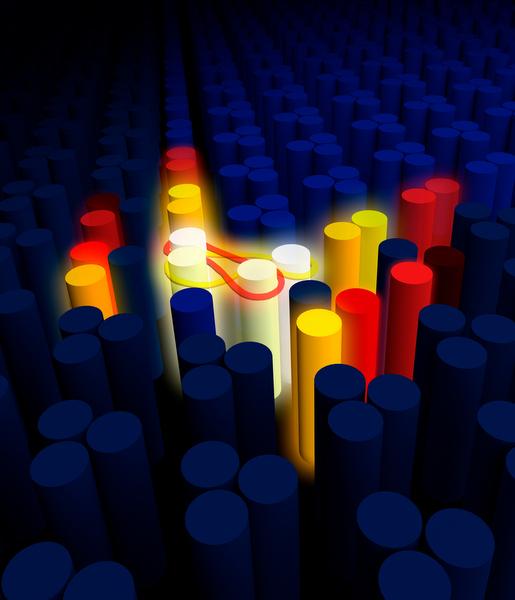
A new approach to trapping light in artificial photonic materials by a City College of New York-led team could lead to a tremendous boost in the transfer speed of data online.
Research into topological photonic metamaterials headed by City College physicist Alexander B. Khanikaev reveals that long-range interactions in the metamaterial changes the common behavior of light waves forcing them to localize in space. Further, the study shows that by controlling the degree of such interactions one can switch between trapped and extended (propagating) character of optical waves.
"The new approach to trap light allows the design of new types of optical resonators, which may have a significant impact on devices used on a daily basis, said Khanikaev. "These range from antennas in smartphones and Wi-Fi routers, to optical chips in optoelectronics used for transferring data over the Internet with unprecedented speeds."
Entitled "Higher-order topological states in photonic kagome crystals with long-range interactions," the research appears in the journal Nature Photonics published today.
It is a collaboration between CCNY, the Photonics Initiative at the Graduate Center, CUNY; and ITMO University in St. Petersburg, Russia. As the lead organization, CCNY initiated the research and designed the structures, which were then tested both at CCNY and at ITMO University.
Khanikaev's research partners included: Andrea Alù, Mengyao Li, Xiang Ni (CCNY/CUNY); Dmitry Zhirihin (CCNY/ ITMO); Maxim Gorlach, Alexey Slobozhanyuk (both ITMO), and Dmitry Filonov (Center for Photonics and 2D Materials, Moscow Institute of Physics and Technology.
Research continues to extend the new approach to trap visible and infra-red light. This would further expand the range of possible applications of the discovery.
Higher-order topological states in photonic kagome crystals with long-range interactions
Mengyao Li, Dmitry Zhirihin, Maxim Gorlach, Xiang Ni, Dmitry Filonov, Alexey Slobozhanyuk, Andrea Alù & Alexander B. Khanikaev
Nature Photonics (2019)
DOI: 10.1038/s41566-019-0561-9
Contact information:
Alexander B. Khanikaev
City College asscoiate professor of electrical engineering and physics
akhanikaev@ccny.cuny.edu
Phone: 212-650-7518
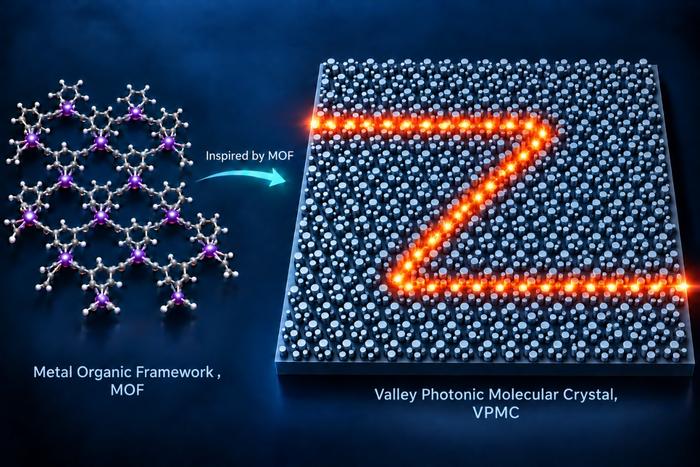
Inspired by Metal-Organic Framework based topological insulators, researchers at Tsinghua University proposed valley photonic molecular crystal (VPMC) and investigated the impact of molecular rotation on the valley-topological properties of VPMC. Credit: Tsinghua University/Xue Feng A research team led by Yidong Huang at Tsinghua University, including Xue Feng and Yongzhuo Li, has developed valley photonic molecular crystals (VPMCs) on a silicon platform. Combining theoretical modeling,...
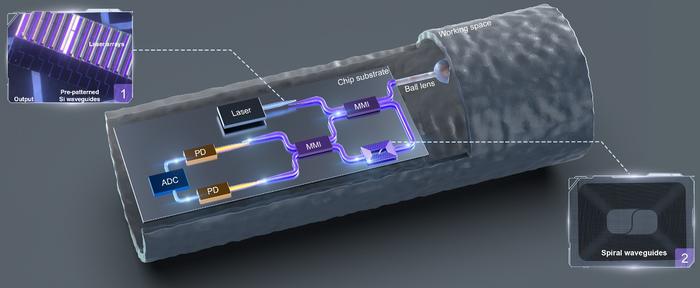
The system integrates a III-V semiconductor light source, SiN-based interferometers, Si-Ge photodetectors (PDs), and an integrated ball-lens microprobe, thereby combining the distinct advantages of multiple photonic integration platforms. The insets illustrate complementary technologies that can be incorporated to realize a miniaturized, fully integrated OCT system. Abbreviations: ADC, analog-to-digital converter. Inset 1: Foundry-scalable embedded III-V lasers on silicon-on-insulator (SOI)...

From left to right: Three photons with different quantum states enter an interferometer with three beam splitters. At each beam splitter, they can take different paths at the same time in superposition. The researchers then measured how often the three photons ended up together at the same output. Counterintuitively, it is possible to make the photons more similar to each other and at the same make them less likely to “bunch” together. AI-generated illustration, by Leonardo Novo. We usually...
