Physicists from Switzerland, Germany and Ukraine have proposed an innovative new data storage medium. The technique is based on specific properties of antiferromagnetic materials that had previously resisted experimental examination.
Using nanoscale quantum sensors, an international research team has succeeded in exploring certain previously uncharted physical properties of an antiferromagnetic material. Based on their results, the researchers developed a concept for a new storage medium published in the journal Nature Physics. The project was coordinated by researchers from the Department of Physics and the Swiss Nanoscience Institute at the University of Basel.
Antiferromagnets make up 90 percent of all magnetically ordered materials. Unlike ferromagnets such as iron, in which the magnetic moments of the atoms are oriented parallel to each other, the orientation of the magnetic moments in antiferromagnets alternates between neighboring atoms. As a result of the cancelation of the alternating magnetic moments, antiferromagnetic materials appear non-magnetic and do not generate an external magnetic field.
Antiferromagnets hold great promise for exciting applications in data processing, as the orientation of their magnetic moment - in contrast to the ferromagnets used in conventional storage media - cannot be accidentally overwritten by magnetic fields. In recent years, this potential has given rise to the budding research field of antiferromagnetic spintronics, which is the focus of numerous research groups around the world.
Quantum sensors provide new insights
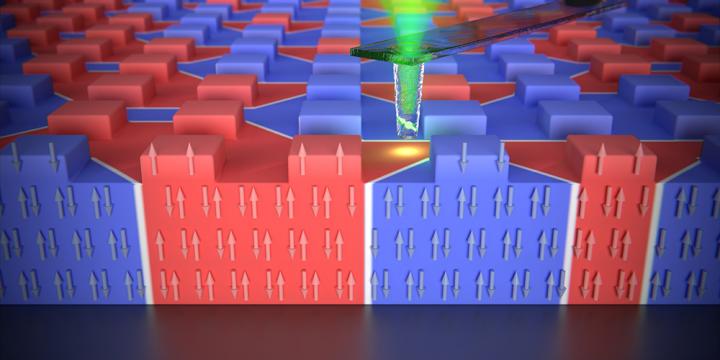
In collaboration with the research groups under Dr. Denys Makarov (Helmholtz-Zentrum in Dresden, Germany) and Professor Denis D. Sheka (Taras Sevchenko National University of Kyiv, Ukraine), the team led by Professor Patrick Maletinsky in Basel examined a single crystal of chromium(III) oxide (Cr2O3). This single crystal is an almost perfectly ordered system, in which the atoms are arranged in a regular crystal lattice with very few defects. "We can alter the single crystal in such a way as to create two areas (domains) in which the antiferromagnetic order has different orientations," explains Natascha Hedrich, lead author of the study.
These two domains are separated by a domain wall. To date, experimental examinations of domain walls of this sort in antiferromagnets have only succeeded in isolated cases and with limited detail. "Thanks to the high sensitivity and excellent resolution of our quantum sensors, we were able to experimentally demonstrate that the domain wall exhibits behavior similar to that of a soap bubble," Maletinsky explains. Like a soap bubble, the domain wall is elastic and has a tendency to minimize its surface energy. Accordingly, its trajectory reflects the crystal's antiferromagnetic material properties and can be predicted with a high degree of precision, as confirmed by simulations performed by the researchers in Dresden.
Surface architecture determines trajectory
The researchers exploit this fact to manipulate the trajectory of the domain wall in a process that holds the key to the proposed new storage medium. To this end, Maletinsky's team selectively structures the surface of the crystal at the nanoscale, leaving behind tiny raised squares. These squares then alter the trajectory of the domain wall in the crystal in a controlled manner.
The researchers can use the orientation of the raised squares to direct the domain wall to one side of the square or the other. This is the fundamental principle behind the new data storage concept: if the domain wall runs to the "right" of a raised square, this could represent a value of 1, while having the domain wall to the "left" could represent a value of 0. Through localized heating with a laser, the trajectory of the domain wall can be repeatedly altered, making the storage medium reusable.
"Next, we plan to look at whether the domain walls can also be moved by means of electrical fields," Maletinsky explains. "This would make antiferromagnets suitable as a storage medium that is faster than conventional ferromagnetic systems, while consuming substantially less energy."
Contact
Prof. Dr. Patrick Maletinsky
University of Basel, Department of Physics, Swiss Nanoscience Institute
+41 61 207 37 63
patrick.maletinsky@unibas.ch
Reference
Nanoscale mechanics of antiferromagnetic domain walls
Natascha Hedrich, Kai Wagner, Oleksandr V. Pylypovskyi, Brendan J. Shields, Tobias Kosub, Denis D. Sheka, Denys Makarov & Patrick Maletinsky
