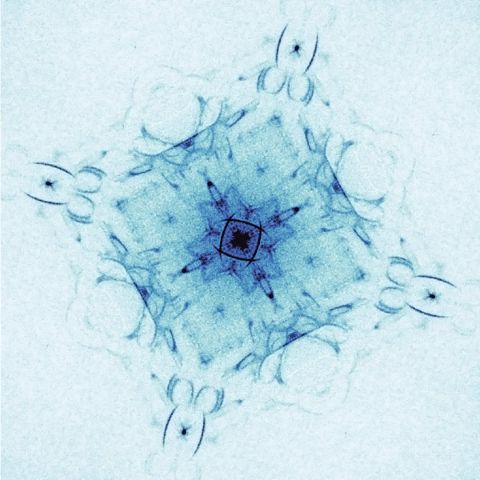
Tiny strains in a crystal can cause electrons to behave in a surprising way that closely resembles a highly sought-after mechanism, RIKEN physicists have found1. Previous studies may need to be re-evaluated in light of this finding.
Symmetry is a hugely important concept in physics because it can greatly simplify the analysis of complex systems. Spontaneous symmetry breaking (SSB) is an area of particular interest to Christopher Butler of the RIKEN Center for Emergent Matter Science.
“SSB is a phenomenon of fundamental importance, underpinning the physics of phase transitions, from the freezing of a liquid to the celebrated Higgs mechanism thought to have conferred mass to all particles in the early Universe,” says Butler.
An example of SSB is a ball perched on top of a perfectly symmetrical hill that starts rolling down the hill. The rolling breaks the initial symmetry of the system despite the law of gravity having no preferred direction.
To gain a better understanding of this key phenomenon, Butler’s team is searching for SSB that emerges in the collective behavior of large numbers of electrons in materials. “Any example of SSB we find in nature will yield profound insights,” Butler says.
At first, his team became highly excited when they thought they had discovered an example of SSB in electrons on the surfaces of crystals of zirconium silicon sulfide using a scanning tunneling microscope.
“We were hugely surprised and excited when we saw the electrons exhibiting wave-like behavior along a preferred axis,” he recalls. “It was like throwing a stone into a pond and observing ripples travelling only left and right, and not in other directions—it seemed like smoking-gun evidence for SSB in a fluid of electrons.”
But then Butler started having doubts. The amount of symmetry breaking varied between samples, which shouldn’t happen if it was due to SSB.
On performing very demanding measurements—monitoring the same 100 or so atoms for ten weeks—the team discovered that the symmetry breaking was due to tiny strains in the crystals introduced during fabrication.
“We found a phenomenon that outwardly resembled SSB but is actually a counterfeit,” says Butler. “The messy realities of real materials (tiny but ubiquitous distortions) contrived to present us with a very convincing fake.”
This effect could be harnessed in devices using strain engineering. But the study also has bigger implications, Butler believes.
“Many findings, including some very high-profile ones, may need to be re-evaluated,” he says. “If some report claims to observe symmetry-breaking electronic behavior, the onus is now to show it’s not simply due to residual strain.”
Undeterred, Butler plans to continue searching for genuine examples of SSB in the fluid of electrons in a crystal.
Reference
Valley Polarization of Landau Levels in the ZrSiS Surface Band Driven by Residual Strain
Christopher J. Butler, Masayuki Murase, Shunki Sawada, Ming-Chun Jiang, Daisuke Hashizume, Guang-Yu Guo, Ryotaro Arita, Tetsuo Hanaguri, and Takao Sasagawa
https://journals.aps.org/prx/abstract/10.1103/PhysRevX.15.011033
RIKEN
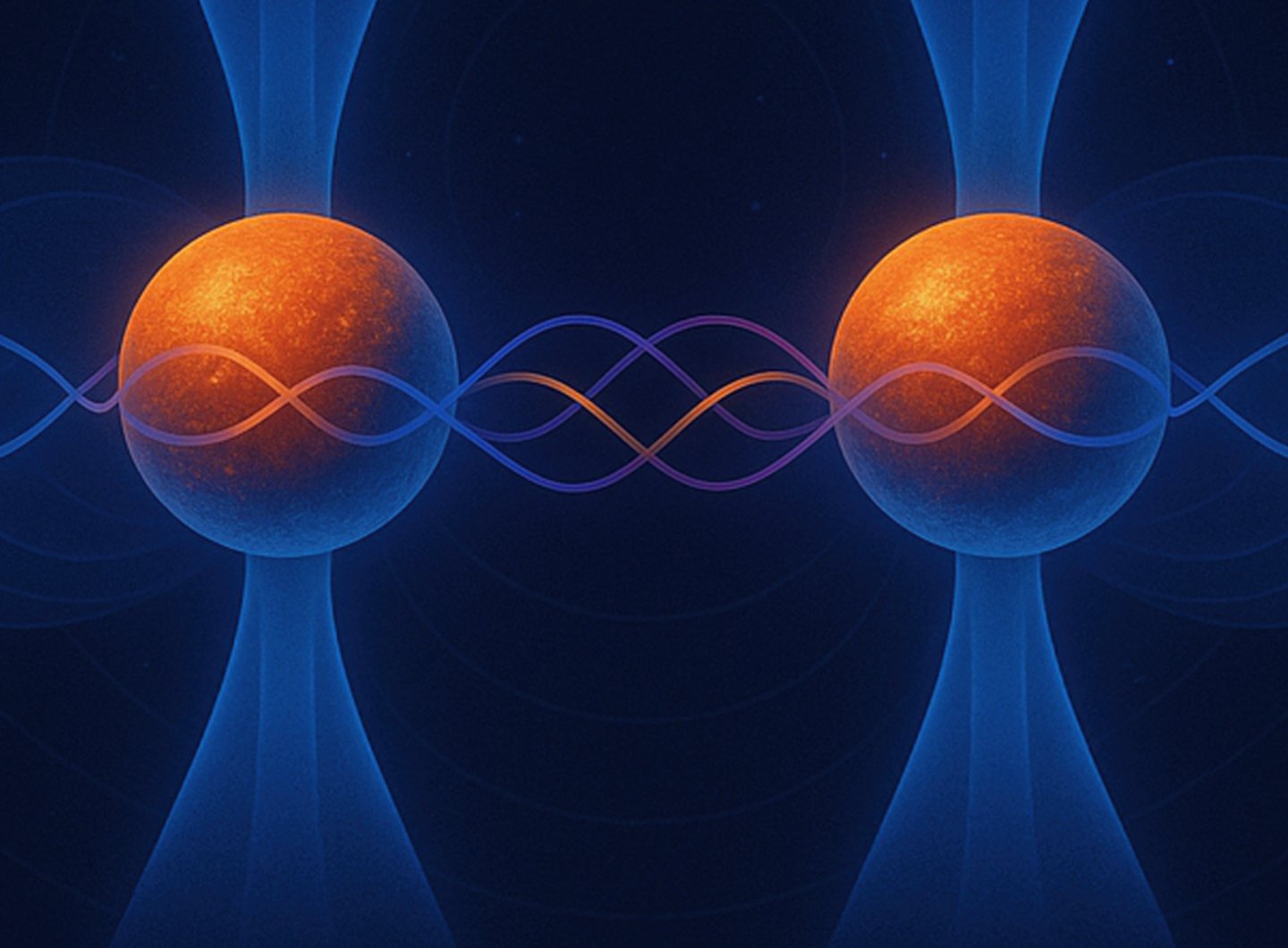
In hyper-entanglement, two characteristics of a particle pair are correlated. As a simple analogy, this would be like a set of twins separated at birth having both the same names and same types of cars: The two traits are correlated between the twins. In the new study, Endres and his team were able to hyper-entangle pairs of atoms such that their individual states of motion and their individual electronic states—their internal energy levels—were correlated among the atoms.
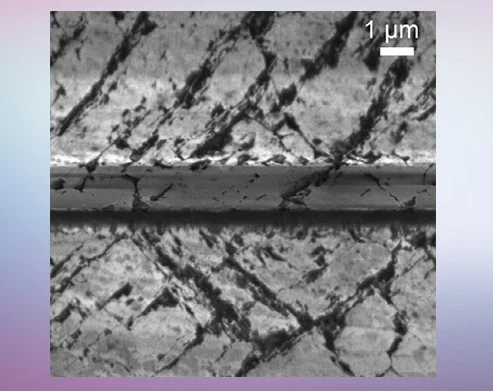
According to a study published in Advanced Functional Materials, the refined technique can bypass the high-temperature annealing and generates higher-purity diamond films than the original substrates. Moreover, the substrate sustains minimal damage in the process and can be reused, making the whole process resource-efficient and scalable.
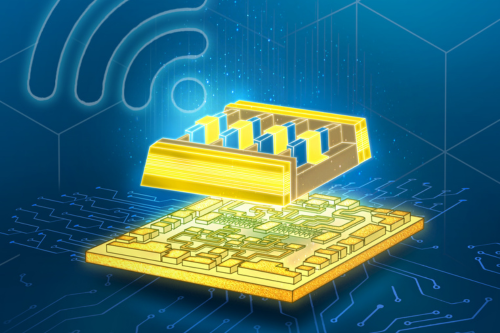
Self-driving cars which eliminate traffic jams, getting a healthcare diagnosis instantly without leaving your home, or feeling the touch of loved ones based across the continent may sound like the stuff of science fiction. But new research, led by the University of Bristol and published in the journal Nature Electronics, could make all this and more a step closer to reality thanks to a radical breakthrough in semiconductor technology.
