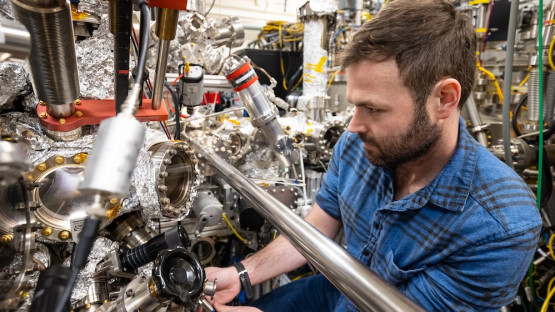
Cornell physicists have discovered that minimizing disorder, not varying electron count, is the key factor for controlling the superconductivity in the unique material iron selenide (FeSe), a new insight for understanding high-temperature superconductors.
Using a new technique to control this iron-based superconductor, researchers in Kyle Shen’s lab have found that iron selenide’s superconducting “dome” – the curve tracing how the superconductivity strengthens and then weakens as the properties are tuned – is more closely linked to resistance caused by imperfections in its crystal lattice rather than the number of electrons flowing through the crystal. Iron selenide could be fundamentally different than other high-temperature (or unconventional) superconductors, the finding suggests.
“We found that in this material, that dome is driven by factors much different than what you see normally,” said postdoctoral researcher Paul Malinowski, a former Klarman Postdoctoral Fellow in the College of Arts and Sciences (A&S). “It’s not driven by how many electrons you’re adding in, but rather, it’s driven by the obstacles the electrons are hitting – how perfect or imperfect is the crystal lattice?”
The study “What Controls the Superconducting Dome of Electron-doped FeSe?” published in Proceedings of the National Academy of Sciences Aug. 20 with Malinowski as first author.
“It’s an important new result that could give a lot of insight into high-temperature superconductivity,” said Shen, the James A. Weeks Professor of Physical Sciences and Stephen H. Weiss Presidential Fellow (A&S) and director of the Laboratory of Atomic and Solid State Physics, corresponding author of the study. “The key is the ability to precisely control the doping in the fashion Paul has been able to accomplish.”
For years, researchers have tried and failed to understand the dome of iron selenide, Shen said, because the material’s chemistry resisted conventional doping methods, so Malinowski and colleagues had to invent a new way to study it.
The standard way to add electrons to a material system is to grow a new compound that has more electrons in it, Malinowski said. “But that means every time you want to change the number of electrons, you have to grow a completely new material. Not only is that a lot of work; you’re also changing the material every time so other things might be changing that you don’t know and can’t control.”
In their new approach, Malinowski and colleagues synthesized samples using a technique called molecular beam epitaxy (MBE), and added electrons by spraying them on the surface of the material in a process called alkali surface deposition. The material properties were then probed using a combination of in situ electrical transport and angle-resolved photoemission spectroscopy (ARPES). This was done in ultra-high vacuum, using the alkali metal cesium.
MBE and alkali deposition are both techniques used elsewhere, but the Shen lab, which has expertise in synthesizing thin films, were uniquely positioned to combine the synthesis with electrical and spectroscopic probes, Malinowski said, without removing or regrowing the sample.
“The novel thing here is we can do it all at once in a very comprehensive way,” he said. “That turned out to be essential for figuring out what’s going on.”
Data from this new approach showed that physical disorder was controlling the dome. Disorder refers to any number of deviations from the strict atomic order of a crystal material that disrupt the flow of electrons, the researchers said, such as an atom out of place here and there or a break in the pattern. In a perfect crystal, these imperfections would not exist, but in practice they are always there. Moreover, adding electrons inevitably introduces disorder, Shen said.
In the case of iron selenide, the prominence of disorder in controlling the superconducting dome is surprising because it makes the material stand out from all others, Malinowski said. It also reveals something about the microscopic mechanism of superconductivity in this compound and can inform theoretical descriptions of how superconductivity develops.
In other families of high-temperature superconductors, like the cuprates, it’s believed that the number of electrons is the primary driver for the phase diagram and the dome, Shen said.
“Disorder is there but it’s generally believed to be a secondary or tertiary player, playing a minor role,” he said. “In this material it looks like it’s reversed. We know that we are doping the material, but it looks like the disorder is the dominant factor, and the doping is a secondary player. That was counterintuitive, and it took us some time to come to grips with that and to believe our results because it was so counter to other unconventional superconductors.”
There’s more work to be done with theorists to understand the larger picture of why iron selenide behaves this way, Shen said. Further experiments are also being done in his group to focus only on changing disorder.
Reference
What Controls the Superconducting Dome of Electron-doped FeSe
Paul T. Malinowski, Chad J. Mowers, Yaoju Tarn, Darrell G. Schlom, Brendan D. Faeth, and Kyle M. Shen

Researchers at the University of Basel have identified and coherently controlled so called forbidden vibrational transitions in individual trapped nitrogen molecular ions without destroying them. Using quantum logic spectroscopy, a single calcium ion served as messenger, letting the team probe the molecule repeatedly and determine its fundamental vibrational frequency ten times more precisely than before.
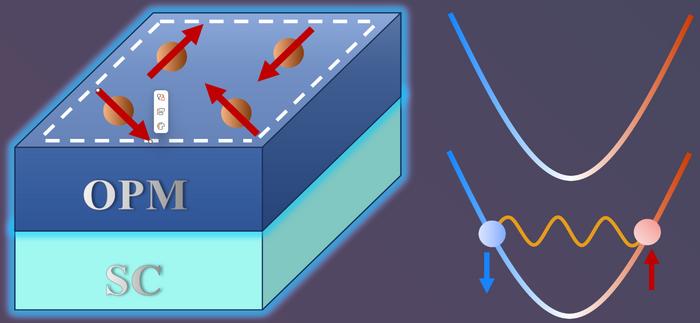
Odd-parity magnets host an intrinsic hidden Zeeman field that lifts Kramers degeneracy without any applied field, researchers report. Using an f-wave magnet model on a triangular lattice, the team shows how non-relativistic spin splitting and this hidden field combine to stabilize s-wave superconductivity far beyond the Pauli limit.

Rhombohedral hexalayer graphene, in which six carbon sheets are stacked with a slight lateral offset like staircase steps, hosts both superconductivity and electrically controllable orbital magnetism, researchers report in Nature Physics. The arrangement yields a rich collection of quantum states in a simple carbon-based material, positioning rhombohedral multilayer graphene as a platform for probing the fundamental mechanisms of superconductivity and magnetism and potentially for new ways of…
This week in nanotech
10 deals tracked
New products
 DLS-1 Mass Spectrometer for Fusion Gas AnalysisHiden Analytical Featured
 Ti-WCMBN Nanomaterialia Featured
 Talphene™ Graphene AdditivesTalga Group
Market insights
Last 30 days: Semiconductors & Electronics was the busiest vertical: 44 of 142 events (31%).
Money raised per month