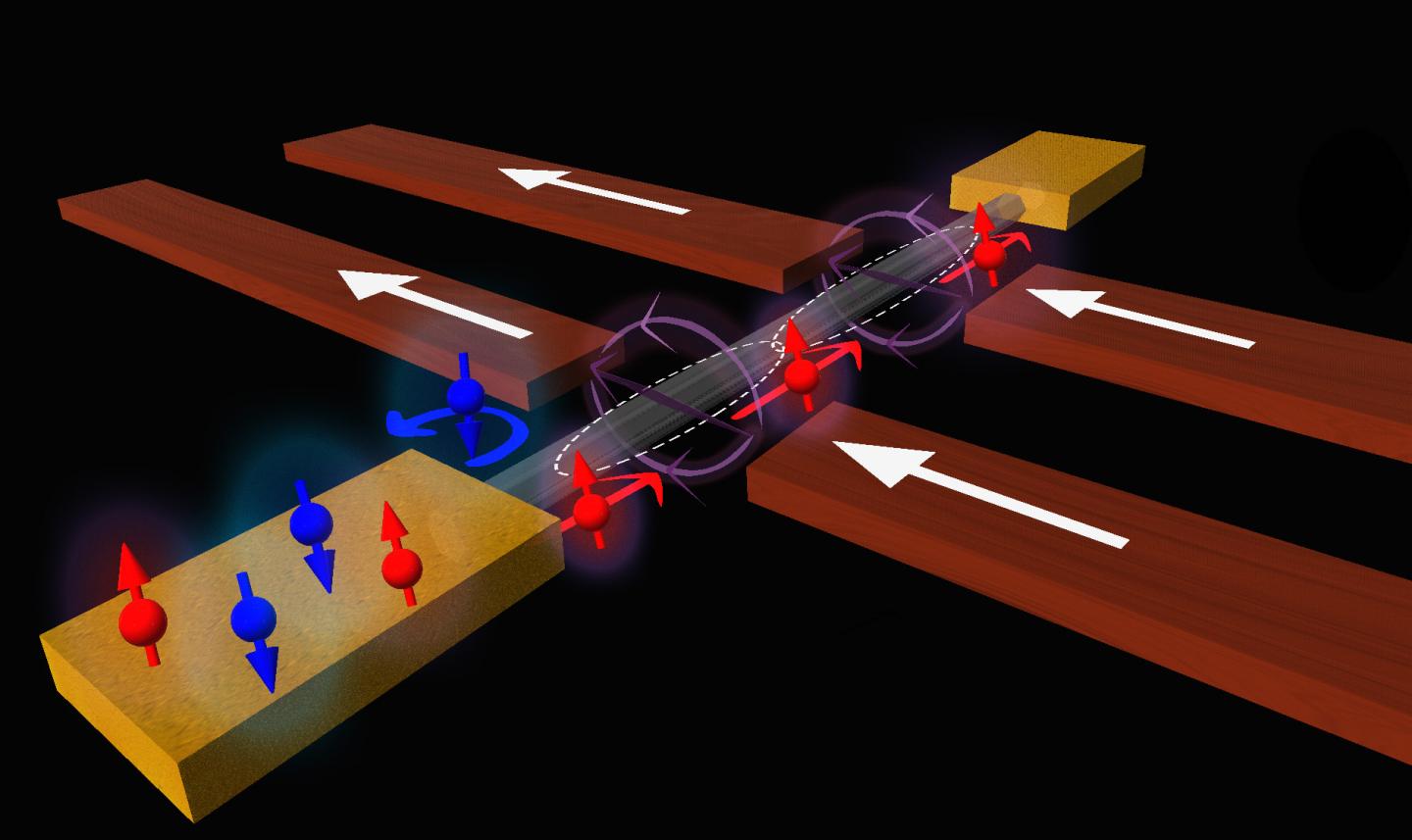
Researchers at the University of Basel in collaboration with colleagues from Pisa have developed a new concept that uses the electron spin to switch an electrical current. In addition to fundamental research, such spin valves are also the key elements in spintronics - a type of electronics that exploits the spin instead of the charge of electrons. The results were published in the scientific journal Communications Physics.
At some point, spintronics might become a buzzword that is as much a part of our vocabulary as electronics. The idea behind it is to use the angular momentum (spin) of an electron instead of the electrical charge. Researchers around the world have been pursuing this goal for many years. Spintronics promises numerous applications in information storage and processing, and could improve the energy efficiency of electronic devices. An important prerequisite is the efficient control and detection of electron spins.
A team of physicists around Professor Christian Schönenberger and Dr. Andreas Baumgartner from the Swiss Nanoscience Institute and the Department of Physics at the University of Basel has now developed a new technique for spintronics in semiconductor devices. Researchers from the Instituto Nanoscienze-CNR in Pisa were also involved.
Nanomagnets are the key
For this purpose, the scientists form two small semiconductor islands (quantum dots) behind each other on a nanowire and generate magnetic fields in the quantum dots using nanomagnets. Using an external field, they are able to control these magnets individually and thus can determine whether a quantum dot allows electrons to pass with a spin directed upward (up) or downward (down). When two quantum dots are connected in series, a current only flows if both are set to "up" or both to "down". Ideally, no current flows if they are oriented in opposite directions.
Arunav Bordoloi, first author of the publication and PhD student in the Schönenberger team, found that this method produced a spin polarization close to the theoretical maximum. "With this technique, we can choose whether a single electron in a given spin state is allowed to enter or leave a quantum system - with an efficiency far greater than in conventional spin valves," he says.
"In recent years, researchers around the world found it a hard nut to crack to fabricate spin valves useful for nano- and quantum-electronic devices," says Dr. Andreas Baumgartner, who is supervising the project. "We have now succeeded in producing one."
Exploring new phenomena
The physicists were also able to show that the magnetic fields are localized to specific locations on the nanowire. "This technique should therefore allow us to study the spin properties of new phenomena typically too sensitive to magnetic fields, such as novel states at the ends of special superconductors," comments Dr. Baumgartner.
This new approach to spintronics should now enable direct measurements of spin correlations and spin entanglement and shed new light on many old and new physical phenomena. In the future, the concept could even prove useful in the quest to use electron spins as the smallest information unit (quantum bit) in a quantum computer.
Reference:
A double quantum dot spin valve
Arunav Bordoloi, Valentina Zannier, Lucia Sorba, Christian Schönenberger, Andreas Baumgartner
DOI: http://dx.doi.org/10.1038/s42005-020-00405-2
Contact information:
Dr. Andreas Baumgartner
andreas.baumgartner@unibas.ch
41-612-073-906
Universität Basel
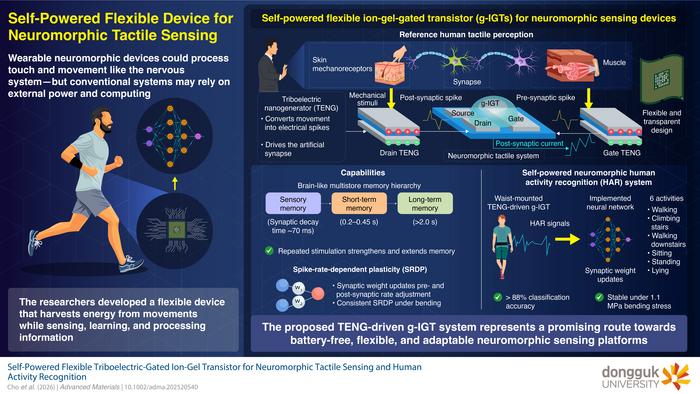
The proposed TENG-driven g-IGT is a flexible, self-powered neuromorphic device capable of reproducing multiple memory states and spike-rate-dependent learning Neuromorphic devices, which are designed to emulate aspects of biological neural networks, are promising candidates for developing low-power and intelligent sensing technologies, including wearable applications. Among the device architectures explored for neuromorphic computing, graphene-channel ion-gel-gated transistors (g-IGTs) are...
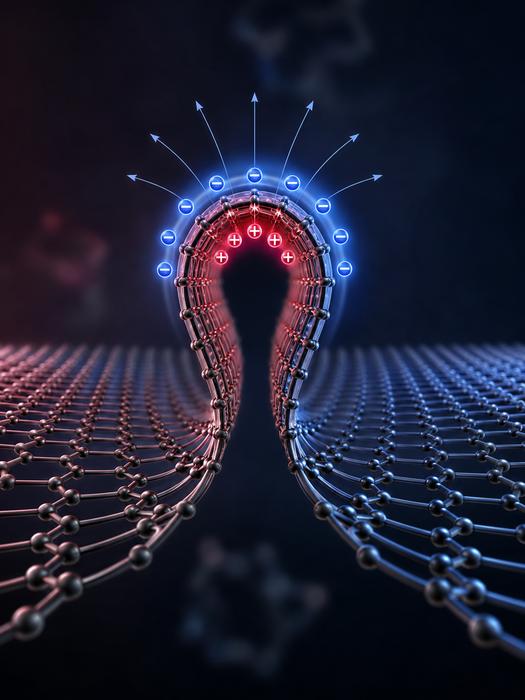
Rice University researchers have shown that sub-nanometer wrinkles in graphene generate flexoelectric charge separation, reshaping local electrical behavior through curvature alone. Extreme bending produces polarization far stronger than in larger systems and may enable geometry-controlled electronics without chemical doping. Published in Advanced Materials.
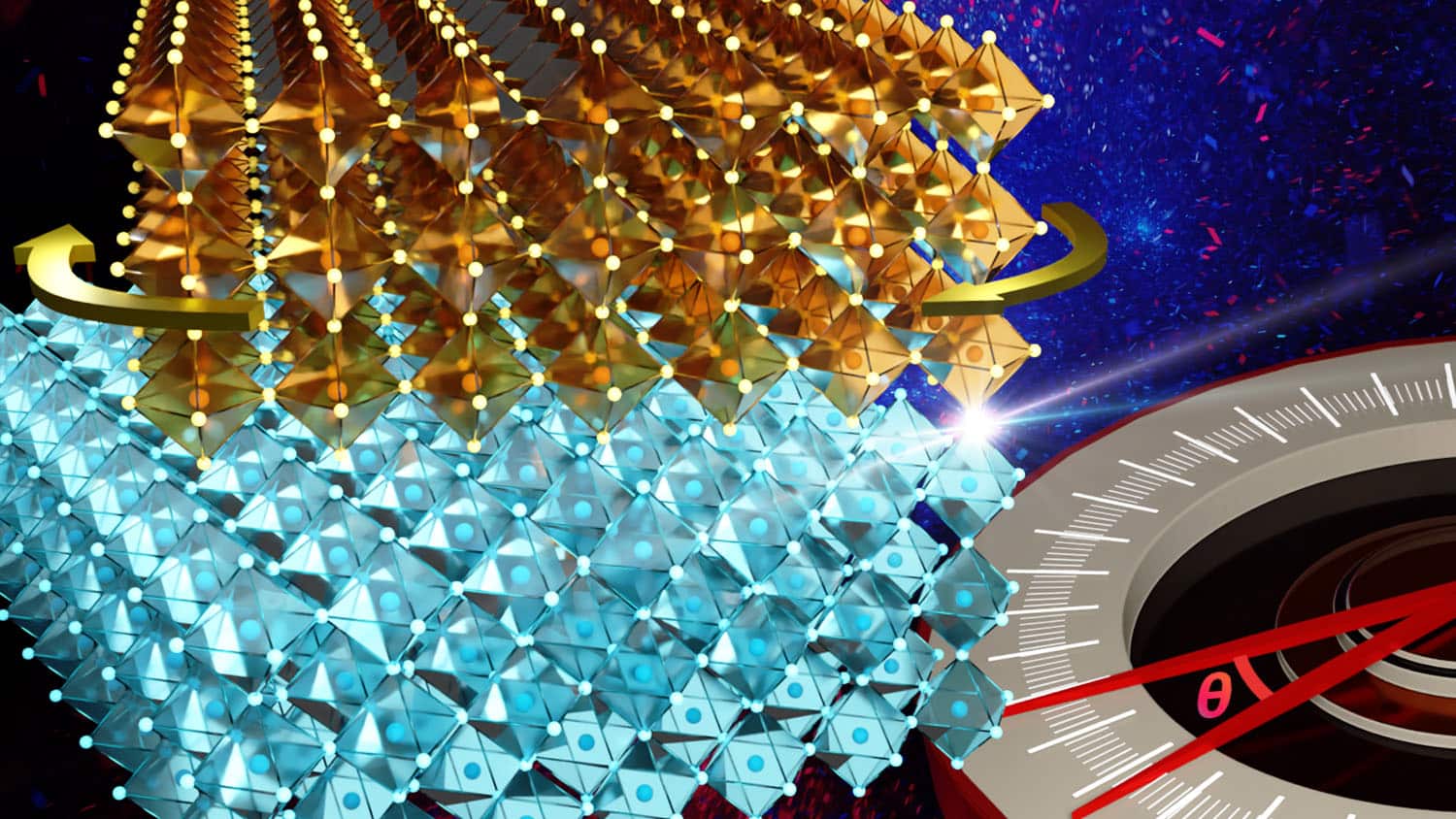
Researchers at NC State have extended twistronics beyond van der Waals materials into strongly bonded crystalline oxides. By stacking sodium niobate membranes with twist angles controlled down to 0.1 degrees, and confirming results via synchrotron X-ray diffraction, the team found interlayer bonds distort the atomic lattice, shifting phase structure and domain configuration. The technique works at near-millimeter scale, far larger than typical twistronic devices, marking a real step toward pract






