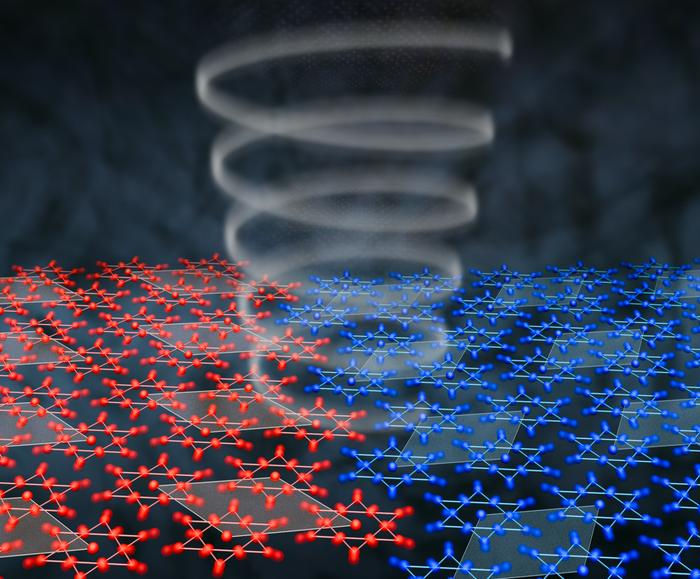
First demonstration of atomic spin qubit interaction with a single-quantum sound wave

Researchers at the Harvard John A. Paulson School of Engineering and Applied Sciences (SEAS) have demonstrated, for the first time, a single quantum of vibrational energy interacting with a single atomic spin, seeding a pathway to quantum technologies that use sound as an information carrier, instead of light or electricity. The results are published in Nature.
Led by Marko Lončar, the Tiantsai Lin Professor of Electrical Engineering, the researchers engineered a nanometer-scale mechanical resonator around a single color-center spin qubit in diamond. These color centers, atomic defects in the diamond’s crystal structure, act as quantum memory capable of storing quantum information. The researchers’ new system can host sufficiently strong spin-phonon interactions for quantum information storage – a key challenge thus far in the field.
“At the heart of the experiment is a phonon — the smallest possible unit of sound,” Lončar said. “When we listen to music, it takes countless phonons working together to move our eardrums and maybe even get us spinning on the dance floor. But qubits are far more sensitive: a single phonon can be enough to change their quantum state — to excite them, or, as in our experiment, to help them relax.”
Mechanical vibrations, like those of a guitar string, can “ring” for a long time while occupying a volume far smaller than a comparative electromagnetic cavity of the same frequency. That combination of long lifetime and compact size makes phonons especially promising as quantum information carriers, or interconnects that link compact quantum memories, processors, and sensors on future quantum chips.
“Many quantum systems, including superconducting qubits, quantum dots, or solid-state defects are known to interact strongly with phonons,” explained Graham Joe, first author and former Harvard graduate student. “So quantum acoustics holds a lot of promise as a sort of ‘universal quantum bus’ which could connect up disparate sorts of quantum systems into hybrid systems.”

When one phonon can change the atomic qubit’s state, the spin also acts as an exquisitely sensitive probe of its mechanical environment. The spin could be used to measure very small forces, stresses, or temperature changes by “listening” to the quantum noise of the device. This could lead to precision sensing and other applications.
The results point to new control over quantum defects in solids, bringing spin-mechanical interactions closer to the threshold of full quantum coherence, or the ability of an otherwise fragile quantum system to remain stable.
“This experiment was both a compelling demonstration of new tools for sensing the environment of a single atom, and a meaningful step towards practical quantum acoustic devices,” Joe said.
“Purcell-enhanced spin-phonon coupling with a single color-center” was co-authored by Michael Haas, Kazuhiro Kuruma, Chang Jin, Dongyeon Daniel Kang, Sophie W. Ding, Cleaven Chia, Hana Warner, Benjamin Pingault, Bartholomeus Machielse, and Srujuan Meesala.
U.S. federal support for the research came from the National Science Foundation under grant No. DMR-1231319; the Army Research Office/Department of the Army under award No. W911NF1810432; and the NSF under award No. EEC-1941583.
The Harvard Office of Technology Development is actively pursuing patent protection and commercialization opportunities for the innovations arising from this research.
Reference
Purcell-enhanced spin–phonon coupling with a single colour centre
Graham Joe, Michael Haas, Kazuhiro Kuruma, Chang Jin, Dongyeon Daniel Kang, Sophie W. Ding, Cleaven Chia, Hana Warner, Benjamin Pingault, Bartholomeus Machielse, Srujan Meesala & Marko Lončar
Harvard John A. Paulson School of Engineering and Applied Sciences (SEAS)