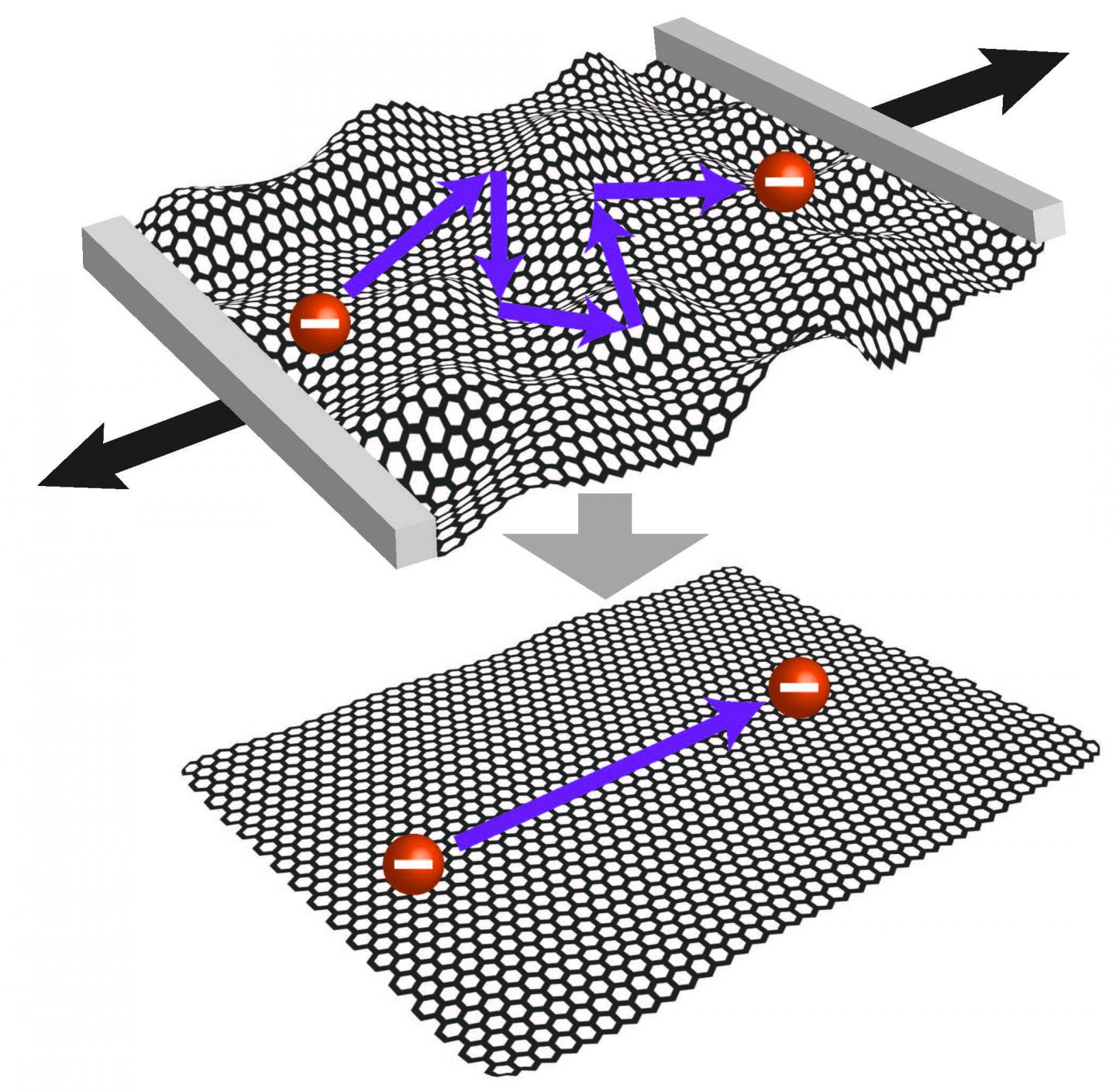
Bumps on a road slow down our pace, so do corrugations in graphene to travelling electrons. By flattening the corrugations out, we help electrons move effectively faster through a graphene sheet.
The sample quality of graphene has been improved significantly since its discovery. One factor that limited further improvements has not been investigated directly so far, namely corrugations in the graphene sheet, i.e. microscopic distortions that form even when placed on atomically flat surfaces. Such corrugations can scatter the electrons when moving through an electronic device.
The team of professor Christian Schönenberger of the Swiss Nanoscience Institute and Department of Physics at the University of Basel has developed a technique to pull the graphene sheet on two opposite sides and thereby flattening and smoothing it. "It is similar to pulling on a piece of crumpled paper which irons out wrinkles and folds», says Dr. Lujun Wang, first author of the study. "After this process, the electrons travel effectively faster through the graphene sheet, their "mobility" increases, demonstrating an improved sample quality", his supervisor Dr. Andreas Baumgartner adds.
These findings not only help us to further understand the electron transport in graphene but also provide instructions for studying other two-dimensional materials.
Mobility enhancement in graphene by in situ reduction of random strain fluctuations
Lujun Wang, Péter Makk, Simon Zihlmann, Andreas Baumgartner, David I. Indolese, Kenji Watanabe, Takashi Taniguchi, and Christian Schönenberger
Physical Review Letters (2020) Vol. 124, Iss. 15
DOI: 10.1103/PhysRevLett.124.157701
Contact information:
Andreas Baumgartner
Head of Swiss Nanoscience Institute, University of Basel
andreas.baumgartner@unibas.ch
Phone: +41 (0)61 207 39 06
Christian Schönenberger
Professor in experimental condensed matter physics at the University of Basel
Christian.Schoenenberger@unibas.ch
Phone: +41 (0)61 207 36 90
Quantum- and Nanoelectronics
University of Basel
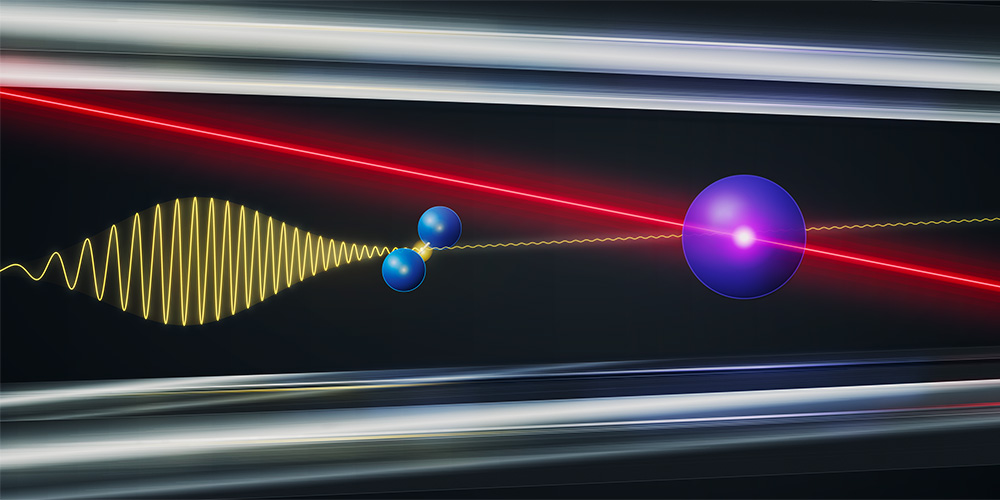
Researchers at the University of Basel have identified and coherently controlled so called forbidden vibrational transitions in individual trapped nitrogen molecular ions without destroying them. Using quantum logic spectroscopy, a single calcium ion served as messenger, letting the team probe the molecule repeatedly and determine its fundamental vibrational frequency ten times more precisely than before.
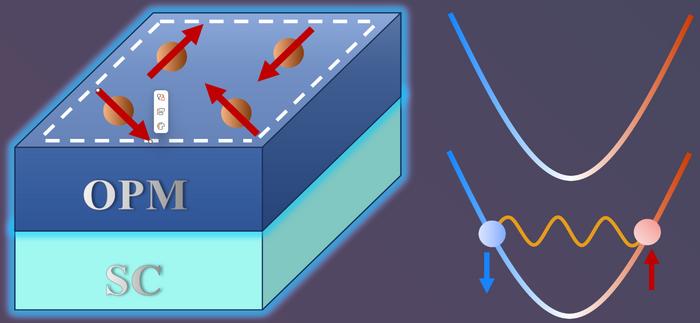
Odd-parity magnets host an intrinsic hidden Zeeman field that lifts Kramers degeneracy without any applied field, researchers report. Using an f-wave magnet model on a triangular lattice, the team shows how non-relativistic spin splitting and this hidden field combine to stabilize s-wave superconductivity far beyond the Pauli limit.
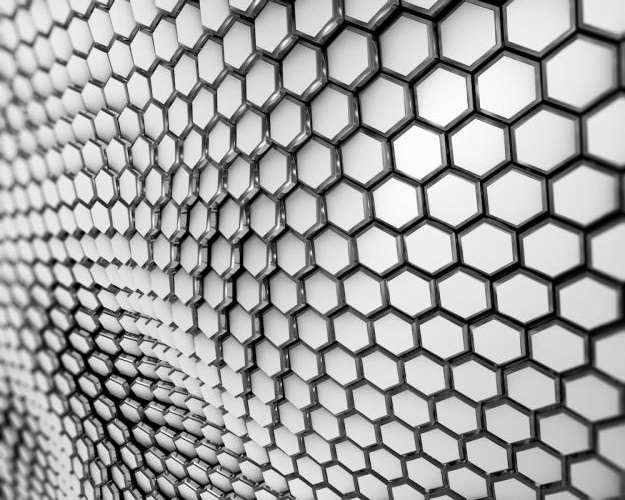
Rhombohedral hexalayer graphene, in which six carbon sheets are stacked with a slight lateral offset like staircase steps, hosts both superconductivity and electrically controllable orbital magnetism, researchers report in Nature Physics. The arrangement yields a rich collection of quantum states in a simple carbon-based material, positioning rhombohedral multilayer graphene as a platform for probing the fundamental mechanisms of superconductivity and magnetism and potentially for new ways of…
This week in nanotech
9 deals tracked
New products
 Nion-compatible In Situ STEM Holders for Electrical BiasingHummingbird Scientific Featured
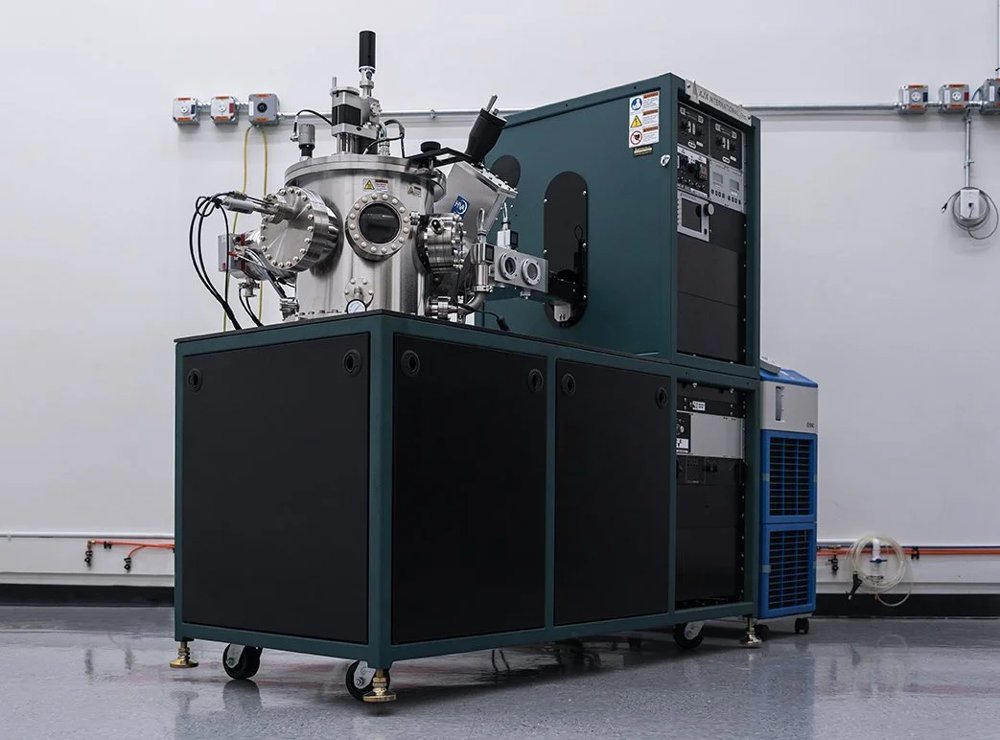 Orion Sputtering Deposition SystemsAJA International Featured
 GHK-CuPeoples Peps
Market insights
Last 30 days: Semiconductors & Electronics was the busiest vertical: 39 of 130 events (30%).
Money raised per month