From atoms to reactors, polymer design is a relay race across scales. A polymer begins with elementary reactions, but its final behavior is shaped by chain growth, diffusion, sequence evolution, and self-assembly. For complex polymer systems, that makes the journey from molecular mechanism to engineering design especially difficult: no single method can carry the whole story from reaction barriers to reactor conditions.
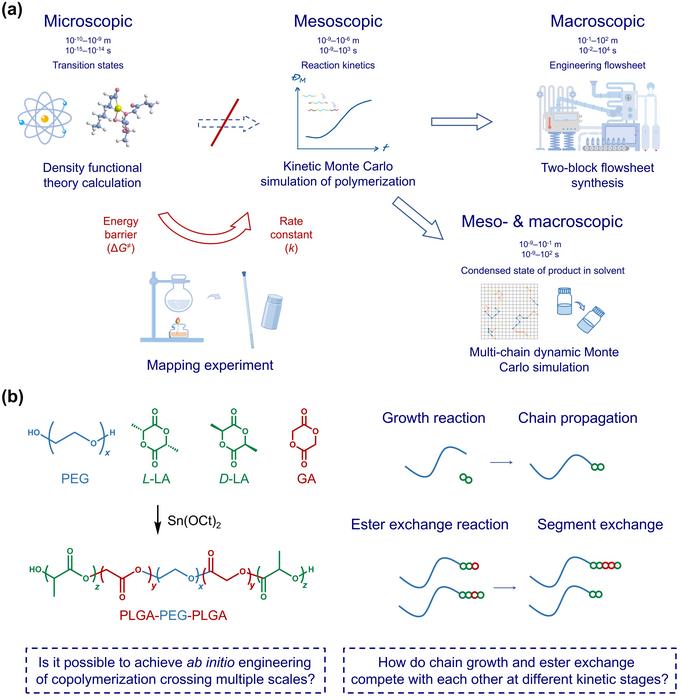
To address this challenge, Ding et al. developed a “4+1” multiscale molecular engineering strategy that integrates density functional theory (DFT) calculation, kinetic Monte Carlo (KMC) simulation, dynamic Monte Carlo (DMC) simulation, and flowsheet synthesis with one mapping experiment (Figure 1). The workflow links calculated energy barriers (ΔG≠) with reaction rate constants (k) via a mapping experiment, uses KMC to track the evolution of molecular parameters, applies DMC to predict condensed-state behavior, and then translates the results into engineering level design. In other words, information is passed step by step across scales, so that outputs from one level become inputs for the next.
Using thermogels, a star biomaterial that has been awarded as one of the 2025 Top 10 Emerging Technologies by the International Union of Pure and Applied Chemistry (IUPAC), as a model system, the study shows that the ring-opening polymerization of poly(lactide-co-glycolide)-b-poly(ethylene glycol)-b-poly(lactide-co-glycolide) (PLGA-PEG-PLGA) does not proceed as a single process. Instead, it follows distinct kinetic stages, with conversion, molar mass dispersity, and chain sequence reaching equilibrium sequentially. The products collected at different time points display different condensed states in water, including sol, precipitate, and heating-induced physical hydrogel (Figure 2). The work also shows that thermogellability can be predicted with artificial intelligence (AI). Together, these results establish a fundamental methodology for ab initio molecular engineering of valuable polymers and offer a general route for the design of complex polymer systems with industrial-scale synthesis potential.
Beyond PLGA-PEG-PLGA thermogels, the “4+1” strategy is designed as a general framework for polymer systems with complicated synthesis reactions. Its key strength lies in connecting information across scales step by step, so that quantum-level calculations, kinetic modeling, condensed-state prediction, and process design can be used together rather than in isolation. In this sense, the strategy provides a practical route for other polymer materials whose properties depend on coupled reaction kinetics, molecular evolution, and self-assembly, and it may be extended to the design and synthesis of a broader range of functional polymers.
The work was carried out by the research team led by Prof. Jiandong Ding at Fudan University, the director of the State Key Laboratory of Molecular Engineering of Polymers. He has long focused on thermogelling polymer systems, their theoretical mechanisms, and their applications in biomedical materials.
Reference
Multiscale molecular engineering of a thermogelling polymer integrating quantum mechanics, polymer chemistry and artificial intelligence
Tao Sun, Weihan Rao, Junyi Li, Lingxi Li, Yiman Wei, Shuquan Cui, Wenqian Li, Yanshuang Zhang, Yixuan Wang, Lin Yu, and Jiandong Ding
Quantum Elements and Qarakal Quantum have been selected by the BIRD Foundation to jointly develop a quantum simulation platform for chemical reactions on material surfaces. The project has a budget of $2.4 million.
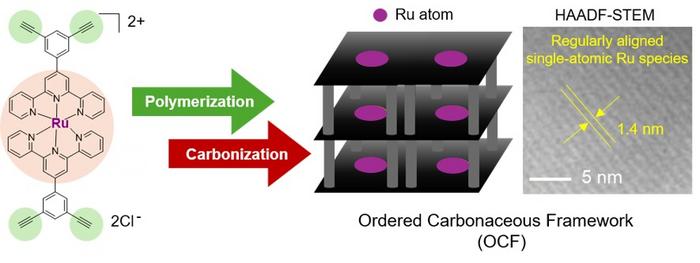
Researchers have developed a method to embed individual ruthenium atoms in porous carbon at concentrations up to 11 percent by weight, far above the typical 2 percent in conventional single-atom catalysts. The flexible molecular design keeps the atoms separated even at high loading, and the catalyst converts carbon dioxide into formic acid with over 99 percent selectivity while staying stable over repeated use.
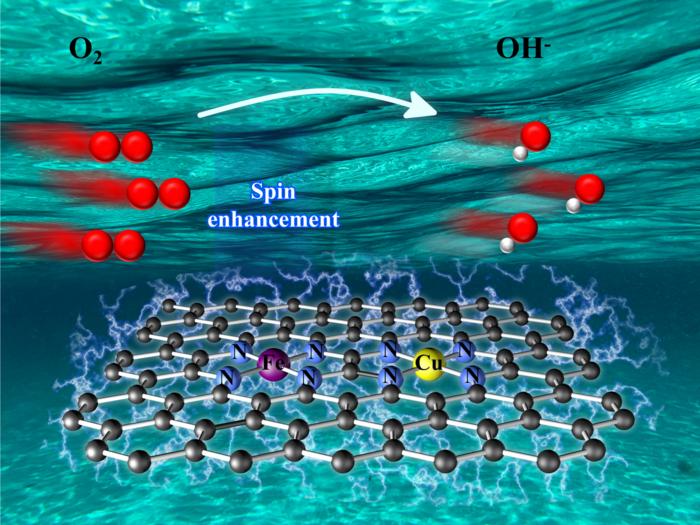
Researchers have developed an FeCu dual-single-atom catalyst in which spatially adjacent CuN4 sites tune the spin state of neighboring FeN4 centers, boosting oxygen adsorption and activation for the oxygen reduction reaction. The catalyst achieved a half-wave potential of 0.88 V versus RHE and outperformed commercial Pt/C in zinc-air battery tests.
This week in nanotech
$9M raised
1 funding round · 22 deals tracked
New products
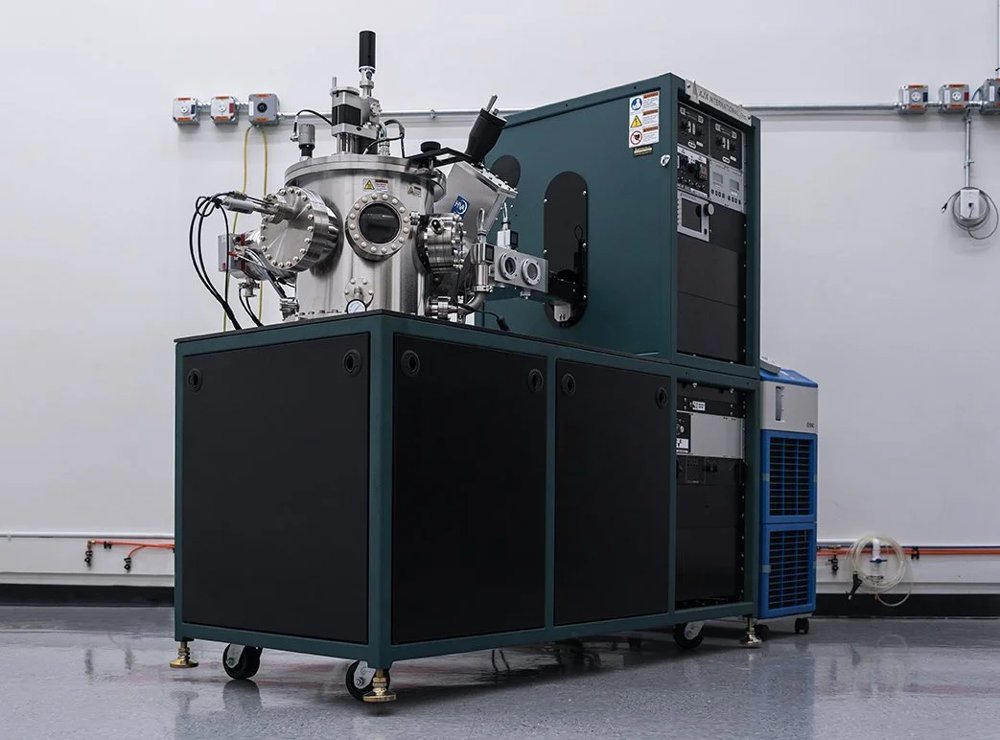 Orion Sputtering Deposition SystemsAJA International Featured
 Nion-compatible In Situ STEM Holders for Electrical BiasingHummingbird Scientific Featured
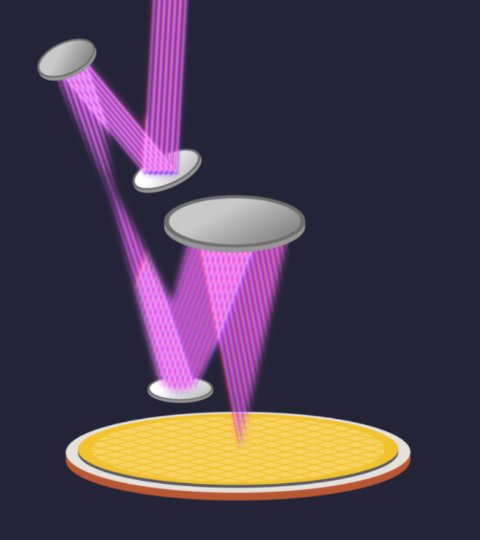 Aether®Lam Research
Market insights
Last 30 days: Quantum Technologies was the busiest vertical: 59 of 192 events (31%).
Money raised per month