Catalan Institute of Nanoscience and Nanotechnology
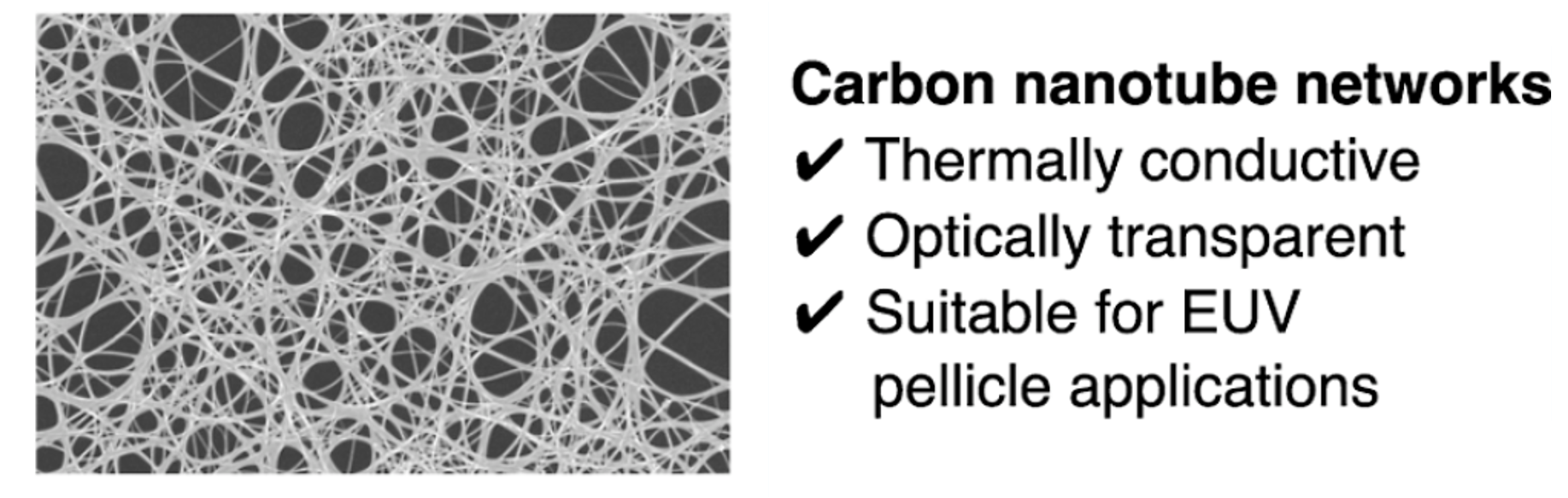
Heat dissipation and low power consumption have become key challenges for modern electronics, which must be addressed hand in hand with the development of new integration and miniaturisation technologies for electronic circuits and systems. In particular, as devices become smaller and more powerful, excess heat issues arise, which can compromise operation and durability. In this context, new materials and nanotechnologies can provide solutions for designing high-performance electronic devices that consume little power and are able to manage heat efficiently.
Carbon nanotube (CNT) networks –an emerging class of nanostructured materials that exhibit outstanding electrical and mechanical properties— are promising candidates for applications requiring efficient heat dissipation, such as extreme ultraviolet (EUV) lithography. EUV lithography is a key technology for the miniaturisation of integrated circuits that requires the use of protective films to avoid damaging photomasks during the process. Suitable materials for these shielding pellicles should be transparent to EUV light, mechanically robust, and thermally stable with high thermal conductivity.
As demonstrated in a research paper published in ACS Applied Materials & Interfaces, free-standing CNT films are strong candidates for this application, due to their high EUV transparency and ability to withstand heat. The authors of this study –a team of researchers from the ICN2 Ultrafast Dynamics in Nanoscale Systems Group (led by Prof. Klaas-Jan Tielrooij), the former ICN2 Phononic and Photonic Nanostructures Group (led by Prof. Clivia Sotomayor-Torres), and from imec (Leuven, Belgium)— employed all-optical Raman thermometry to gain insight into the thermal properties of free-standing CNT networks.
The authors investigated two types of carbon nanotube films: single-walled CNTs (SWCNTs) and double-walled CNTs (DWCNTs). The first structure consists of a network of nanotubes, whose walls are one atom thick; the second is composed of a network of nanotubes each made of two single-walled nanotubes nested within each other. By Raman thermometry –which is a non-invasive technique— the researchers were able to measure the thermal conductivity of these two types of free-standing CNT films at temperatures ranging from 300 K to 700 K.
The study revealed thermal conductivities up to 50 W m−1 K−1 for films made of double-walled CNTs, a remarkable seven times higher than those of single-walled CNT films. “We believe that this enhanced thermal conduction is due to the additional wall in double-walled carbon nanotube networks, which introduces an extra heat-dissipation channel and reduces the impact of defects,” explains Prof. Klaas-Jan Tielrooij, the coordinator of this research and corresponding author of the paper. “Furthermore, the nanotubes in the studied CNT network films were randomly oriented; we think that aligning the double-walled CNTs within the network would lead to even higher thermal conductivity.”
These outcomes show that free-standing carbon nanotube network films, in particular the double-walled one, provide efficient heat dissipation, demonstrating their suitability for application as EUV pellicle materials. In addition, they hold promise for use in flexible electronics and interconnects in integrated circuits. In fact, the relatively high thermal conductivity of these films makes them ideal for efficient thermal management in devices where traditional materials fall short when dimensions are extremely reduced.
Reference
Enhanced Thermal Conductivity of Free-Standing Double-Walled Carbon Nanotube Networks
Jake Dudley Mehew, Marina Y. Timmermans, David Saleta Reig, Stefanie Sergeant, Marianna Sledzinska, Emigdio Chávez-Ángel, Emily Gallagher, Clivia M. Sotomayor Torres, Cedric Huyghebaert, and Klaas-Jan Tielrooij
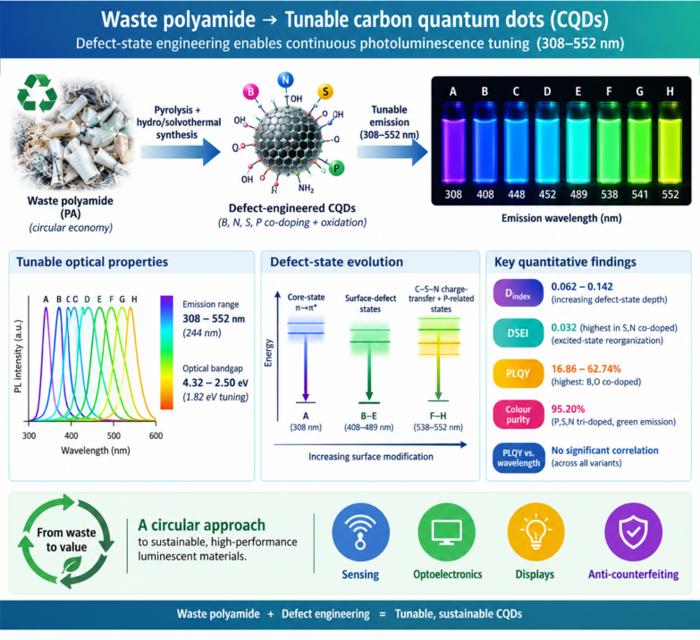
Waste polyamide-derived CQDs show continuous photoluminescence tuning from 308 to 552 nm through sequential defect-state engineering, with optical transition energies decreasing from 4.32 to 2.50 eV. @Christian Ebere Enyoh from Saitama University Carbon quantum dots (CQDs) are fluorescent carbon nanomaterials with potential applications in sensing, optoelectronics, displays, anti-counterfeiting, and environmental technologies. Their optical properties can be adjusted by modifying the carbon...
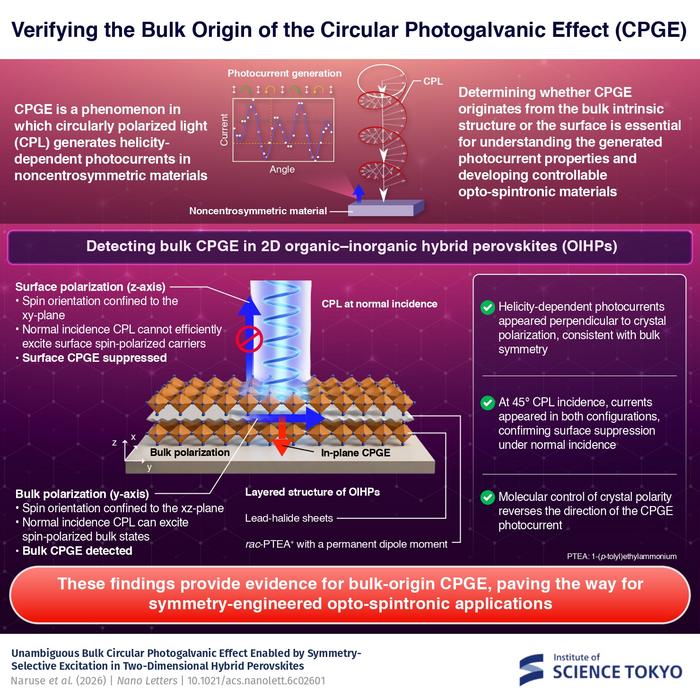
The researchers used circularly polarized light at normal incidence and found that helicity-dependent photocurrents appeared perpendicular to the crystal’s polarization but vanished when measured parallel to it, supporting a bulk origin of CPGE. @Institute of Science Tokyo The circular photogalvanic effect (CPGE), a phenomenon that generates helicity-dependent photocurrents in noncentrosymmetric materials, can originate purely from a crystal's internal structure without contribution from the...
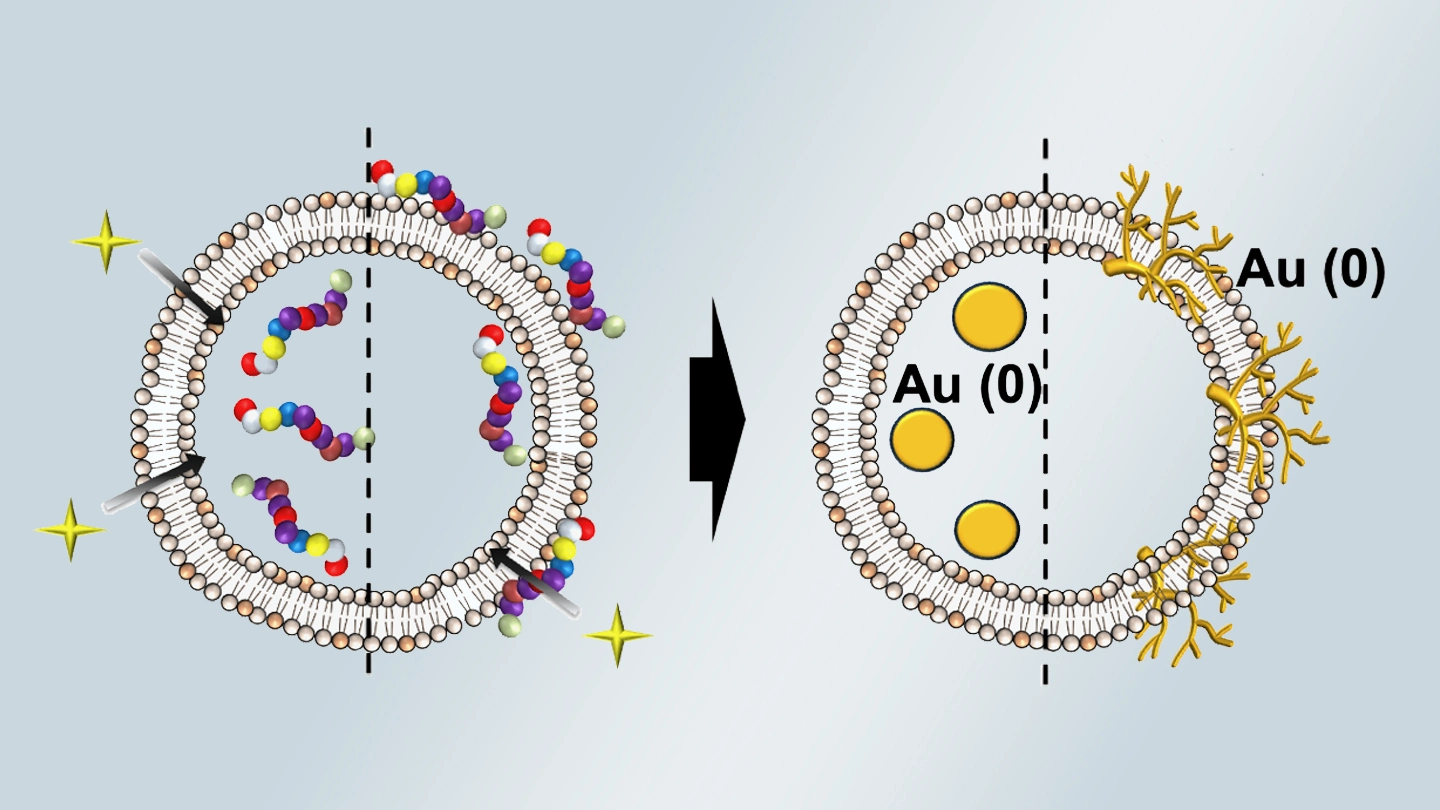
Summary of gold nanoparticle growth programming in liposome based on localization of biomineralization peptide The position of biomineralization peptides within liposomes can influence how gold nanoparticles grow, reports a research team from Institute of Science Tokyo. Peptides localized at the membrane interface promote branched structures, while those confined to the liposome interior favor spherical nanoparticles. The findings offer a new strategy for controlling nanoscale reaction...
