Purdue University
Internet searches, decade-old emails and on-demand video offerings help contribute to electricity consumption by America’s server farms and data centers amounting to more than 2 percent of the country’s annual total.
Those data centers – which operate millions of drives and hold massive amounts of digital data – use some 70 billion kilowatt hours per year of energy. One kWh is enough power to keep a smartphone charged for about a year. At an average cost of 10 cents per kWh, the annual cost of all that power is around $7 billion.
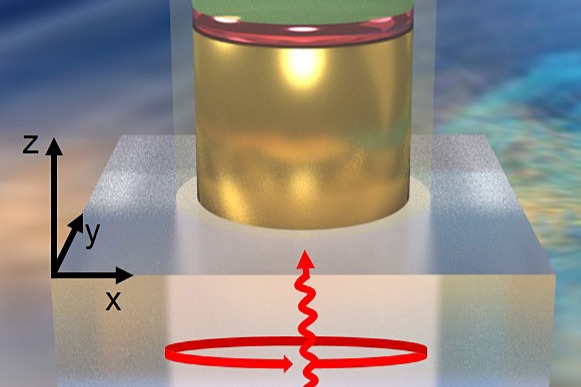
Now a method that can potentially reduce energy consumption in magnetic memory devices and improve their speeds is advancing at Purdue University. The method involves a combination of spintronic and photonic materials, where ultrashort laser pulses are employed to generate intense magnetic fields to manipulate the spin orientation of magnetic materials.
“We have brought together these two fields to derive a solution to a decades-old problem,” said Ernesto Marinero, a professor of materials engineering and electrical and computer engineering in Purdue’s College of Engineering. “We wanted to figure out faster ways of switching the magnetization in spintronic nanoscale memory devices.”
Marinero worked with Vlad Shalaev and Alexandra Boltasseva, photonics experts and professors in Purdue’s College of Engineering, to develop a new magneto-photonics effort to employ light to control magnetization processes for a variety of applications – resulting in ultra-fast switchable devices.
“We are among the first to successfully develop a method for all-optical switching of on-chip nanomagnets in high-density memory modules,” Marinero said.
This emerging technology involves collective electron waves, or plasmons, triggered when light strikes a nanoscale material such as a metal that can sustain the electron waves. These plasmons generate intense, ultra-short magnetic fields at the interface of judiciously chosen optical and magnetic materials.
By changing the properties of the incident light, the direction of the resulting magnetic field is reversed, which enables the manipulation of the magnetic orientation in the magnetic material, a critical requirement for magnetic information storage. Numerical simulations conducted by Aveek Dutta, a graduate student in engineering, predict large magnetic field enhancements driven by induced plasmon excitations.
The Purdue team’s method involves using the power of optics, through features called localized surface plasmon resonances, to couple light to nanomagnets and produce faster spintronic devices switching speeds and potential lower energy consumption. The light enables switching of the magnetization orientation, the key principle behind encoding information digitally in magnetic storage devices.
“We believe that our method could ultimately lead to memory writing speeds that are 1,000 times faster than current ones,” Marinero said. “One of our key areas for success is continuing to develop materials that interact with the magnets in an efficient way.”
Surface-plasmon opto-magnetic field enhancement for all-optical magnetization switching
Aveek Dutta, Alexander V. Kildishev, Vladimir M. Shalaev, Alexandra Boltasseva, and Ernesto E. Marinero
Optical Materials Express 7(12)
DOI: 10.1364/OME.7.004316
Contact information:
Ernesto E. Marinero
Professor of Materials Engineering and Electrical & Computer Engineering at Purdue University
eemarinero@purdue.edu
Vladimir M. Shalaev
Professor of Electrical and Computer Engineering at Purdue University
shalaev@ecn.purdue.edu
Lab: Shalaev Lab
Alexandra Boltasseva
Professor of Electrical and Computer Engineering at Purdue University & Adjunct Associate Professor at DTU Fotonik, Department of Photonics Engineering, Technical University of Denmark
aeb@purdue.edu
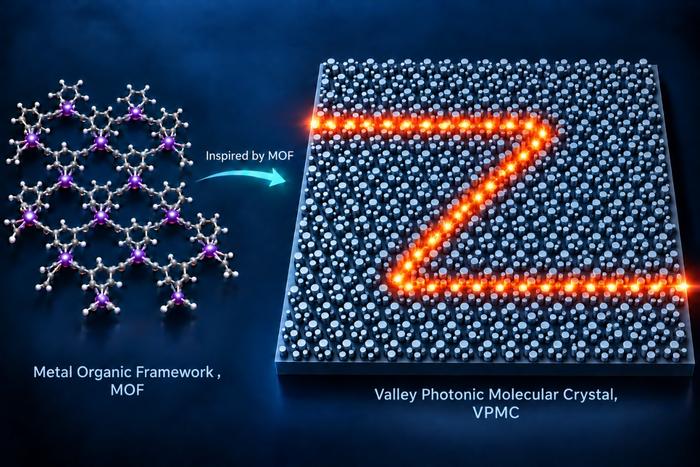
Inspired by Metal-Organic Framework based topological insulators, researchers at Tsinghua University proposed valley photonic molecular crystal (VPMC) and investigated the impact of molecular rotation on the valley-topological properties of VPMC. Credit: Tsinghua University/Xue Feng A research team led by Yidong Huang at Tsinghua University, including Xue Feng and Yongzhuo Li, has developed valley photonic molecular crystals (VPMCs) on a silicon platform. Combining theoretical modeling,...
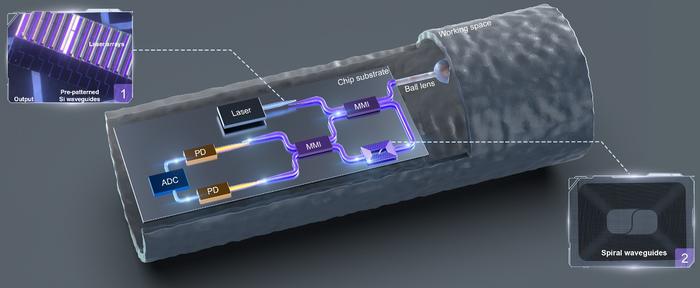
The system integrates a III-V semiconductor light source, SiN-based interferometers, Si-Ge photodetectors (PDs), and an integrated ball-lens microprobe, thereby combining the distinct advantages of multiple photonic integration platforms. The insets illustrate complementary technologies that can be incorporated to realize a miniaturized, fully integrated OCT system. Abbreviations: ADC, analog-to-digital converter. Inset 1: Foundry-scalable embedded III-V lasers on silicon-on-insulator (SOI)...

From left to right: Three photons with different quantum states enter an interferometer with three beam splitters. At each beam splitter, they can take different paths at the same time in superposition. The researchers then measured how often the three photons ended up together at the same output. Counterintuitively, it is possible to make the photons more similar to each other and at the same make them less likely to “bunch” together. AI-generated illustration, by Leonardo Novo. We usually...
