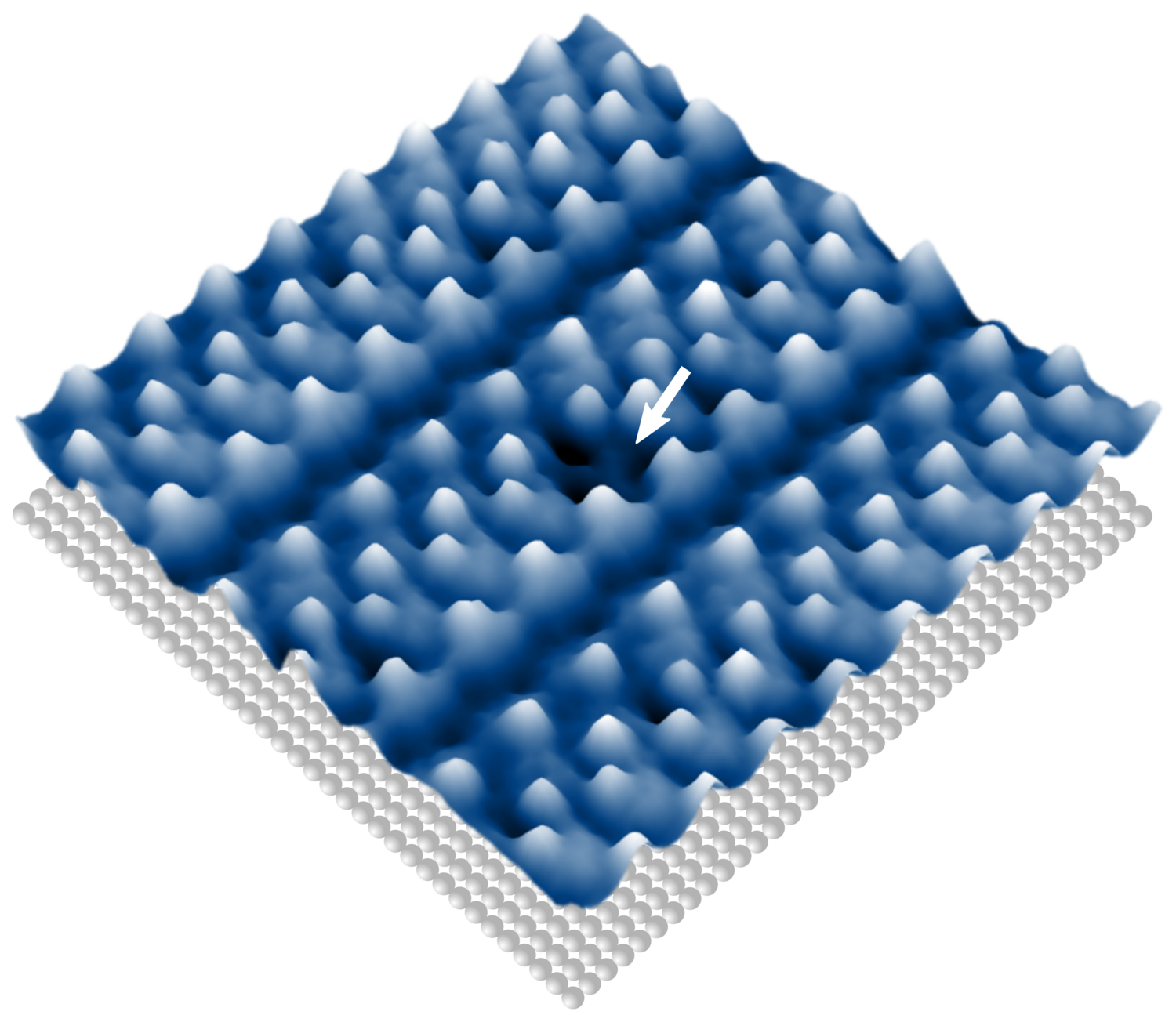
Researchers around the world are working to develop efficient materials to convert CO2 into usable chemical substances – work that is particularly pressing in view of global warming. A team from the University of Göttingen, Germany, and the Ulsan National Institute for Science, South Korea, has discovered a new and promising approach: catalytically active molecules are nanoconfined – meaning they are put into an environment that leaves very little space for the single molecules – on a surface that serves as a conductive electron supplier. These molecules promote specific chemical reactions. Such hybrid systems make use of both the properties of the molecules and the properties of the substrate. The results were published in Science Advances.
The first step for the team was to deposit the catalytically active molecules as a vapour onto polished silver before examining them with a high-resolution scanning tunneling microscope built in Göttingen. "To our absolute astonishment, the molecules arrange themselves, as if by magic, into almost perfect single-layer structures on the surface," says Lucas Paul, PhD student, University of Göttingen, and co-author of the study.
"In addition to imaging individual molecules, the energy of the injected electrons can be adjusted so precisely in the scanning tunneling microscope that chemical reactions can be induced and observed in a single molecule," explains physicist Professor Martin Wenderoth. Wenderoth led the project together with chemist Professor Inke Siewert, at the University of Göttingen’s Collaborative Research Centre 1073 ‘Atomic Scale Control of Energy Conversion’. Siewert adds, "We are able to very precisely break individual chemical bonds."
The researchers show that molecules that are particularly densely packed on the surface have altered chemical properties. Thus, exclusively for the "trapped" molecules the bond can be broken and subsequently also restored, since the separated part of the molecule can only move very slightly away from the rest of the molecule. "This shows how a lack of space, at an atomic level, can be used to manipulate chemical reactions," says first author Ole Bunjes, University of Göttingen.
The research team wants their experiments to contribute to the development of efficient molecular surface systems with precisely determined properties. In addition, they want to investigate whether their new system is suitable as a molecular data memory.
Reference
Making and breaking of chemical bonds in single nanoconfined molecules
Ole Bunjes, Daniel Hedman, Alexandra Rittmeier, Lucas A. Paul, Inke Siewert, Feng Ding, Martin Wenderoth
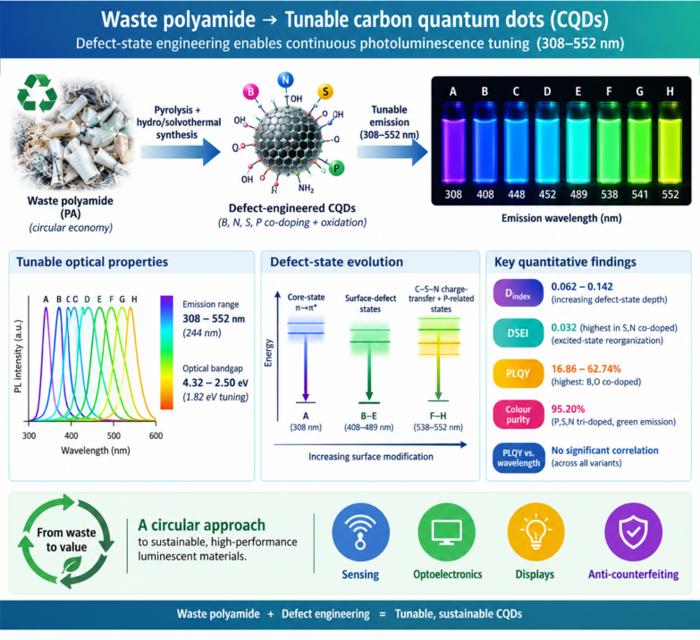
Waste polyamide-derived CQDs show continuous photoluminescence tuning from 308 to 552 nm through sequential defect-state engineering, with optical transition energies decreasing from 4.32 to 2.50 eV. @Christian Ebere Enyoh from Saitama University Carbon quantum dots (CQDs) are fluorescent carbon nanomaterials with potential applications in sensing, optoelectronics, displays, anti-counterfeiting, and environmental technologies. Their optical properties can be adjusted by modifying the carbon...
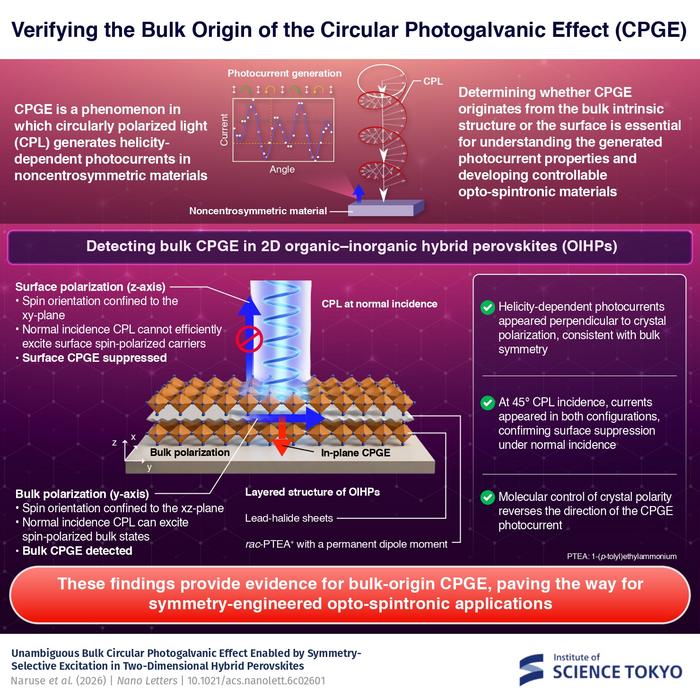
The researchers used circularly polarized light at normal incidence and found that helicity-dependent photocurrents appeared perpendicular to the crystal’s polarization but vanished when measured parallel to it, supporting a bulk origin of CPGE. @Institute of Science Tokyo The circular photogalvanic effect (CPGE), a phenomenon that generates helicity-dependent photocurrents in noncentrosymmetric materials, can originate purely from a crystal's internal structure without contribution from the...
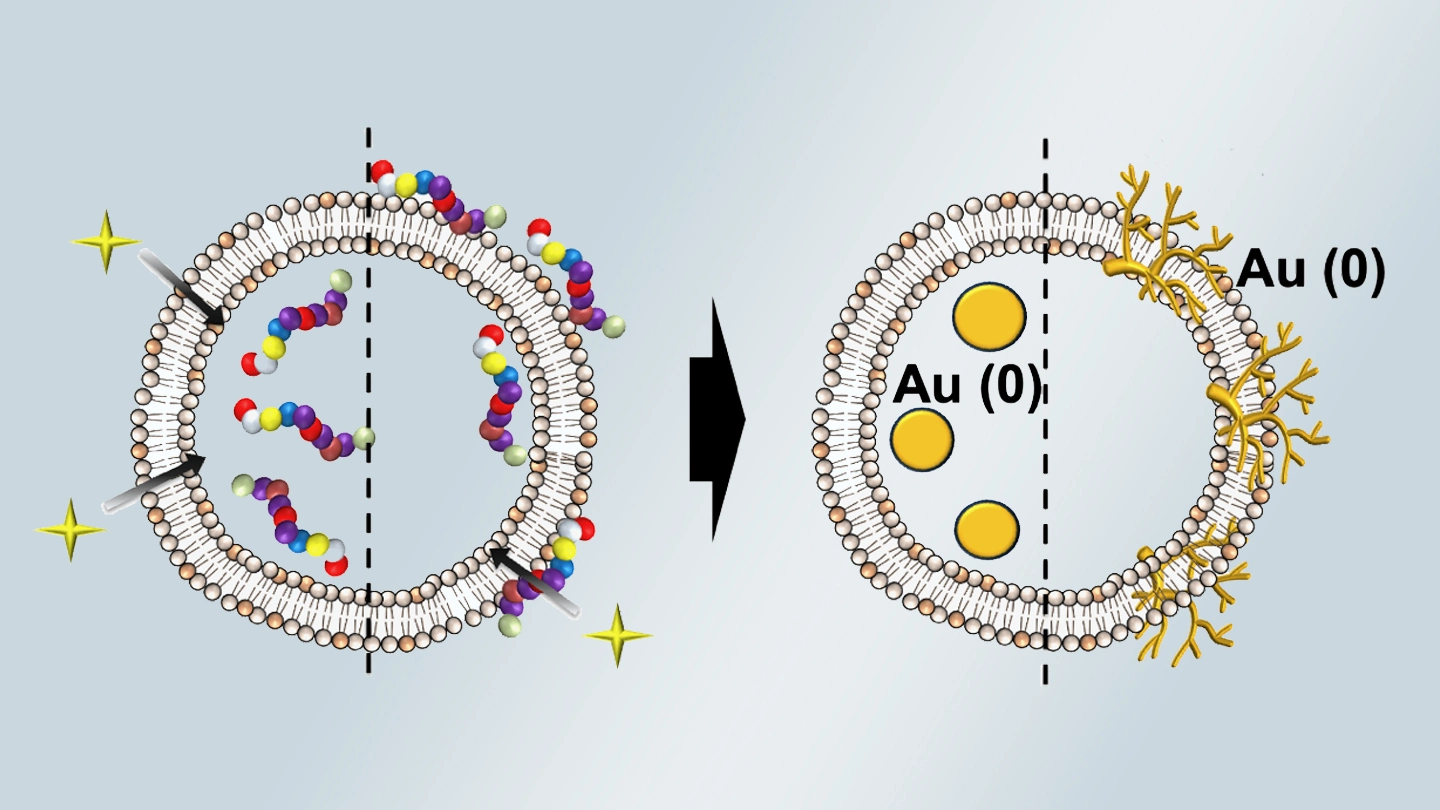
Summary of gold nanoparticle growth programming in liposome based on localization of biomineralization peptide The position of biomineralization peptides within liposomes can influence how gold nanoparticles grow, reports a research team from Institute of Science Tokyo. Peptides localized at the membrane interface promote branched structures, while those confined to the liposome interior favor spherical nanoparticles. The findings offer a new strategy for controlling nanoscale reaction...