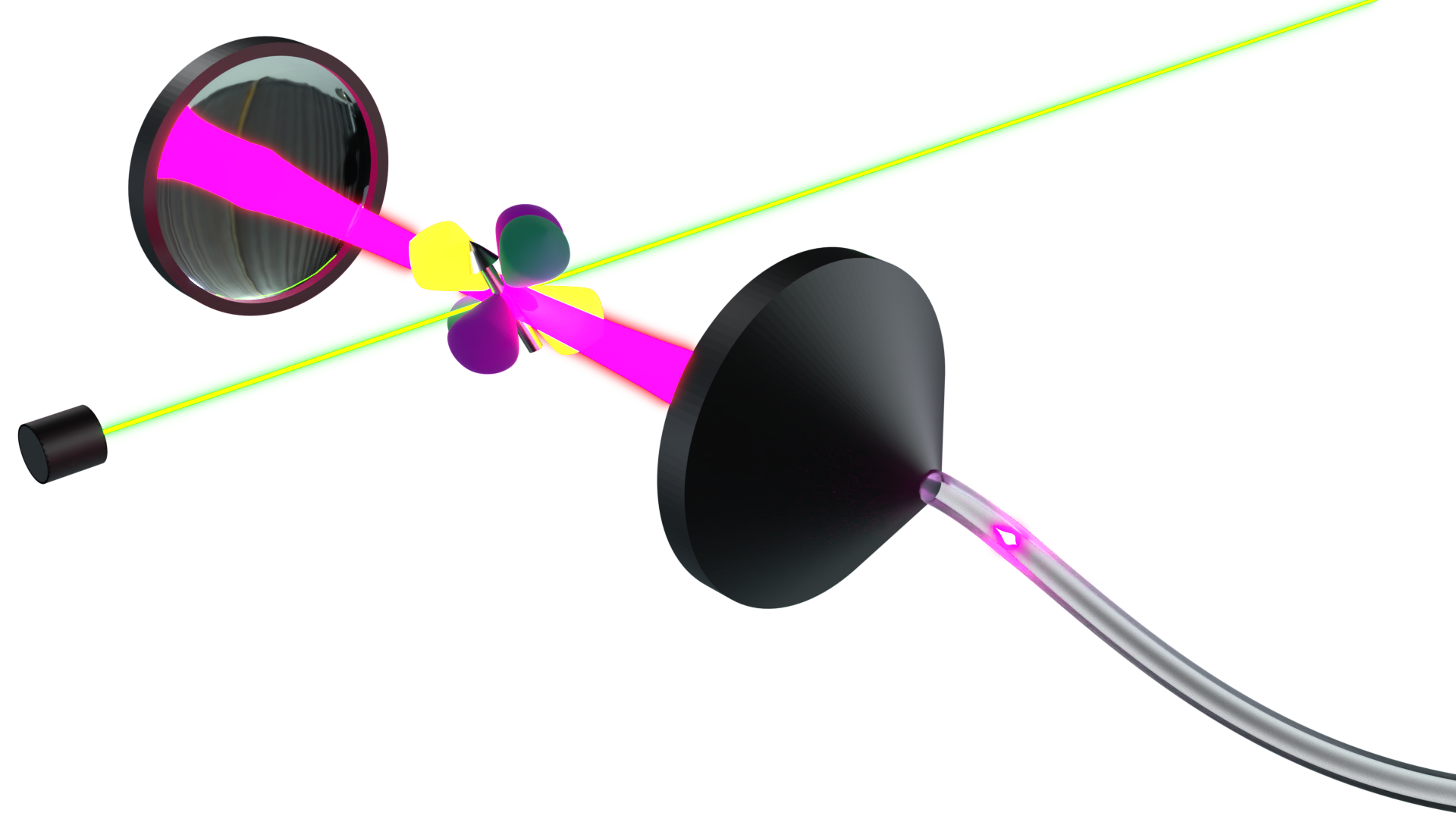
Two physicists at the University of Konstanz are developing a method that could enable the stable exchange of information in quantum computers. In the leading role: photons that make quantum bits "fly".
Quantum computers are considered the next big evolutionary step in information technology. They are expected to solve computing problems that today's computers simply cannot solve – or would take ages to do so. Research groups around the world are working on making the quantum computer a reality. This is anything but easy, because the basic components of such a computer, the quantum bits or qubits, are extremely fragile. One type of qubits consists of the intrinsic angular momentum (spin) of a single electron, i.e. they are at the scale of an atom. It is hard enough to keep such a fragile system intact. It is even more difficult to interconnect two or more of these qubits. So how can a stable exchange of information between qubits be achieved?
Flying qubits
The two Konstanz physicists Benedikt Tissot and Guido Burkard have now developed a theoretical model of how the information exchange between qubits could succeed by using photons as a "means of transport" for quantum information. The general idea: The information content (electron spin state) of the material qubit is converted into a "flying qubit", namely a photon. Photons are "light quanta” that constitute the basic building blocks making up the electromagnetic radiation field. The special feature of the new model: stimulated Raman emissions are used for converting the qubit into a photon. This procedure allows more control over the photons. "We are proposing a paradigm shift from optimizing the control during the generation of the photon to directly optimizing the temporal shape of the light pulse in the flying qubit," explains Guido Burkard.
Benedikt Tissot compares the basic procedure with the Internet: "In a classic computer, we have our bits, which are encoded on a chip in the form of electrons. If we want to send information over long distances, the information content of the bits is converted into a light signal that is transmitted through optical fibers". The principle of information exchange between qubits in a quantum computer is very similar: "Here, too, we have to convert the information into states that can be easily transmitted – and photons are ideal for this", explains Tissot.
A three-level system for controlling the photon
"We need to consider several aspects", says Tissot: "We want to control the direction in which the information flows – as well as when, how quickly and where it flows to. That's why we need a system that allows for a high level of control". The researchers’ method makes this control possible by means of resonator-enhanced, stimulated Raman emissions. Behind this term is a three-level system, which leads to a multi-stage procedure. These stages offer the physicists control over the photon that is created. "We have 'more buttons' here that we can operate to control the photon", Tissot illustrates.
Stimulated Raman emission are an established method in physics. However, using them to send qubit states directly is unusual. The new method might make it possible to balance the consequences of environmental perturbations and unwanted side effects of rapid changes in the temporal shape of the light pulse, so that information transport can be implemented more accurately. The detailed procedure was published in the journal Physical Review Research in February 2024.
Reference
Efficient high-fidelity flying qubit shaping
Benedikt Tissot and Guido Burkard
https://journals.aps.org/prresearch/abstract/10.1103/PhysRevResearch.6.013150
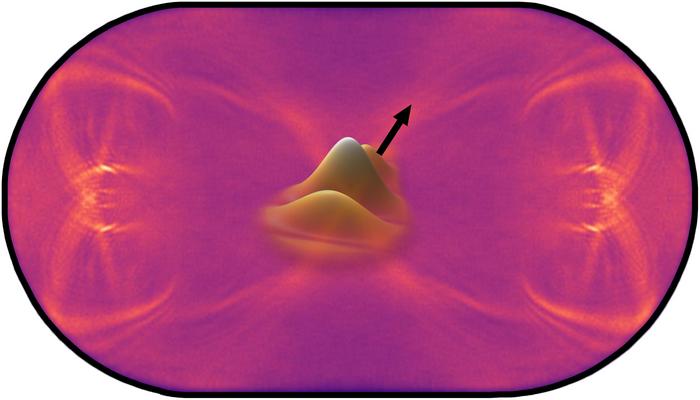
A quantum "wave packet" (in the middle) launched from the same kind of starting point behaves differently. Even after bouncing around for a very long time, faint filament-like patterns (bright glow) are still visible, a tattoo tracing back to its early history. This lingering imprint is the "quantum birthmark" described in the study. Credit: Joonas Keski-Rahkonen, Tampere University Even the most chaotic quantum systems keep a permanent mark of their own past – a "quantum birthmark" – that...
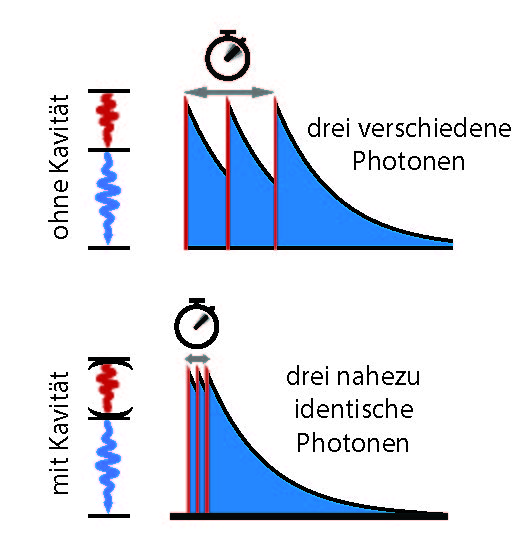
Illustration (University of Basel, Timon Baltisberger): Biexziton decay can generate photons of very high quality if the system is specifically controlled using an optical cavity. Under these conditions, 90 per cent of the photons are indistinguishable. Working in close collaboration, researchers from Paderborn University, the University of Basel and Ruhr University Bochum have made a significant breakthrough in the field of quantum communication. In their recently published paper in the...
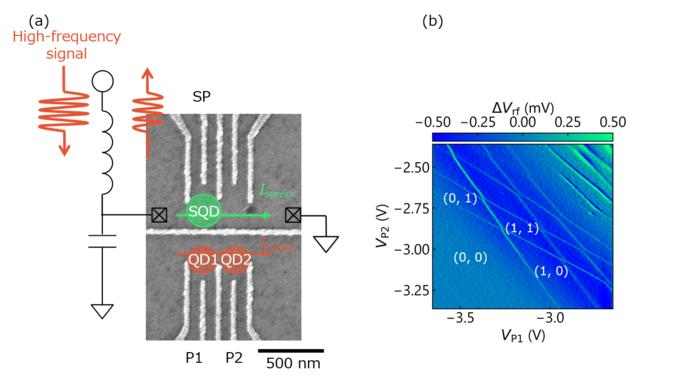
(a) The structure of the gate electrodes on the ZnO device used in the experiment in this paper. (b) The charge stability diagram indicating the formation of ZnO double quantum dot in few-electron regime. Researchers at Tohoku University, in collaboration with the National Institute for Materials Science (NIMS) and the University of Tokyo, have taken an important step toward semiconductor quantum computing using zinc oxide (ZnO). The team successfully demonstrated charge sensing,...
