Pohang University of Science and Technology (POSTECH)
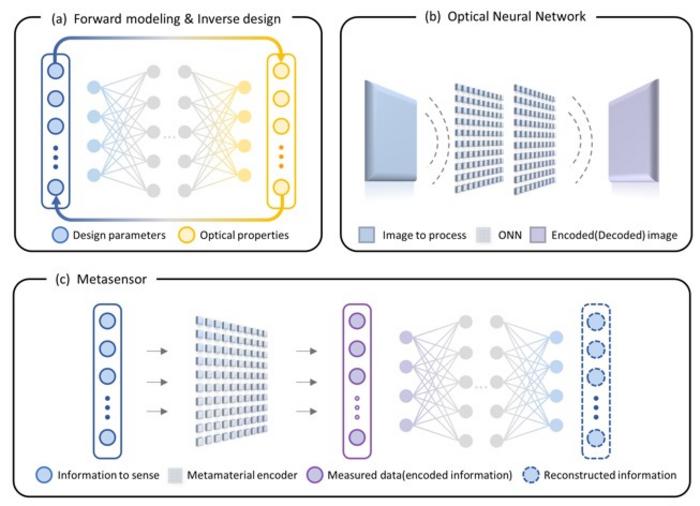
A research team, comprising Professor Junsuk Rho from the Department of Mechanical Engineering, the Department of Chemical Engineering, and the Department of Electrical Engineering, and PhD candidates Seokho Lee and Cherry Park from the Department of Mechanical Engineering at Pohang University of Science and Technology (POSTECH), has recently published a paper that highlights the next generation of research trends that combine metaphotonics research with artificial intelligence. The paper has been published in the international journal, Current Opinion in Solid State and Materials Science.
Metalenses have sparked a revolution in optics, drastically slimming down conventional lens thickness to one/10,000th while maintaining control over light properties. Notably, the academic community has begun harnessing AI as a mapping tool to discern relationships between input and output data. In their paper, the research team outlines three key trends emerging from AI-fueled metaphotonics research.
Previous research involving simulations to develop metamaterial-based devices were time-consuming endeavors. However, with the application of AI technology, researchers have achieved rapid predictions of optical properties based on input data, significantly saving time and energy. By inputting data regarding optical properties into AI systems, researchers can now design optical devices with desired properties.
In the realm of optical neural networks, a burgeoning field of optical computer technology is emerging, aiming to enable AI at the speed of light by using metamaterials to convert information into light. The research team, in particular, offers a fresh perspective on the synergy between AI and future metaphotonics research by classifying optical neural networks into encoders, responsible for compressing and abstracting information, and decoders, tasked with interpreting information.
The team also highlighted metasensors based on metamaterials as a next-generation research trend. Metasensors, devices that encode measured data into light and concurrently amplify it, enable remarkably precise and swift data analysis when integrated with AI. These metasensors hold promise across various domains including diagnosis and treatment of patients, environmental monitoring, security, and beyond, facilitating the highly detailed detection and analysis of data.
Professor Junsuk Rho expressed the team's expectation by stating, "This paper presents the trajectory of metaphotonics research, encompassing past, present, and future endeavors, spanning from recent research to challenges and forthcoming trends.” He added, “We anticipate further creative and innovative research that capitalizes on the intrinsic attributes of AI and metamaterials."
Reference
Mapping information and light: Trends of AI-enabled metaphotonics
Seokho Lee, Cherry Park, Junsuk Rho
https://www.sciencedirect.com/science/article/abs/pii/S135902862400010X?via%3Dihub
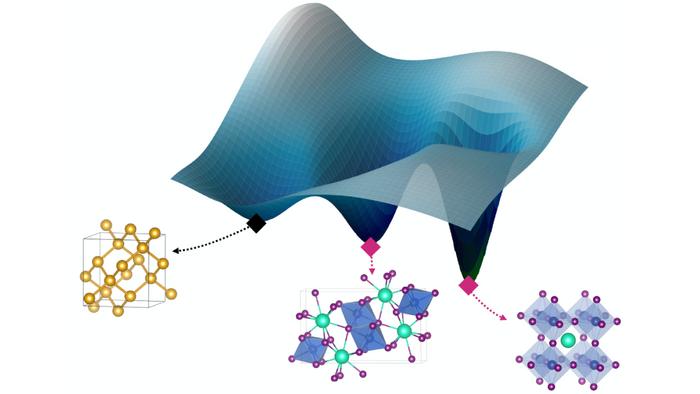
Michele Simoncelli’s group introduces a new benchmark to evaluate how well machine learning models for atomic interactions translate quantum characteristics into macroscopic physical properties
Artificial intelligence is transforming the way we work and live, but training AI models requires enormous amounts of computing power and energy. Finding new ways to make AI faster and more energy efficient is becoming one of the biggest challenges in the field. Researchers from the R. Ferreira group at INL have developed a new type of spintronic hardware that allows artificial intelligence to potentially learn directly on the chip, making the learning process more efficient. The new...

The intricate dance of atoms fusing and releasing energy has fascinated scientists for decades. Now, human ingenuity and artificial...
