University of California San Diego
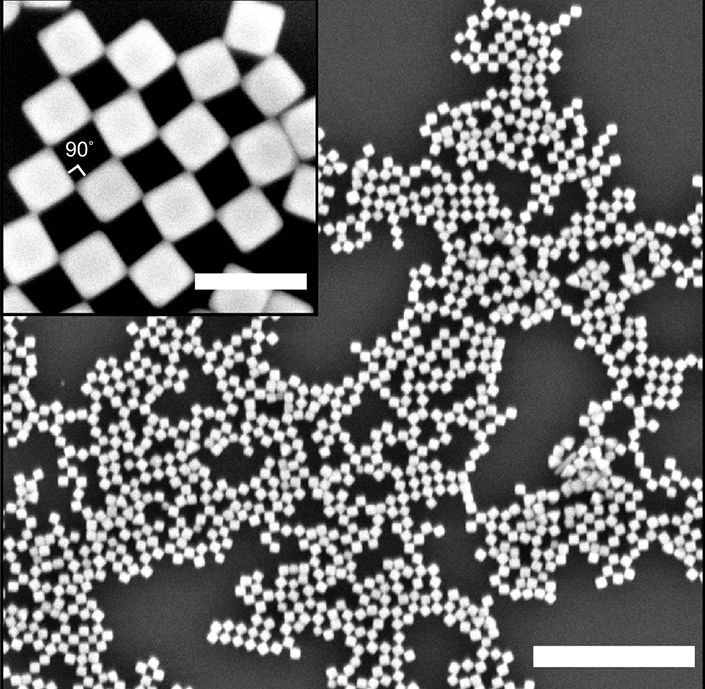
Researchers have engineered nanosized cubes that spontaneously form a two-dimensional checkerboard pattern when dropped on the surface of water. The work, published in Nature Communications, presents a simple approach to create complex nanostructures through a technique called self-assembly.
“It’s a cool way to get materials to build themselves,” said study co-senior author Andrea Tao, a professor in the Aiiso Yufeng Li Family Department of Chemical and Nano Engineering at the University of California San Diego. “You don’t have to go into a nanofabrication lab and do all these complex and precise manipulations.”
Each nanocube is composed of a silver crystal with a mixture of hydrophobic (oily) and hydrophilic (water-loving) molecules attached to the surface. When a suspension of these nanocubes is introduced to a water surface, they arrange themselves such that they touch at their corner edges. This arrangement creates an alternating pattern of solid cubes and empty spaces, resulting in a checkerboard pattern.
The self-assembly process is driven by the surface chemistry of the nanocubes. A high density of hydrophobic molecules on the surface brings the cubes together to minimize their interaction with water. Meanwhile, the long chains of hydrophilic molecules cause enough repulsion to create voids between the cubes, creating the checkerboard pattern.
To fabricate the structure, researchers applied drops of the nanocube suspension onto a petri dish containing water. The resulting checkerboard can be easily transferred to a substrate by dipping the substrate into the water and slowly withdrawing it, allowing the nanostructure to coat it.
This study stems from a collaborative effort between multiple research groups that are part of the UC San Diego Materials Research Science and Engineering Center (MRSEC). The work featured a synergistic combination of computational and experimental techniques. “We’ve built a continuous feedback loop between our computations and experiments,” said Tao. “We used computer simulations to help us design the materials at the nanoscale and predict how they will behave. We also used our experimental results in the lab to validate the simulations, fine tune them and build a better model.”
In designing the material, researchers chose silver crystal nanocubes due to the Tao lab’s expertise in their synthesis. Determining the optimal surface chemistry required extensive computational experimentation, which was led by Gaurav Arya, a professor in the Department of Mechanical Engineering and Materials Science at Duke University and co-senior author of the study. The simulations identified the best molecules to attach to the nanocubes and predicted how the cubes would interact and assemble on the water surface. The simulations were iteratively refined using experimental data obtained by Tao’s lab. Electron microscopy performed by the lab of study co-author Alex Frañó, a professor in the Department of Physics at UC San Diego, confirmed the formation of the desired checkerboard structures.
Tao envisions applications for the nanocube checkerboard in optical sensing. “Such a nanostructure can manipulate light in interesting ways,” she explained. “The spaces between the cubes, particularly near the corner edges where the cubes connect, can act as tiny hotspots that focus or trap light. That could be useful for making new types of optical elements like nanoscale filters or waveguides.”
The researchers plan to explore the optical properties of the checkerboard in future studies.
Reference
Self-assembly of nanocrystal checkerboard patterns via non-specific interactions
Yufei Wang, Yilong Zhou, Quanpeng Yang, Rourav Basak, Yu Xie, Dong Le, Alexander D. Fuqua, Wade Shipley, Zachary Yam, Alex Frano, Gaurav Arya & Andrea R. Tao
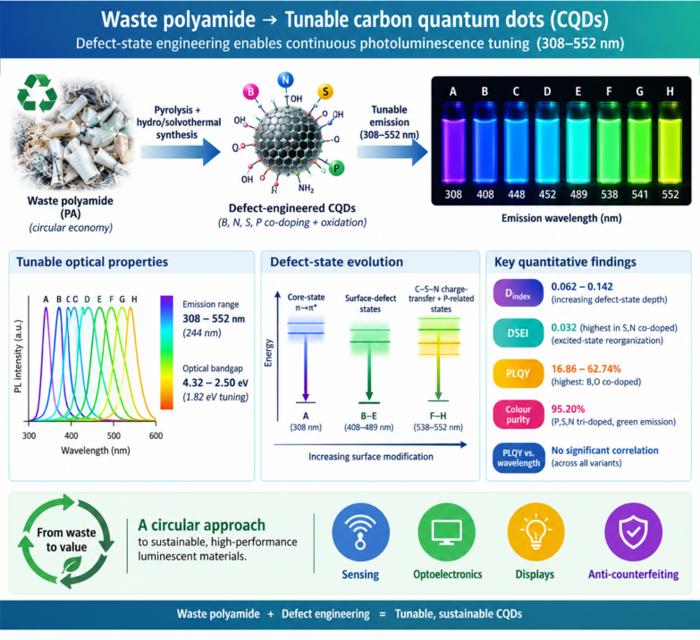
Waste polyamide-derived CQDs show continuous photoluminescence tuning from 308 to 552 nm through sequential defect-state engineering, with optical transition energies decreasing from 4.32 to 2.50 eV. @Christian Ebere Enyoh from Saitama University Carbon quantum dots (CQDs) are fluorescent carbon nanomaterials with potential applications in sensing, optoelectronics, displays, anti-counterfeiting, and environmental technologies. Their optical properties can be adjusted by modifying the carbon...
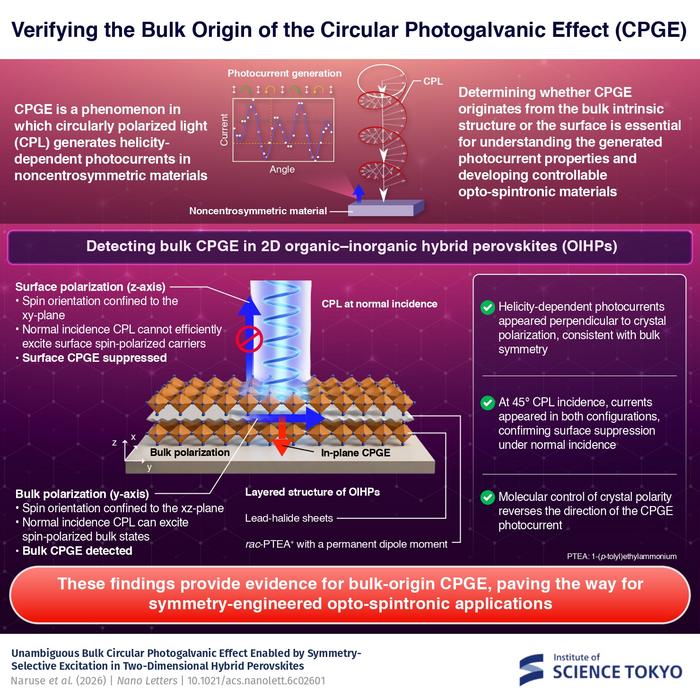
The researchers used circularly polarized light at normal incidence and found that helicity-dependent photocurrents appeared perpendicular to the crystal’s polarization but vanished when measured parallel to it, supporting a bulk origin of CPGE. @Institute of Science Tokyo The circular photogalvanic effect (CPGE), a phenomenon that generates helicity-dependent photocurrents in noncentrosymmetric materials, can originate purely from a crystal's internal structure without contribution from the...
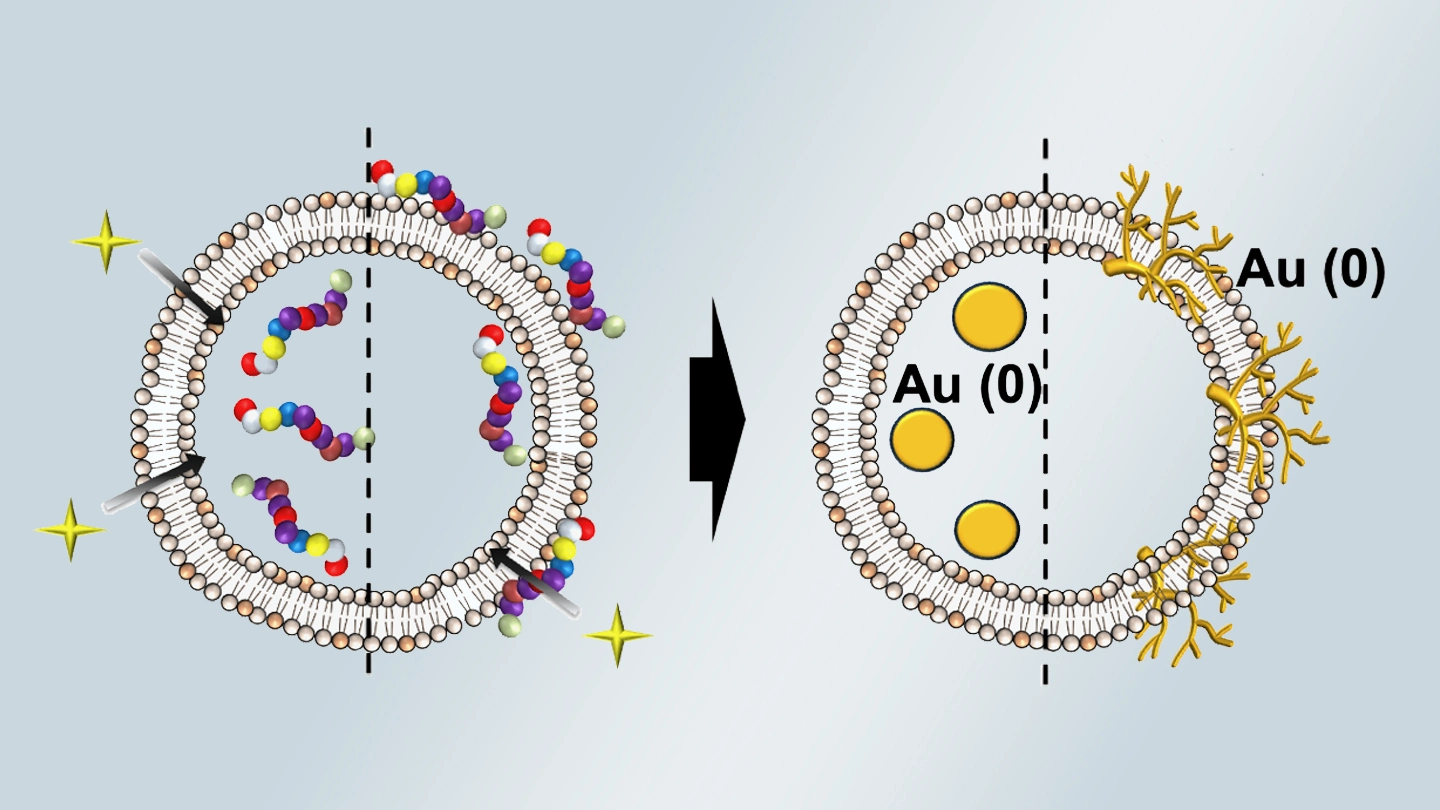
Summary of gold nanoparticle growth programming in liposome based on localization of biomineralization peptide The position of biomineralization peptides within liposomes can influence how gold nanoparticles grow, reports a research team from Institute of Science Tokyo. Peptides localized at the membrane interface promote branched structures, while those confined to the liposome interior favor spherical nanoparticles. The findings offer a new strategy for controlling nanoscale reaction...
