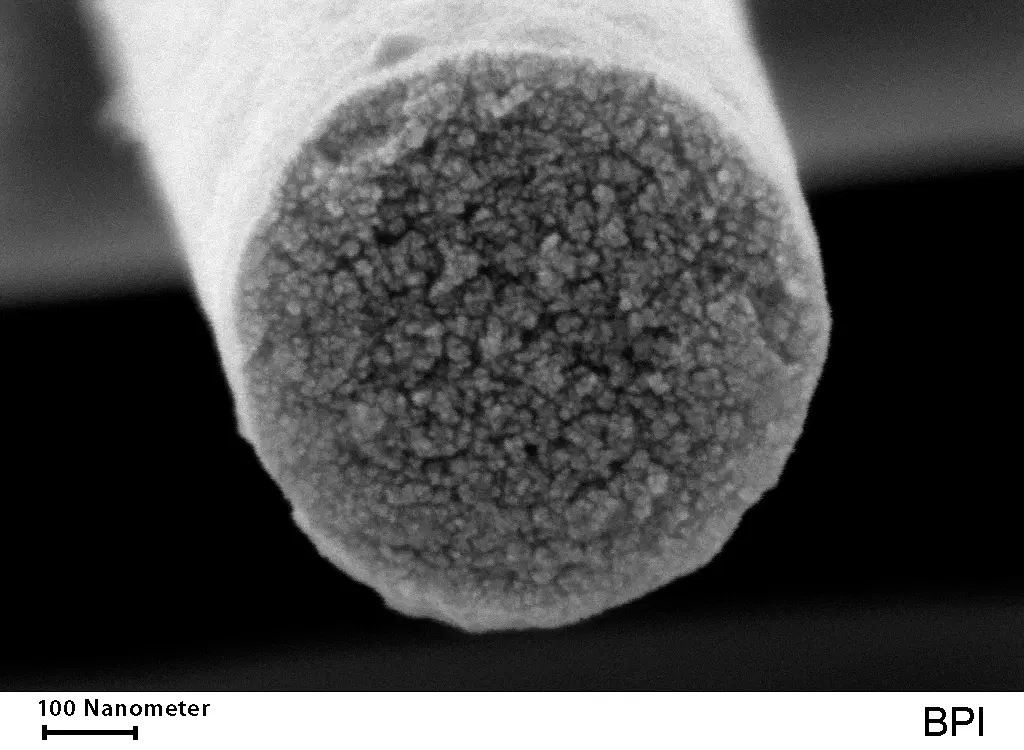
Researchers at the University of Bayreuth present novel electrospun nonwovens in "Science Advances" that exhibit an unusual combination of high electrical conductivity and extremely low thermal conductivity. The nonwovens represent a breakthrough in materials research: it has been possible to decouple electrical and thermal conductivity based on a simple-to-implement material concept. The nonwovens are made of carbon and silicon-based ceramic via electrospinning process and are attractive for technological applications, for example, in energy technology and electronics. They can be manufactured and processed cost-effectively on an industrial scale.
Normally, high electrical conductivity is associated with high thermal conductivity, and low thermal conductivity goes with low electrical conductivity. However, in many high-tech industries, there is growing interest in multifunctional materials that that combine good electric with low thermal transport. Though several strategies have been developed in the materials, like dense inorganic materials, conjugated polymers, and alloys, achieving extremely low thermal conductivity in combination with high electrical conductivity is still a major challenge for flexible, foldable materials.
The research team at the University of Bayreuth has discovered an innovative concept to address this challenge: new electrospun nonwovens are made of carbon and silicon based ceramic and consist of fibers with a sea-island type nanostructure and with a diameter between 500 and 600 nanometers. Every fiber contains a matrix of carbon in which nano-sized ceramic phases are homogeneously distributed. The particles form tiny "islands" in the "sea" of carbon matrix and have opposite, complementary effects. The carbon matrix enables the electron transport in the fibers and thus high electrical conductivity, meanwhile the nano-sized silicon-based ceramic, prevent thermal energy from spreading just as easily. This is because the interface between the nano-sized ceramic and the carbon matrix is very high, while the pores of the nonwoven are very small. As a result, there is a strong scattering of phonons, which is the smallest physical units of vibrations triggered by thermal energy. A continuous directed heat flow does not occur.
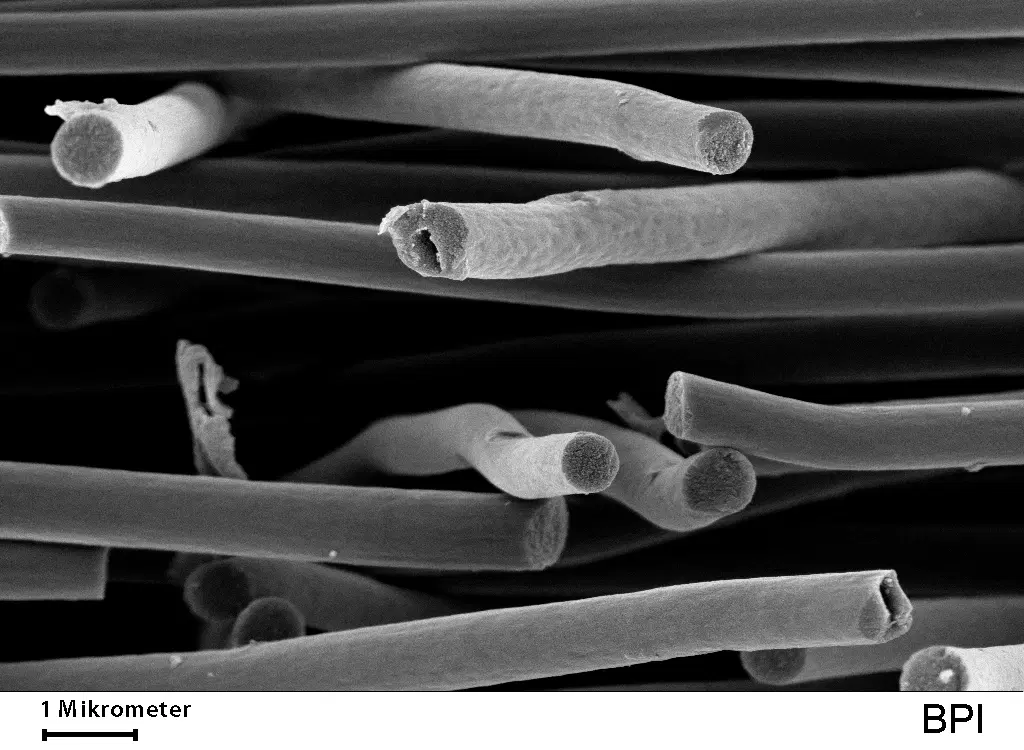
The unusual combination of high electrical and extremely low thermal conductivity now is highlighted by a comparison with more than 3,900 materials of all types, including ceramics, carbons, natural materials, synthetic polymers, metals, glasses, and various composites. Electron transport and thermal energy insulation were more coupled in the new electrospun composite fiber material than in those other materials.
"Our electrospun nonwovens combine highly attractive multifunctional properties that are usually distributed among different classes of materials: high electrical conductivity, thermal insulation familiar from polymer foams, and non-flammability and heat resistance characteristic of ceramics. The fibers are based on a simple material concept, and they were made from commercial polymers," says first author Dr. Xiaojian Liao, a postdoctoral researcher in macromolecular chemistry at the University of Bayreuth. "We are convinced that our new fibers are suited for several application areas: for example, in the fields of energy management, battery-powered electromobility, smart textiles, or aerospace," says Prof. Dr. Seema Agarwal, professor of macromolecular chemistry at the University of Bayreuth and one of the corresponding authors of this new study. The interdisciplinary team at the University of Bayreuth, with expertise in ceramics, polymers, electrospinning, physical chemistry, and electron microscopy, made this work successful.
Interdisciplinary collaboration on the Bayreuth campus
Bayreuth scientists from different research centers collaborated in the development of the new material and the necessary preliminary studies: the Bavarian Polymer Institute (BPI), the Bayreuth Center for Colloids and Interfaces (BZKG), the Bavarian Geoinstitute (BGI), and the Bavarian Center for Battery Technology (BayBatt).
Reference
Extremely low thermal conductivity and high electrical conductivity of sustainable carbonceramic electrospun nonwoven materials
Xiaojian Liao, Jakob Denk, Thomas Tran, Nobuyoshi Miyajima, Lothar Benker, Sabine Rosenfeldt, Stefan Schafföner, Markus Retsch, Andreas Greiner, Günter Motz, Seema Agarwal
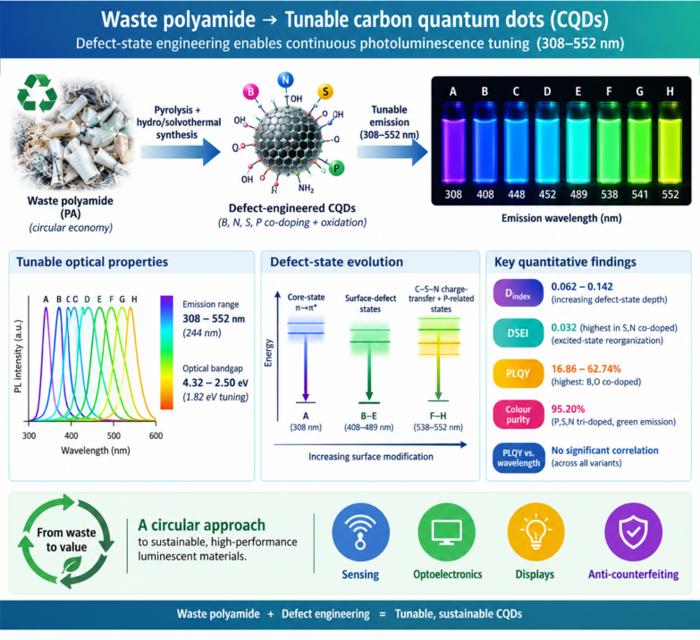
Waste polyamide-derived CQDs show continuous photoluminescence tuning from 308 to 552 nm through sequential defect-state engineering, with optical transition energies decreasing from 4.32 to 2.50 eV. @Christian Ebere Enyoh from Saitama University Carbon quantum dots (CQDs) are fluorescent carbon nanomaterials with potential applications in sensing, optoelectronics, displays, anti-counterfeiting, and environmental technologies. Their optical properties can be adjusted by modifying the carbon...
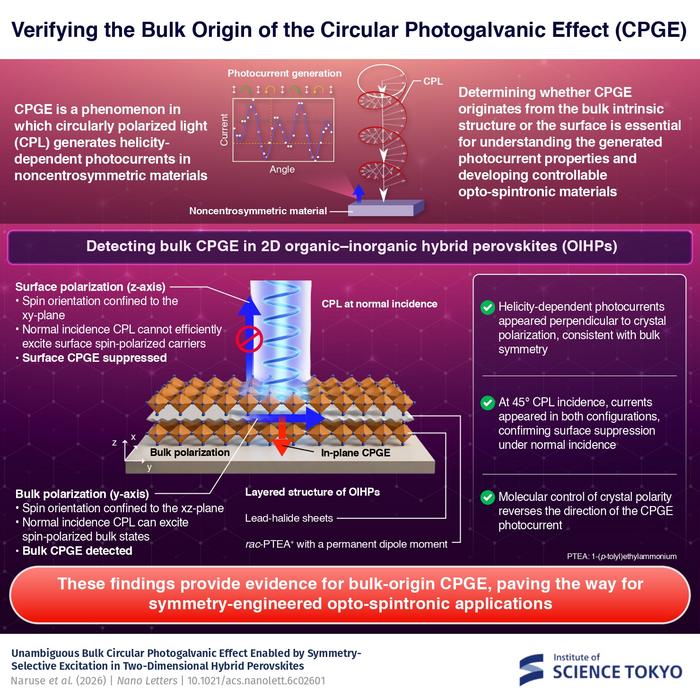
The researchers used circularly polarized light at normal incidence and found that helicity-dependent photocurrents appeared perpendicular to the crystal’s polarization but vanished when measured parallel to it, supporting a bulk origin of CPGE. @Institute of Science Tokyo The circular photogalvanic effect (CPGE), a phenomenon that generates helicity-dependent photocurrents in noncentrosymmetric materials, can originate purely from a crystal's internal structure without contribution from the...
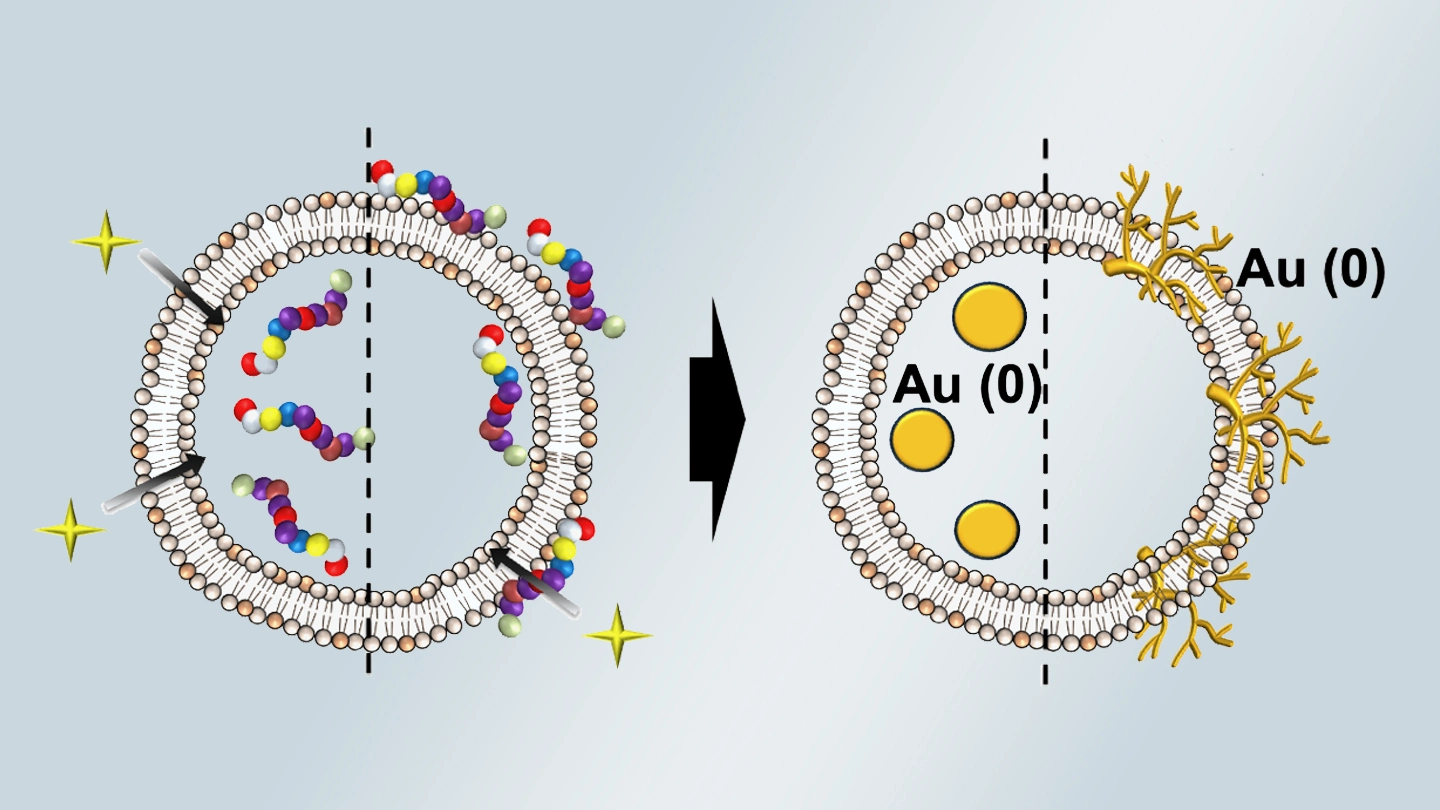
Summary of gold nanoparticle growth programming in liposome based on localization of biomineralization peptide The position of biomineralization peptides within liposomes can influence how gold nanoparticles grow, reports a research team from Institute of Science Tokyo. Peptides localized at the membrane interface promote branched structures, while those confined to the liposome interior favor spherical nanoparticles. The findings offer a new strategy for controlling nanoscale reaction...
