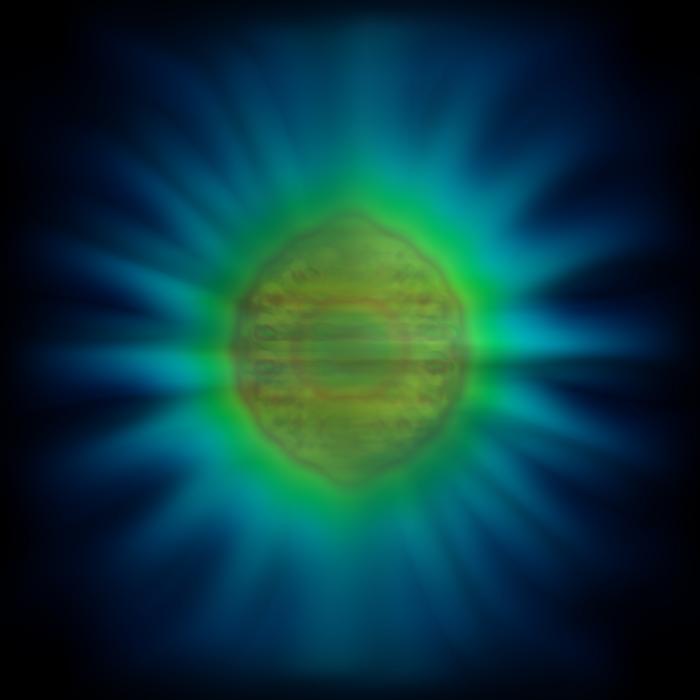
A new theory, that explains how light and matter interact at the quantum level has enabled researchers to define for the first time the precise shape of a single photon.
Research at the University of Birmingham, published in Physical Review Letters, explores the nature of photons (individual particles of light) in unprecedented detail to show how they are emitted by atoms or molecules and shaped by their environment.
The nature of this interaction leads to infinite possibilities for light to exist and propagate, or travel, through its surrounding environment. This limitless possibility, however, makes the interactions exceptionally hard to model, and is a challenge that quantum physicists have been working to address for several decades.
By grouping these possibilities into distinct sets, the Birmingham team were able to produce a model that describes not only the interactions between the photon and the emitter, but also how the energy from that interaction travels into the distant ‘far field’.
At the same time, they were able to use their calculations to produce a visualisation of the photon itself.
First author Dr Benjamin Yuen, in the University’s School of Physics, explained: “Our calculations enabled us to convert a seemingly insolvable problem into something that can be computed. And, almost as a bi-product of the model, we were able to produce this image of a photon, something that hasn’t been seen before in physics.”
The work is important because it opens up new avenues of research for quantum physicists and material science. By being able to precisely define how a photon interacts with matter and with other elements of its environment, scientists can design new nanophotonic technologies that could change the way we communicate securely, detect pathogens, or control chemical reactions at a molecular level for example.
Co-author, Professor Angela Demetriadou, also at the University of Birmingham, said: “The geometry and optical properties of the environment has profound consequences for how photons are emitted, including defining the photons shape, colour, and even how likely it is to exist.”
Dr Benjamin Yuen, added: “This work helps us to increase our understanding of the energy exchange between light and matter, and secondly to better understand how light radiates into its nearby and distant surroundings. Lots of this information had previously been thought of as just ‘noise’ - but there’s so much information within it that we can now make sense of, and make use of. By understanding this, we set the foundations to be able to engineer light-matter interactions for future applications, such as better sensors, improved photovoltaic energy cells, or quantum computing.”
Reference
Exact Quantum Electrodynamics of Radiative Photonic Environments
Ben Yuen and Angela Demetriadou
https://journals.aps.org/prl/abstract/10.1103/PhysRevLett.133.203604
University of Birmingham
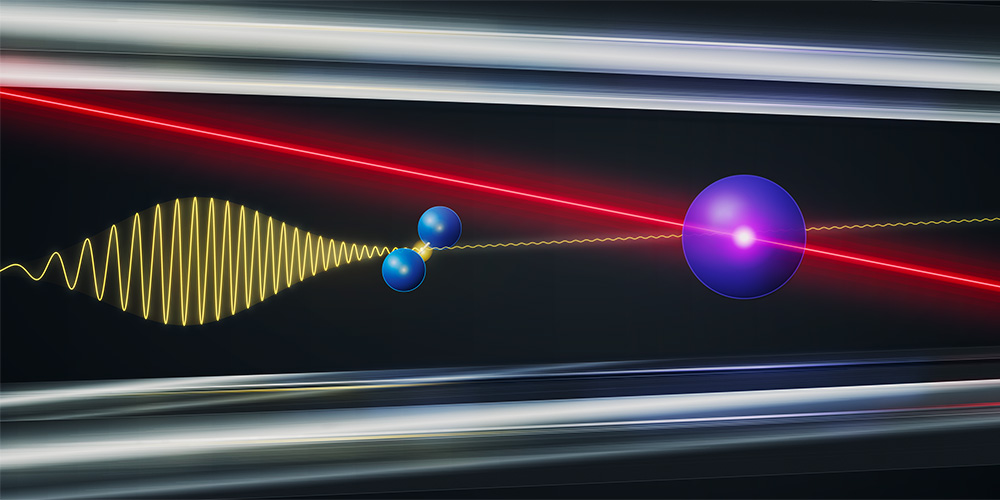
Researchers at the University of Basel have identified and coherently controlled so called forbidden vibrational transitions in individual trapped nitrogen molecular ions without destroying them. Using quantum logic spectroscopy, a single calcium ion served as messenger, letting the team probe the molecule repeatedly and determine its fundamental vibrational frequency ten times more precisely than before.
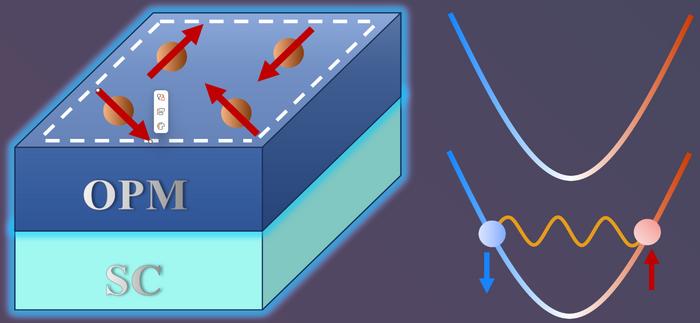
Odd-parity magnets host an intrinsic hidden Zeeman field that lifts Kramers degeneracy without any applied field, researchers report. Using an f-wave magnet model on a triangular lattice, the team shows how non-relativistic spin splitting and this hidden field combine to stabilize s-wave superconductivity far beyond the Pauli limit.
Rhombohedral hexalayer graphene, in which six carbon sheets are stacked with a slight lateral offset like staircase steps, hosts both superconductivity and electrically controllable orbital magnetism, researchers report in Nature Physics. The arrangement yields a rich collection of quantum states in a simple carbon-based material, positioning rhombohedral multilayer graphene as a platform for probing the fundamental mechanisms of superconductivity and magnetism and potentially for new ways of…
This week in nanotech
$109M raised
3 funding rounds · 18 deals tracked
New products
 Ti-WCMBN Nanomaterialia Featured
 DLS-1 Mass Spectrometer for Fusion Gas AnalysisHiden Analytical Featured
 Discover Mapping SuiteOnto Innovation
Market insights
Last 30 days: Semiconductors & Electronics drew the most money: $545M.
Money raised per month