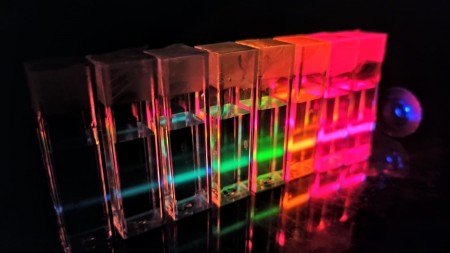
Luminescence refers to the result of a process in which an object absorbs light at one wavelength and then re-emits it at another wavelength. Through light absorption, electrons in the ground state of the material are excited to a higher energy state. After a certain amount of time characteristic of each excited state, the electrons decay to lower energy states, including the ground state, and emit light. The phenomenon is used in a wide array of technological applications involving highly efficient and reproducible emitting devices that can easily be miniaturized.
The materials with the highest luminescence efficiency include quantum dots (QDs), currently used in high-resolution displays, LEDs, solar panels, and sensors of various kinds, such as those used for precision medical imaging. Functionalization of the surface of QDs with various types of molecules permits interaction with cellular structures or other molecules of interest for the purpose of investigating molecular-level biological processes.
QDs are semiconductor nanoparticles whose emissive characteristics are directly linked to dot size, owing to the phenomenon of quantum confinement. For this reason, monitoring and control of crystal growth during synthesis of QDs in solution permits intelligent planning of the desired luminescence. In an article published in the journal Scientific Reports, researchers led by Andrea de Camargo, a professor at the University of São Paulo’s São Carlos Physics Institute (IFSC-USP) in Brazil, and collaborators at Kiel University in Germany present a novel approach to the monitoring of QD formation.
“We used cadmium telluride [CdTe] as a model system and controlled nanoparticle growth in a heated aqueous solution via in situ luminescence analysis,” says Pedro Felipe Garcia Martins da Costa, a PhD candidate at IFSC-USP and first author of the article.
The technique enables scientists to see what is happening in the solution in real time without affecting QD synthesis, so that they can monitor crystal growth by observing the color (wavelength) of the light emitted. “QDs are synthesized by mixing cadmium (Cd2+) and tellurium (Te2-) precursor solutions in the presence of a size control reagent. The temperature is raised and the chemical reaction begins via telluride and cadmium ion clustering. As the reaction proceeds, additional units of CdTe join the cluster spherically in a process known as self-assembly. Nanoparticle size can be estimated thanks to rapid and precise monitoring of the emission frequencies. QDs of CdTe with a diameter of 1-2 nanometers [nm] emit in the blue and green regions of the visible spectrum. Larger QDs, measuring 4-5 nm, emit at lower frequencies, as yellow and red respectively,” says Leonnam Gotardo Merizio, a postdoctoral researcher at IFSC-USP and second author of the article.
According to Costa, the novel method has several advantages over the conventional synthesis strategy. “In the conventional technique, you have to take small samples of the solution to measure QD size, but the in situ technique lets you do so as the process is under way, without having to interfere with the reaction medium to take samples so that more spectra can be obtained per unit of time, reaction volume isn’t affected, and unnecessary waste is avoided. The emission color of the QDs of interest can therefore be controlled far more precisely. The equipment that delivers the excitation light via optical fiber at the appropriate wavelength also collects the emitted light and determines its characteristic frequency in the RGB [red, green and blue] color system. It’s worth noting that control of the RGB system is relevant to image formation in several luminescent devices, such as monitors and smartphone displays,” he explains.
QDs synthesized in this way, he added, were also characterized by means of X-ray diffraction, transmission electron microscopy, ultraviolet-visible absorption spectroscopy, and infrared vibration spectroscopy.
The existence of QDs was predicted theoretically in 1937 by Herbert Fröhlich (1905-91), a German-born British physicist. In the 1980s, Alexey Ekimov (born 1945), in what was then the Soviet Union, and Louis Brus (born 1943), in the United States, independently observed quantum confinement in semiconductor nanoparticles for the first time. In the 1990s, French-American physicist Moungi Bawendi (born 1961) developed significantly enhanced methods of QD synthesis. In 2023, Ekimov, Brus and Bawendi were awarded the Nobel Prize for Chemistry for their work in the field.
“Quantum confinement gives QDs the capacity to confine electrons in three dimensions, making quantum phenomena more evident and characterizing them as intermediate materials between atoms, molecules and larger crystalline arrays,” Costa says.
“Many papers have been published on the synthesis of QDs made of CdTe. Our study’s main contribution relates to the development and application of a highly versatile in situ luminescence measurement system. The methodology enabled us to infer the size of the crystalline nanoparticles and to characterize the formation of intermediate compounds in the chemical reactions by in situ association with other techniques that permit chemical and/or structural analysis [FT-IR, Raman, DRX, etc]. This evolution of synthesis optimizes chemical yields and saves energy,” Camargo says.
Reference
Real-time monitoring of CdTe quantum dots growth in aqueous solution
P. F. G. M. da Costa, L. G. Merízio, N. Wolff, H. Terraschke & A. S. S. de Camargo
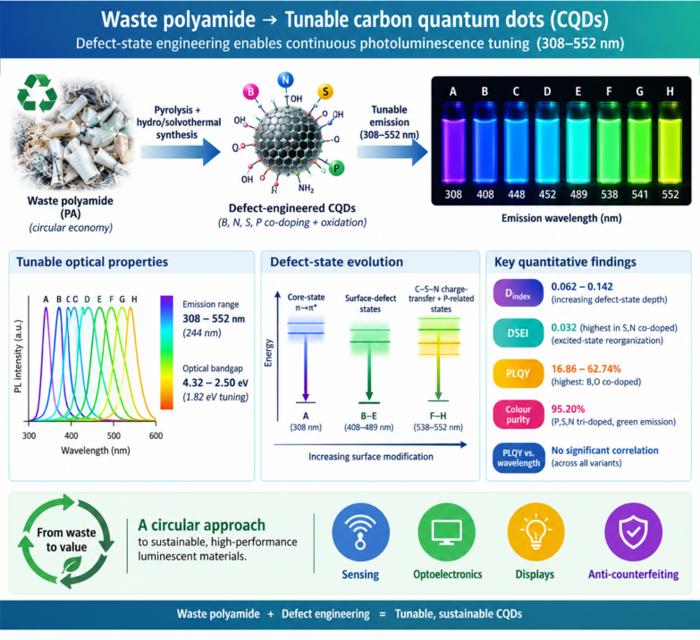
Waste polyamide-derived CQDs show continuous photoluminescence tuning from 308 to 552 nm through sequential defect-state engineering, with optical transition energies decreasing from 4.32 to 2.50 eV. @Christian Ebere Enyoh from Saitama University Carbon quantum dots (CQDs) are fluorescent carbon nanomaterials with potential applications in sensing, optoelectronics, displays, anti-counterfeiting, and environmental technologies. Their optical properties can be adjusted by modifying the carbon...
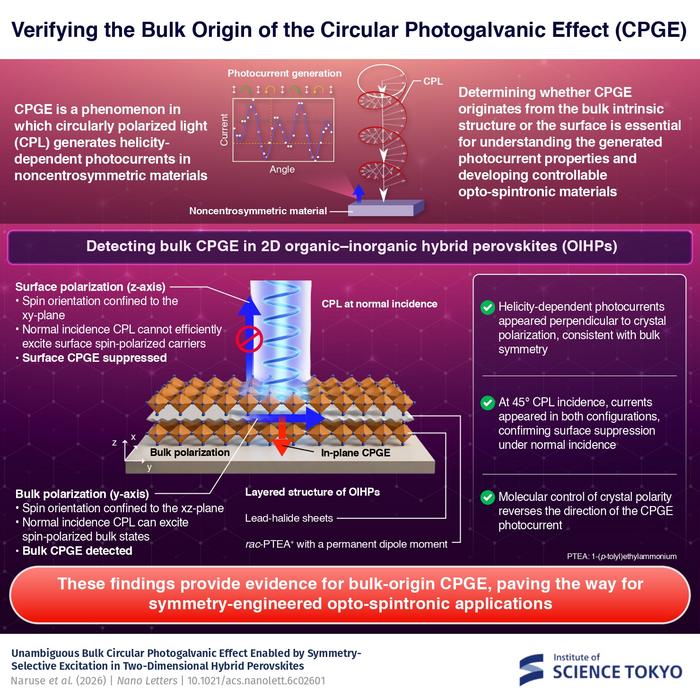
The researchers used circularly polarized light at normal incidence and found that helicity-dependent photocurrents appeared perpendicular to the crystal’s polarization but vanished when measured parallel to it, supporting a bulk origin of CPGE. @Institute of Science Tokyo The circular photogalvanic effect (CPGE), a phenomenon that generates helicity-dependent photocurrents in noncentrosymmetric materials, can originate purely from a crystal's internal structure without contribution from the...
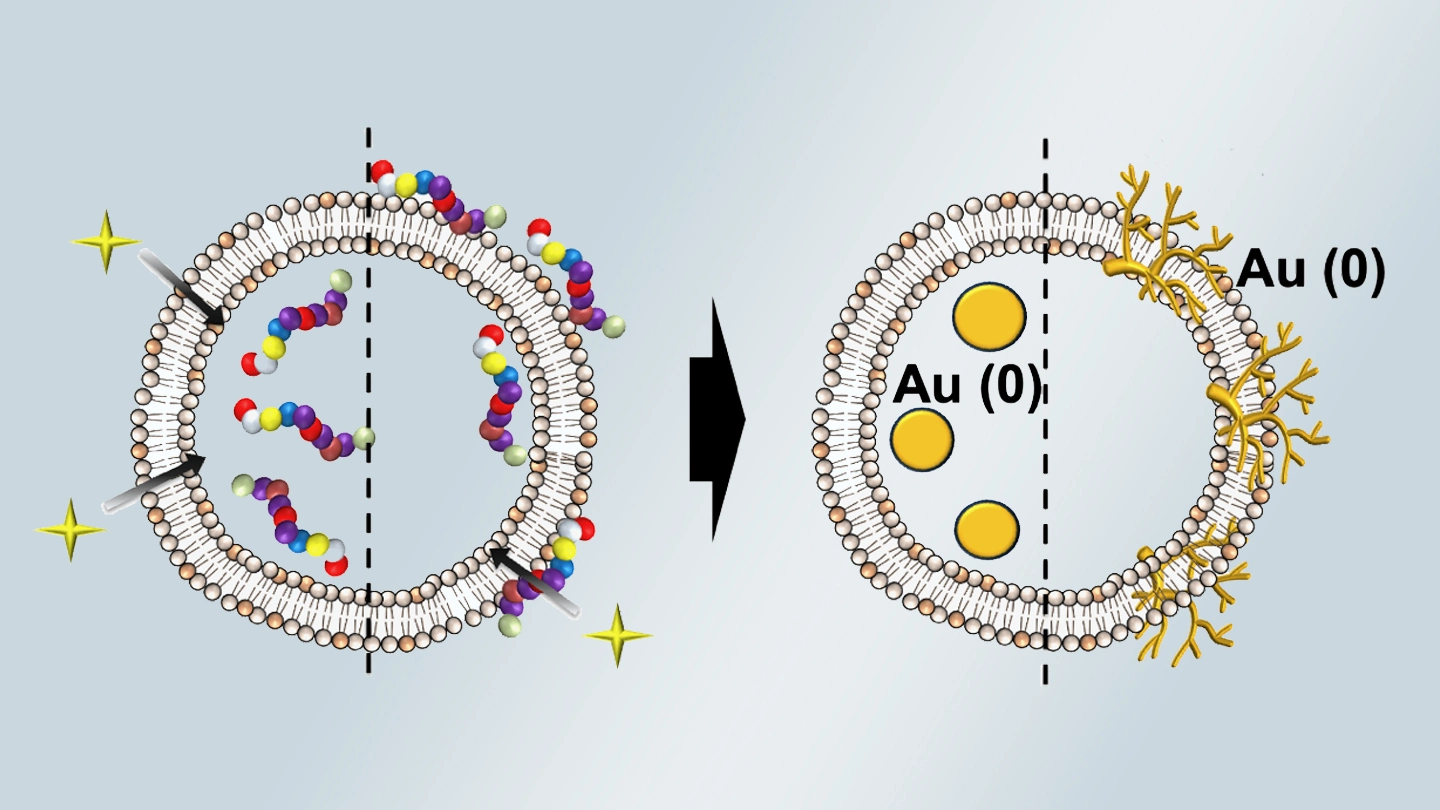
Summary of gold nanoparticle growth programming in liposome based on localization of biomineralization peptide The position of biomineralization peptides within liposomes can influence how gold nanoparticles grow, reports a research team from Institute of Science Tokyo. Peptides localized at the membrane interface promote branched structures, while those confined to the liposome interior favor spherical nanoparticles. The findings offer a new strategy for controlling nanoscale reaction...
