ARC Center of Excellence in Future Low Energy Electronics Technology (FLEET)

In a ground-breaking discovery, University of Wollongong (UOW) researchers, have reached a new milestone in soft-matter transport. The team, based at the UOW node of the ARC Center of Excellence in Future Low Energy Electronics Technology (FLEET), has successfully demonstrated the transfer of liquid metal from an anode to a cathode without short circuiting, defying expectations of conventional electronics.
Led by Distinguished Professor Xiaolin Wang, node director and theme leader of FLEET, and the Director of UOW’s Institute for Superconducting and Electronic Materials, the study published last week in Nature Chemical Engineering unveils a method where liquid-metal, specifically gallium-based room temperature liquid metal, anodes can flow towards cathodes with a small electrical current without short circuiting.
Conventionally, the contact of positively charged anodes to cathodes would result in short circuits. However, this research introduces a novel approach that allows liquid metal to flow towards the cathode without causing electrical disruptions.
The experimental implementation showed that droplets of liquid metals attached to an anode move towards the cathode due to electrochemical oxidation, creating surface tension. Despite expectations, the liquid metal does not short circuit upon approaching the cathode. Instead, it surrounds the cathode, ultimately detaching from the anode and transferring seamlessly.
According to FLEET Research Fellow Dr Yahua He, “The underlying mechanisms involve hydrogen bubbles at the cathode, an ultra-thin surface oxide layer on the liquid metal, and a screening effect, collectively preventing short circuiting and facilitating the selective detachment and transfer of liquid metal droplets.”
Professor Wang emphasises the wide-ranging implications of this research: “By reversing the polarity of electrodes, continuous back and forth transfer of liquid metal droplets can be achieved. Additionally, the controllability of transfer positions and the potential use of liquid metals in bionics open new avenues for soft robotics and device engineering.”
This ground-breaking research not only challenges conventional electrochemical principles but also offers promising prospects for the development of shape-reconfigurable conductors and actuators. The ability to avoid short-circuiting has significant implications for electrochemical engineering, particularly in convective transport of electrochemically active species and heat transfer near electrodes.
Collaborating with Professor Michael Dickey from North Carolina State University, Professor Wang’s team has consistently pushed the boundaries of understanding liquid metal physics. This latest achievement represents a significant milestone, showcasing the potential for controlled and efficient manipulation of liquid metal systems.
Reference
Liquid-metal transfer from an anode to a cathode without short circuiting
Yahua He, Jing You, Michael D. Dickey & Xiaolin Wang
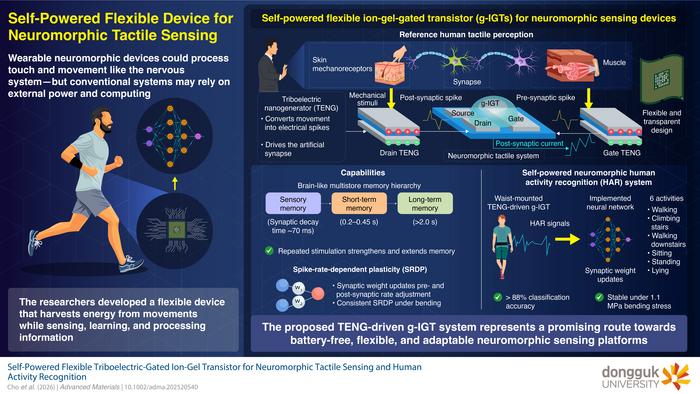
The proposed TENG-driven g-IGT is a flexible, self-powered neuromorphic device capable of reproducing multiple memory states and spike-rate-dependent learning Neuromorphic devices, which are designed to emulate aspects of biological neural networks, are promising candidates for developing low-power and intelligent sensing technologies, including wearable applications. Among the device architectures explored for neuromorphic computing, graphene-channel ion-gel-gated transistors (g-IGTs) are...
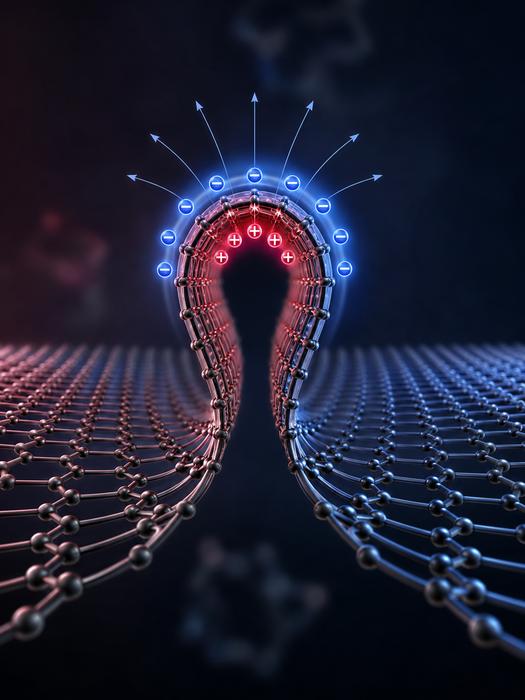
Rice University researchers have shown that sub-nanometer wrinkles in graphene generate flexoelectric charge separation, reshaping local electrical behavior through curvature alone. Extreme bending produces polarization far stronger than in larger systems and may enable geometry-controlled electronics without chemical doping. Published in Advanced Materials.
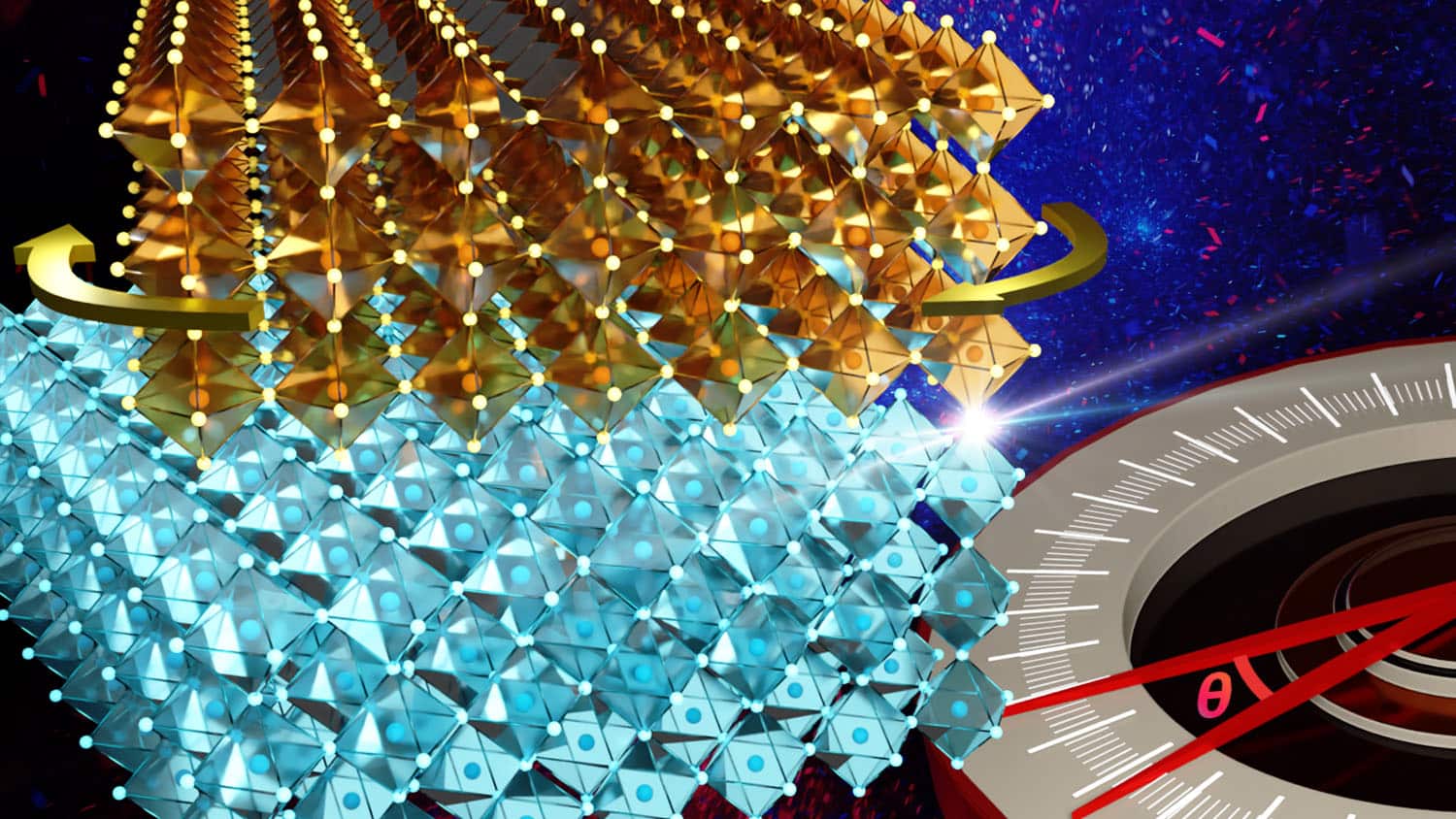
Researchers at NC State have extended twistronics beyond van der Waals materials into strongly bonded crystalline oxides. By stacking sodium niobate membranes with twist angles controlled down to 0.1 degrees, and confirming results via synchrotron X-ray diffraction, the team found interlayer bonds distort the atomic lattice, shifting phase structure and domain configuration. The technique works at near-millimeter scale, far larger than typical twistronic devices, marking a real step toward pract
