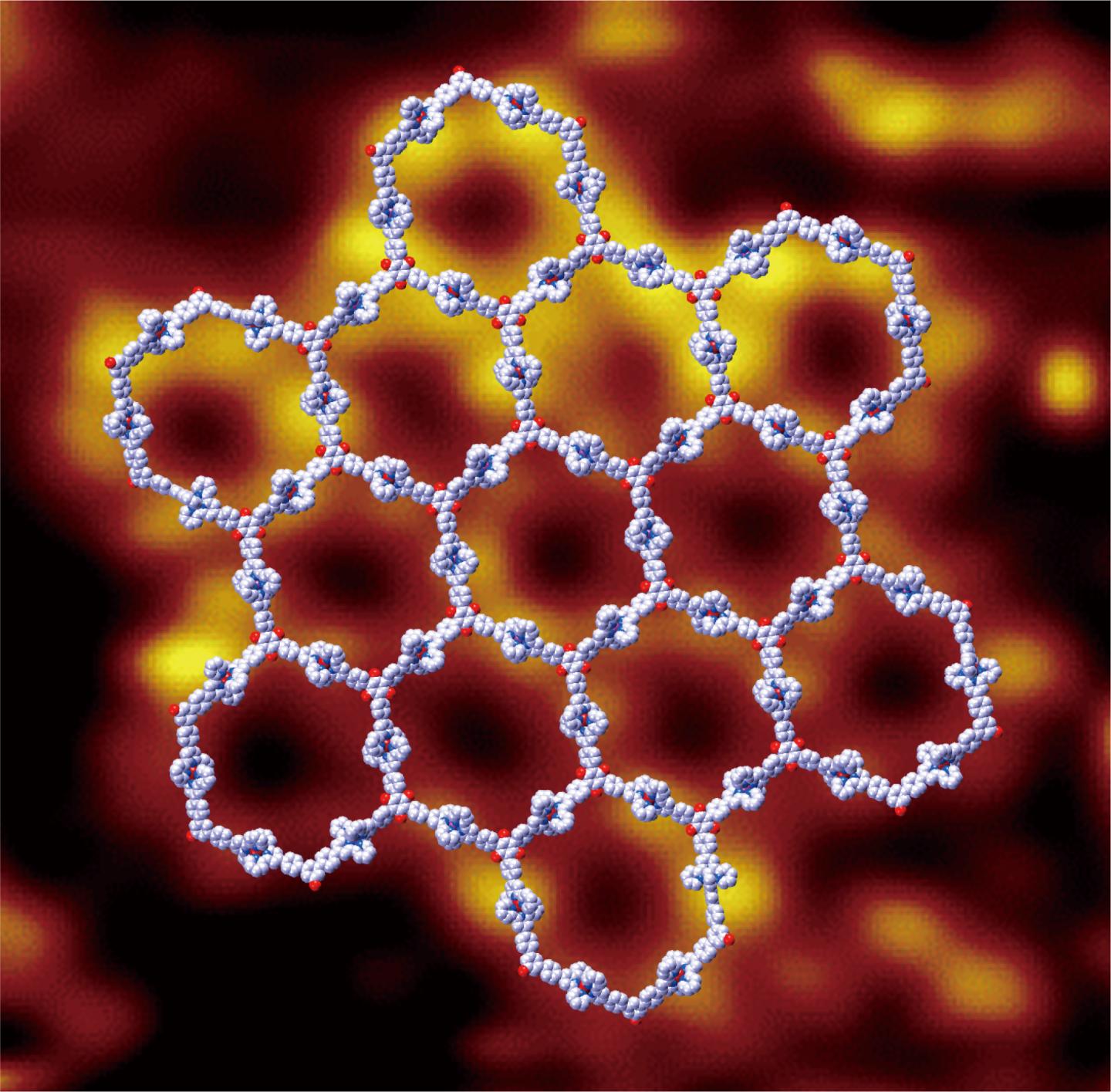
Scientists at the University of South Florida have reached a new milestone in the development of two-dimensional supramolecules - the building blocks that make areas of nanotechnology and nanomaterial advancement possible.
Since the 2004 discovery of graphene, the world's thinnest (one-atom-thick) and strongest (200 times stronger than steel) material, researchers have been working to further develop similar nanomaterials for industrial, pharmaceutical and other commercial uses. Thanks to its conductive properties and strength, graphene can be used in microelectronics to fortify mechanical materials and has recently enabled precise 3D imaging of nanoparticles.
While work to develop new supramolecules capable of further applications has seen some success, those molecular formations are either small - less than 10 nanometers in size - or arbitrarily assemble, limiting their potential use. But now, new research published in Nature Chemistry, outlines a profound leap forward in supramolecular progress.
"Our research team has been able to overcome one of the major supramolecular obstacles, developing a well-defined supramolecular structure that pushes the 20-nanometer scale," said Xiaopeng Li, an associate professor in the USF Department of Chemistry and the study's lead researcher. "It's essentially a world record for this area of chemistry."
Li, along with his USF research team, collaborated with Saw Wai Hia's team at the Argonne National Laboratory and Ohio University, as well as several other U.S. and international research institutes on this effort.
Supramolecules are large molecular structures made up of individual molecules. Unlike traditional chemistry, which focuses on covalent bonds between atoms, supramolecular chemistry studies the noncovalent interactions between molecules themselves. Many times, these interactions lead to molecular self-assembly, naturally forming complex structures capable of performing a variety of functions.
In this latest study, the team was able to build a 20-nm-wide metallo-supramolecular hexagonal grid by combining intra- and intermolecular self-assembly processes. Li says the success of this work will advance further understanding of the design principles governing these molecular formations and could one day lead to the development of new materials with yet-to-be-discovered functions and properties.
Intra- and intermolecular self-assembly of a 20-nm-wide supramolecular hexagonal grid
Zhe Zhang, Yiming Li, Bo Song, Yuan Zhang, Xin Jiang, Ming Wang, Ryan Trumbleson, Changlin Liu, Pingshan Wang, Xin-Qi Hao, Tomas Rojas, Anh T. Ngo, Jonathan L. Sessler, George R. Newkome, Saw Wai Hla & Xiaopeng Li
Nature Chemistry (2020)
DOI: 10.1038/s41557-020-0454-z
Contact information:
Xiaopeng Li
USF associate professor of chemistry
xiaopengli1@usf.edu
Li Group
University of South Florida (USF)

Silver nanoparticles with diameters of ~10 nm deliver the best performance as electrocatalysts. The silver particles are sprayed onto the electrode together with a conductive carbon powder. The ideal mixture consists of 20 per cent by mass silver and 80 per cent by mass carbon powder. This image was taken using a transmission electron microscope (TEM). © HZB Via electrolysis, CO₂ can be reduced to CO, a raw material for further chemical products such as fuels. Within the GreenQuest Project,...

A flexible metal–organic framework developed by researchers from Institute of Science Tokyo enables the structural determination of large "beyond rule of 5" molecules from microgram-scale samples. Using APF-40 as a crystalline sponge, the researchers determined the structures of 12 pharmaceutical-related molecules, including the 899 Da drug molecule doramectin and trace ivermectin derivatives. The method could aid drug discovery, natural products research, and the characterization of rare...
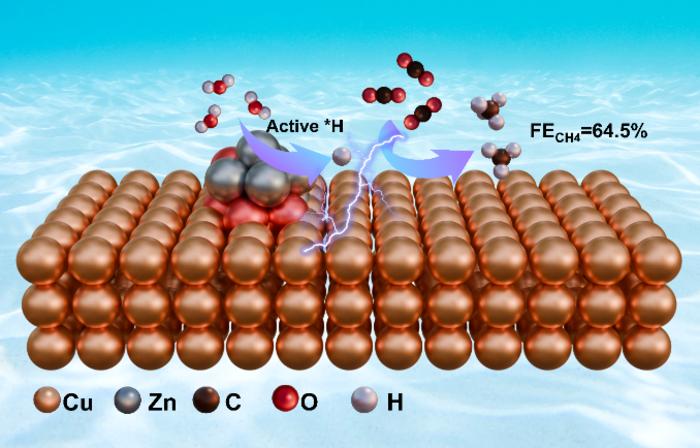
image: CuZn800@C was constructed via solvothermal method and utilizes the high-temperature volatility of zinc to prepare through calcination at different temperatures, which displays a high methane Faradaic efficiency of 64.5% and a remarkable partial current density of -551.3 mA/cm2 at -1.7 V vs. RHE, along with excellent stability. Zn and Cu form a tandem reaction system. Zn sites promote water splitting to provide protons, while Cu sites reduce the energy barrier for *CO hydrogenation....






