
A research team from the Helmholtz-Zentrum Dresden-Rossendorf (HZDR) and the University of Salerno in Italy has discovered that thin films of elemental bismuth exhibit the so-called non-linear Hall effect, which could be applied in technologies for the controlled use of terahertz high-frequency signals on electronic chips. Bismuth combines several advantageous properties not found in other systems to date, as the team reports in Nature Electronics. Particularly: the quantum effect is observed at room temperature. The thin-layer films can be applied even on plastic substrates and could therefore be suitable for modern high-frequency technology applications.
"When we apply a current to certain materials, they can generate a voltage perpendicular to it. We physicists call this phenomenon the Hall effect, which is actually a unifying term for effects with the same impact, but which differ in the underlying mechanisms at the electron level. Typically, the Hall voltage registered is linearly dependent on the applied current," says Dr. Denys Makarov from the Institute of Ion Beam Physics and Materials Research at HZDR.
Most of these effects are a result of the influence of magnetic fields or magnetism in the material. However, in 2015, scientists discovered that the Hall effect can also occur without the influence of magnetism. "We achieve this with materials whose crystalline arrangement enables Hall voltages that are no longer linearly related to the current," adds Prof. Carmine Ortix from the Physics Department at the University of Salerno. This effect is of great interest because it makes new types of components for high-speed electronics possible.
The two researchers have joined forces in the search for suitable materials and possible practical applications of this so-called non-linear Hall effect. While Ortix is a theoretical physicist, Makarov brings in the experimental know-how – and the connection to other institutes at the HZDR, which are significantly involved in the work with their expertise. "We got together with colleagues from the ELBE Center for High Power Radiation Sources, the High Magnetic Field Laboratory and the Institute for Resource Ecology. The common goal: to identify a suitable material with which this quantum effect can appear in a controlled manner at room temperature and which is also easy to handle and non-toxic," says Makarov, describing the starting point of the joint work.
Familiar material, new properties
In the elemental material bismuth, the team has found a candidate that exhibits these properties. Bismuth is known for its strong classical Hall effect which is present in the bulk of the material. The researchers discovered that on surfaces instead, quantum effects dominate and govern the current flow even at room temperature.
A major advantage of the approach is that the researchers can apply their thin films with quantum properties to a variety of substrates for electronics like silicon wafers and even plastic. The team achieves the control of the effect through sophisticated micro-fabrication: they can directly influence the currents via the geometry of the channels on chip.
New quantum materials with technological relevance
Other teams had already created a number of materials that exhibit the non-linear Hall effect, but they do not combine all the desirable properties. Graphene, for example, is environmentally safe and its non-linear Hall effect can be controlled well, but only at temperatures below around -70 degrees Celsius. This means that if the researchers want to use the effect, they have to cool it down with liquid nitrogen. For other compounds, they would have to use even lower temperatures.
Research is currently focusing on finding suitable materials, but the scientists are already thinking ahead. "We see technological potential above all in the conversion of terahertz electromagnetic waves into direct current using our thin-film materials. This will make new components for high-frequency communication possible”, says Ortix. To guarantee significantly higher data transmission rates, future wireless communication systems will have to extend the carrier frequency beyond 100 gigahertz into the terahertz range, which is out of reach with present day technologies.
Reference
A tunable room-temperature nonlinear Hall effect in elemental bismuth thin films
Pavlo Makushko, Sergey Kovalev, Yevhen Zabila, Igor Ilyakov, Alexey Ponomaryov, Atiqa Arshad, Gulloo Lal Prajapati, Thales V. A. G. de Oliveira, Jan-Christoph Deinert, Paul Chekhonin, Igor Veremchuk, Tobias Kosub, Yurii Skourski, Fabian Ganss, Denys Makarov & Carmine Ortix
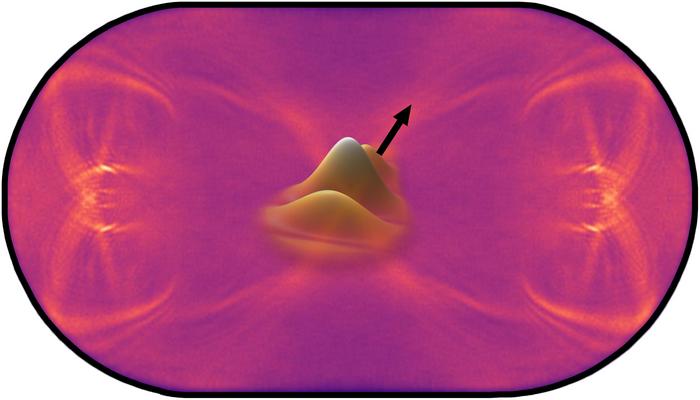
A quantum "wave packet" (in the middle) launched from the same kind of starting point behaves differently. Even after bouncing around for a very long time, faint filament-like patterns (bright glow) are still visible, a tattoo tracing back to its early history. This lingering imprint is the "quantum birthmark" described in the study. Credit: Joonas Keski-Rahkonen, Tampere University Even the most chaotic quantum systems keep a permanent mark of their own past – a "quantum birthmark" – that...
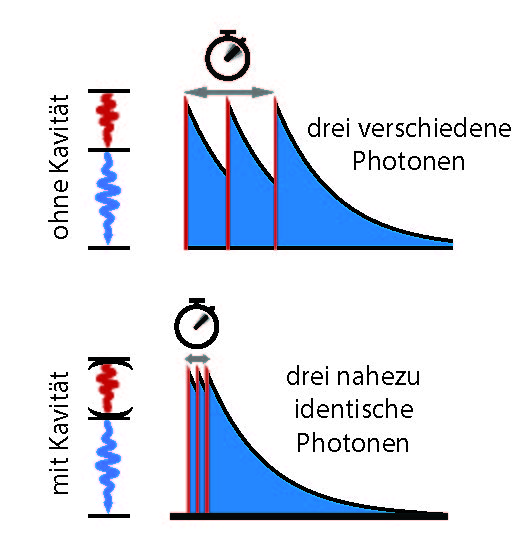
Illustration (University of Basel, Timon Baltisberger): Biexziton decay can generate photons of very high quality if the system is specifically controlled using an optical cavity. Under these conditions, 90 per cent of the photons are indistinguishable. Working in close collaboration, researchers from Paderborn University, the University of Basel and Ruhr University Bochum have made a significant breakthrough in the field of quantum communication. In their recently published paper in the...
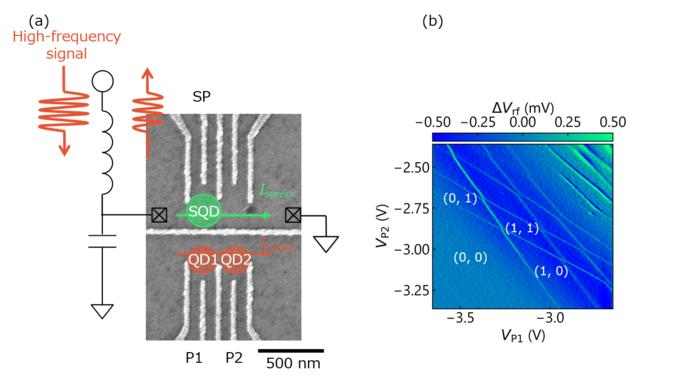
(a) The structure of the gate electrodes on the ZnO device used in the experiment in this paper. (b) The charge stability diagram indicating the formation of ZnO double quantum dot in few-electron regime. Researchers at Tohoku University, in collaboration with the National Institute for Materials Science (NIMS) and the University of Tokyo, have taken an important step toward semiconductor quantum computing using zinc oxide (ZnO). The team successfully demonstrated charge sensing,...
