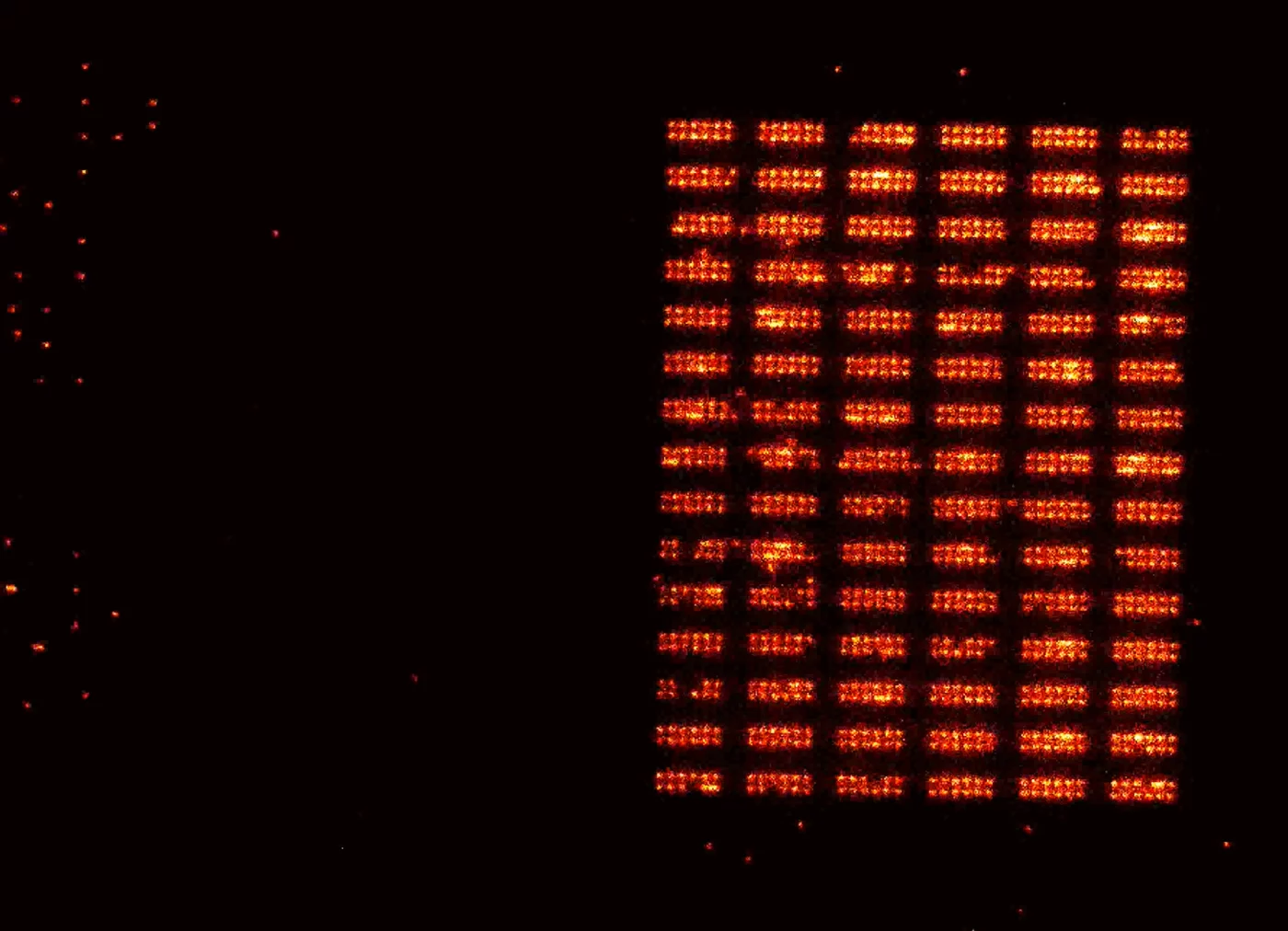
A team of physicists led by Johannes Zeiher, research group leader in Immanuel Bloch's Quantum Many-Body Systems department and co-founder of the MPQ spin-off planqc, has achieved significant progress in scaling up quantum computing platforms with neutral atoms. In an experiment at the Max Planck Institute of Quantum Optics, in cooperation with planqc, the researchers succeeded in setting up a register of 1200 atoms in an optical lattice of laser light and keeping it in continuous operation for one hour. Until now, arrangements of this size have been difficult to maintain due to unavoidable atomic losses. The physicists were able to solve this problem by using a sophisticated technique that allows them to successively reload new atoms into the qubit register – and, in principle, to operate it for an indefinite amount of time.
Today, we know how difficult it is to calculate quantum systems with classical computers. This is owed to the fact that quantum mechanical systems become exponentially more complex as they grow in size. Even a precise calculation of the behaviour of a hundred quantum particles is beyond the capabilities of most modern supercomputers. At the same time, a fundamental understanding of complex quantum systems is essential for predicting the properties of, for example, certain materials or biomolecules. At the beginning of the 1980s, physicist and Nobel Prize winner Richard Feynman therefore proposed using quantum simulators and computers to calculate complex quantum mechanical phenomena rather than classical computers as they obey the same laws as the systems to be calculated, and thus circumvent the limitations of classical computers.
While quantum simulators are primarily suited to very specific, platform-tailored problems, such as in solid-state physics, quantum computers are more universally applicable – require, however, greater effort and control. They are based on individual, interconnected, and fully programmable storage units called qubits, which are able to execute defined algorithms using quantum gates between them. This versatility and the high potential in processing power of quantum computers opens up new scientific and technological possibilities, for example, in the fundamental understanding and development of new materials, or in the field of quantum chemical calculations of molecular structures.
However, a major hurdle to the research of this promising technology is the scaling of quantum computers and simulators to large numbers of qubits, while maintaining the necessary control over the individual constituents. There are currently several approaches competing with each other to tackle this challenge. One of them is based on neutral atoms.
Such atomic quantum computers and quantum simulators rely heavily on stable and scalable atomic arrangements, which form the registers required for computations. The atoms are trapped individually using optical tweezers, tightly focused laser beams, or optical lattices, extremely precise periodic arrays formed from interfering laser beams. Each individual atom trapped in such tweezers or lattices can serve as a qubit. However, the larger the register, the more atoms are lost or heated, thus making the system more prone to detrimental errors over time. In today's systems, the entire register of atoms needs to be replenished regularly, which severely limits the size a system can attain.
Johannes Zeiher and his team have now succeeded in integrating a kind of reloading zone into their experimental setup, which is operating with the alkaline-earth atom strontium. Every 3.5 seconds, around 130 atoms are added to the register. “This technique of replacing lost atoms in real time is an important step towards the practical use of quantum technologies, because only through uninterrupted and longer-lasting operation of the systems large-scale quantum calculations, simulations and measurements become possible,” says Johannes Zeiher, head of the experiment.
The next steps in this experiment involve controlling electronic state of the atoms, for example with optical tweezers, so that each individual atom in the register becomes a qubit holding quantum information. Adding controlled interactions between nearby atoms in the array then enables the generation of quantum entanglement – the basis for any quantum computation.
“We are already working on concepts to combine our new technique with uninterrupted quantum computing. Maintaining the coherence of qubits during the reloading step is essential to unlock the great potential of quantum computing and quantum simulation. We are excited to put together the bits and pieces towards this goal,” adds Dr Flavien Gyger, first author of the paper.
“To execute a quantum algorithm with an industry impact, we're talking about thousands of qubits and need to keep them operational for hours to run error-correction protocols. Our results could pave the way towards continuously maintaining such large arrays to explore near-term applications.” says Stepan Snigirev, Lead Quantum Engineer at planqc and co-author of the paper.
Reference
Continuous operation of large-scale atom arrays in optical lattices
Flavien Gyger, Maximilian Ammenwerth, Renhao Tao, Hendrik Timme, Stepan Snigirev, Immanuel Bloch, and Johannes Zeiher
https://journals.aps.org/prresearch/abstract/10.1103/PhysRevResearch.6.033104
Max Planck Society

A quantum "wave packet" (in the middle) launched from the same kind of starting point behaves differently. Even after bouncing around for a very long time, faint filament-like patterns (bright glow) are still visible, a tattoo tracing back to its early history. This lingering imprint is the "quantum birthmark" described in the study. Credit: Joonas Keski-Rahkonen, Tampere University Even the most chaotic quantum systems keep a permanent mark of their own past – a "quantum birthmark" – that...
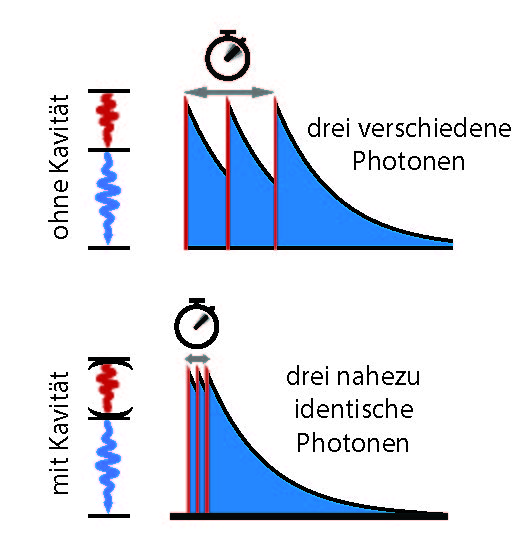
Illustration (University of Basel, Timon Baltisberger): Biexziton decay can generate photons of very high quality if the system is specifically controlled using an optical cavity. Under these conditions, 90 per cent of the photons are indistinguishable. Working in close collaboration, researchers from Paderborn University, the University of Basel and Ruhr University Bochum have made a significant breakthrough in the field of quantum communication. In their recently published paper in the...
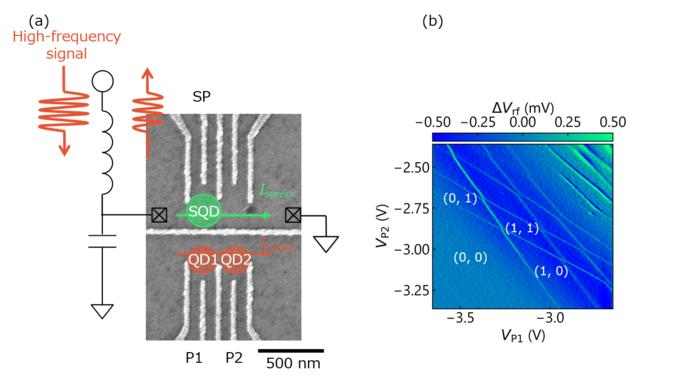
(a) The structure of the gate electrodes on the ZnO device used in the experiment in this paper. (b) The charge stability diagram indicating the formation of ZnO double quantum dot in few-electron regime. Researchers at Tohoku University, in collaboration with the National Institute for Materials Science (NIMS) and the University of Tokyo, have taken an important step toward semiconductor quantum computing using zinc oxide (ZnO). The team successfully demonstrated charge sensing,...
