Whether or not an object is indistinguishable from its mirror image has important consequences for its physical behavior. Say you watch a basketball player in a mirror. The ball, the player and their surroundings are, at first glance, just the same in the mirror as in real life. But if observed closely, some details are different. The ball in the player’s right hand now appears in their left hand in the mirror. While the mirror image still shows the same hand, it has clearly changed from a left to a right hand or vice versa. Many other physical objects also have mirror images that differ in a key aspect, just like hands, which is why scientists call them handed or chiral (from Greek χϵρι = hand). Others, like the ball, cannot be distinguished from their mirror image, which makes them achiral.
Chirality is one of the most fundamental geometric properties and plays a special role in biology, chemistry and physics. It can cause surprising effects: One version of the carvone molecule, for example, produces a spearmint smell but its chiral – mirrored – equivalent smells of caraway.
In material science, one distinguishes between crystals in which the periodic arrangement of the atoms is chiral or not. If it is, the electrons and electric currents flowing within it must also differ somehow from their mirror image, a property that can lead to exotic responses and novel applications. One example is a diode-like effect where the electric currents flowing from left to right are different from those flowing right to left, a property called electronic magneto-chiral anisotropy (eMChA). So far, this phenomenon has only been found in structurally chiral crystals.
Now, however, an international research team has reported the first observation of this chiral transport in a structurally achiral crystal, the Kagome superconductor CsV3Sb5. Its work has been published in Nature. The team involved scientists from the MPSD and the Max Planck Institute for Chemical Physics of Solids (Germany), EPFL and the University of Zurich in Switzerland, the University of the Basque Country (Spain) and Qingdao University in China.
The quantum puzzle is as simple as it is deep: If the atomic positions in the crystal are just the same as in their mirror image, how is it possible that its electrons are not? Clearly a novel mechanism beyond a simple shape effect as in our hands must be at play. Unlike structural chirality, which is as firmly imprinted in a crystal as it is in a human hand, this new electronic chirality can be switched using magnetic fields. Switchable chirality has never before been observed and may well find its application in future technology.
It is clear that this unusual behavior is directly linked to the strong electronic interactions. The team proposes a model in which the electrons arrange themselves in patterns that violate mirror symmetry, even though the atoms are arranged symmetrically.
CsV3Sb5 is already known for many such interacting electronic structures, such as the formation of an unconventional chiral charge order featuring a tantalizing charge modulation. These chiral electronic structures may rotate spontaneously, causing an orbital magnetic response associated to a behavior known as ‘loop currents‘, as described by C. Mielke et al., Nature 2022.
CsV3Sb5 appears to be a fantastic sandbox to probe correlated quantum phenomena, including the first example of switchable electronic chirality. The next steps include increasing the operational range from cryogenic to room temperature and enhancing the magnitude of this response. Clearly, much more is to come from interacting systems on geometrically frustrated lattices.
Reference
Low-temperature magnetic crossover in the topological kagome magnet TbMn6Sn6
C. Mielke III, W. L. Ma, V. Pomjakushin, O. Zaharko, S. Sturniolo, X. Liu, V. Ukleev, J. S. White, J.-X. Yin, S. S. Tsirkin, C. B. Larsen, T. A. Cochran, M. Medarde, V. Porée, D. Das, R. Gupta, C. N. Wang, J. Chang, Z. Q. Wang, R. Khasanov, T. Neupert, A. Amato, L. Liborio, S. Jia, M. Z. Hasan, H. Luetkens & Z. Guguchia
https://www.nature.com/articles/s42005-022-00885-4
Max Planck Institute for the Structure and Dynamics of Matter
Teledyne DALSA has launched the Rad-icon 2329HS X-ray detector, featuring a 27 Mp CMOS sensor, 10X faster frame rate and 3X higher sensitivity than the previous model. It was shown at the NDTMA conference.
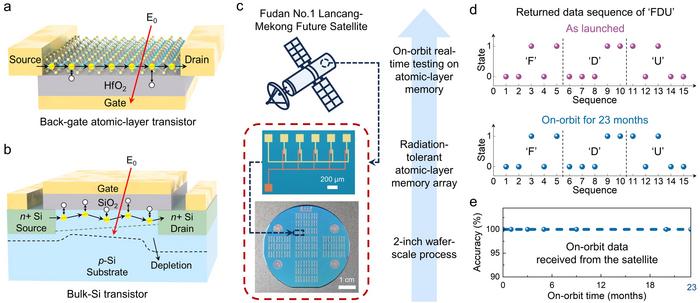
A monolayer MoS2 memory array fabricated at wafer scale on the Fudan No.1 satellite has returned stored data with 100% accuracy after 23 months in low Earth orbit, marking the first on-orbit real-time test of atomic-layer memory. Ground Co-60 gamma irradiation up to 20 Mrad left on/off current ratios stable across roughly eight orders of magnitude and preserved low-noise readout at picoampere levels.
GE HealthCare expanded global clinical and research collaborations to evaluate Photonova Spectra, its photon-counting CT system, across institutions in North America, Europe and Asia.
This week in nanotech
$18.9M raised
4 funding rounds · 31 deals tracked
New products
 DLS-1 Mass Spectrometer for Fusion Gas AnalysisHiden Analytical Featured
 Ti-WCMBN Nanomaterialia Featured
 CruciblesBasis Materials
Market insights
Last 30 days: Semiconductors & Electronics was the busiest vertical: 52 of 170 events (31%).
Money raised per month
Behind the deal
Who led Eindhoven University of Technology’s $1.1M Grant?
See the investors with Insights Pro →