KTH Royal Institute of Technology
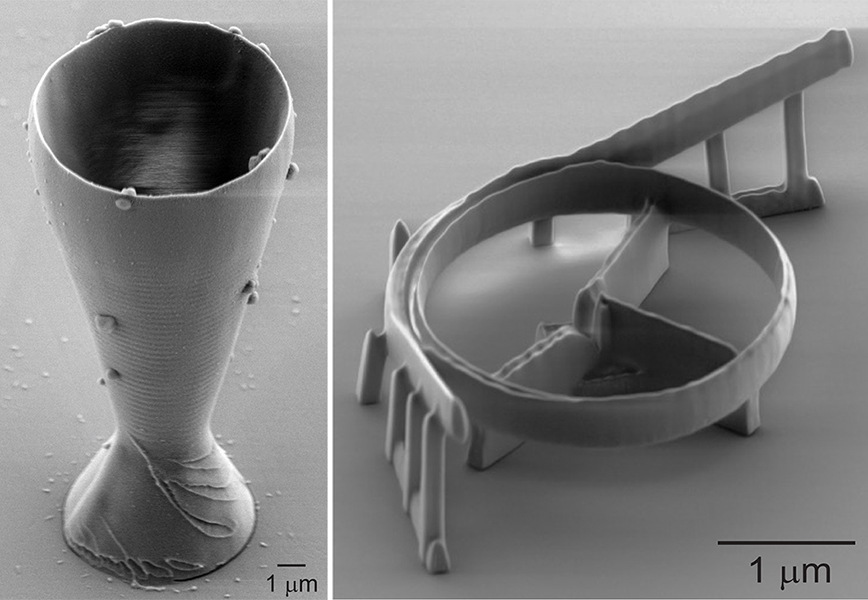
Researchers have 3D-printed the world’s smallest wine glass—nearly indistinguishable with the naked eye—with a rim smaller than the width of a human hair. But the idea wasn’t to cater to extremely light drinkers. Rather, the glass was printed to demonstrate a new simplified technique for creating silica glass structures for a range of applications from telecommunications to robotics.
Developed at KTH Royal Institute of Technology in Stockholm, the new technique surmounts complications—such as the need for thermal treatment—when 3D-printing essential silica glass components, says KTH Professor Frank Niklaus.
Niklaus says it can be used for customized lenses for medical machinery that perform minimally invasive surgery, micro-robots that navigate extreme environments, or filters and couplers for fiber optic networks, to name a few applications.
One such fiber optic filter was produced in the study. The researchers show that the technique can print devices directly on the tip of an optical fiber as thin as a strand of a human hair.
“The backbone of the internet is based on optical fibers made of glass. In those systems, all kinds of filters and couplers are needed that can now be 3D printed by our technique,” says co-author Kristinn Gylfason, an associate professor of Micro- and Nanosystems at KTH. “This opens many new possibilities.”
The method drastically reduces the energy needed to 3D print silica glass, which normally requires heating materials up to several hundred degrees for hours, says the study’s lead author, Po-Han Huang, a doctoral student at KTH. “The advantage of our method is there’s no need for thermal treatment and the glass can withstand extreme heat in applications.”
Another benefit, he says, is that the method can produce silica glass using readily available, commercial materials.
Eliminating the need for thermal treatment increases the possibility for the technique to be used widely in various application scenarios, he says. “The concerns when integrating 3D printing methods are usually different for different applications. Even though optimization of our method is still required for different applications, we believe our method presents an important and necessary breakthrough for 3D glass printing to be used in practical scenarios.”
So what about that wineglass? Is it really the world’s smallest? After all, people have already 3D printed a lot of demonstration objects, like statues and model cars. Niklaus says the difference is that this demo is in glass. “Definitely nobody has 3D printed a wineglass that consists of glass as-printed,” he says.
Reference
Three-dimensional printing of silica glass with sub-micrometer resolution
Po-Han Huang, Miku Laakso, Pierre Edinger, Oliver Hartwig, Georg S. Duesberg, Lee-Lun Lai, Joachim Mayer, Johan Nyman, Carlos Errando-Herranz, Göran Stemme, Kristinn B. Gylfason & Frank Niklaus
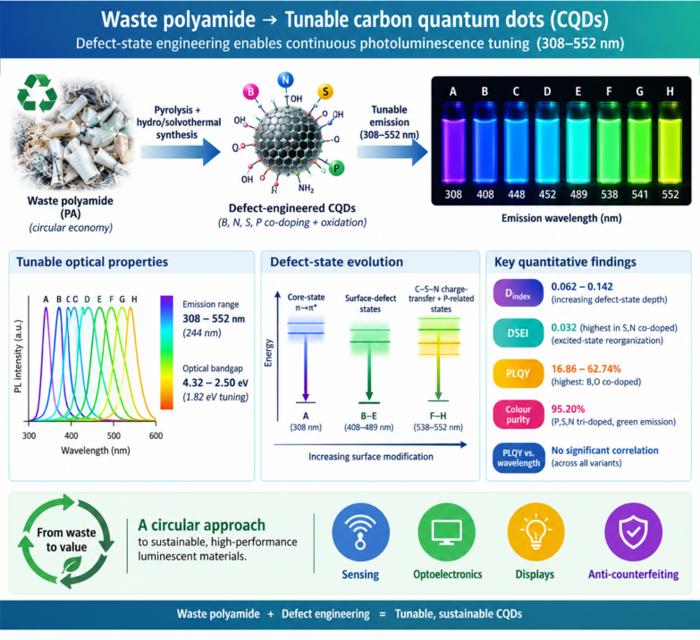
Waste polyamide-derived CQDs show continuous photoluminescence tuning from 308 to 552 nm through sequential defect-state engineering, with optical transition energies decreasing from 4.32 to 2.50 eV. @Christian Ebere Enyoh from Saitama University Carbon quantum dots (CQDs) are fluorescent carbon nanomaterials with potential applications in sensing, optoelectronics, displays, anti-counterfeiting, and environmental technologies. Their optical properties can be adjusted by modifying the carbon...
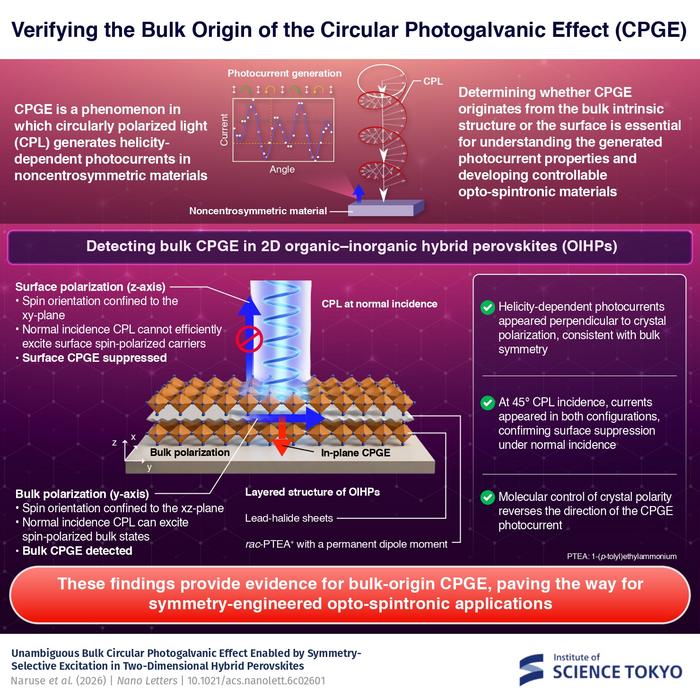
The researchers used circularly polarized light at normal incidence and found that helicity-dependent photocurrents appeared perpendicular to the crystal’s polarization but vanished when measured parallel to it, supporting a bulk origin of CPGE. @Institute of Science Tokyo The circular photogalvanic effect (CPGE), a phenomenon that generates helicity-dependent photocurrents in noncentrosymmetric materials, can originate purely from a crystal's internal structure without contribution from the...
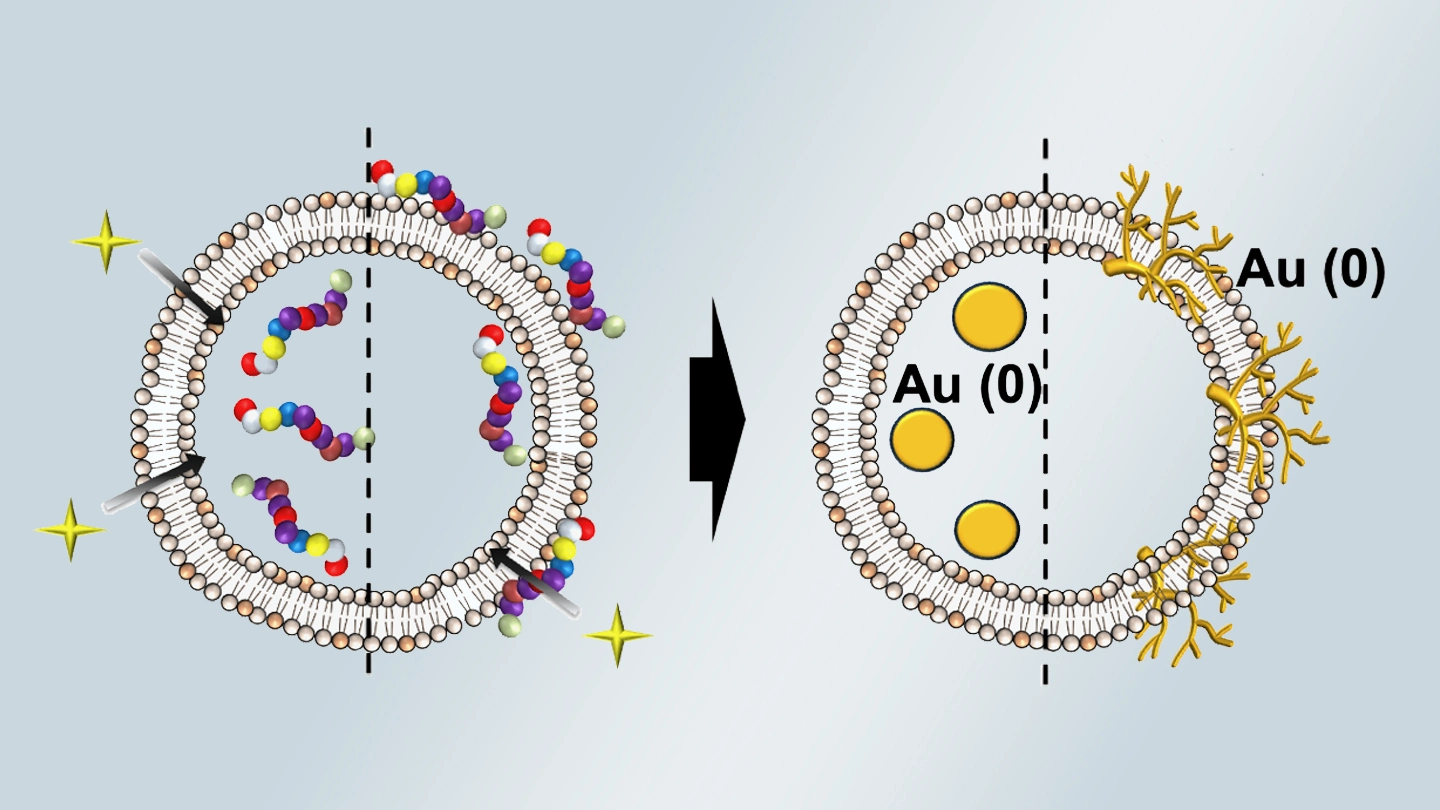
Summary of gold nanoparticle growth programming in liposome based on localization of biomineralization peptide The position of biomineralization peptides within liposomes can influence how gold nanoparticles grow, reports a research team from Institute of Science Tokyo. Peptides localized at the membrane interface promote branched structures, while those confined to the liposome interior favor spherical nanoparticles. The findings offer a new strategy for controlling nanoscale reaction...
