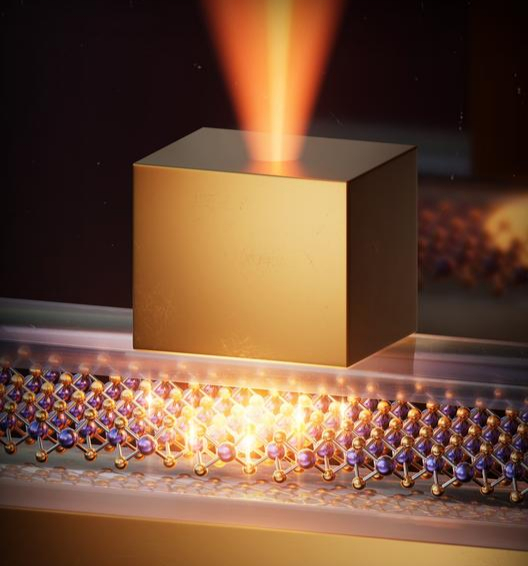
A research team at the City University of New York and the University of Texas at Austin has discovered a way to make previously hidden states of light, known as dark excitons, shine brightly, and control their emission at the nanoscale. Their findings, published today in Nature Photonics, open the door to faster, smaller, and more energy-efficient technologies.
Dark excitons are exotic light-matter states in atomically thin semiconductors that typically remain invisible because they emit light very weakly. These states, however, are highly promising for quantum information and advanced photonic applications due to their unique light-matter interaction properties, long lifetimes and reduced interaction with the environment, which leads to lessened decoherence.
To reveal these elusive states, the team engineered a nanoscale optical cavity using gold nanotubes and a single layer of tungsten diselenide (WSe₂), a material just three atoms thick. This design amplified the light emission from dark excitons by an astonishing 300,000 times, making them not only visible but also controllable.
“This work shows that we can access and manipulate light-matter states that were previously out of reach,” said the study’s principal investigator Andrea Alù, who is a Distinguished and Einstein Professor of Physics at the CUNY Graduate Center and founding director of the Photonics Initiative at the Advanced Science Research Center at the CUNY Graduate Center (CUNY ASRC). “By turning these hidden states on and off at will and controlling them with nanoscale resolution, we open exciting opportunities to disruptively advance next-generation optical and quantum technologies, including for sensing and computing.”
The research team also demonstrated that these dark states can be tuned on demand using electric and magnetic fields, enabling precise control for potential applications in on-chip photonics, sensors, and quantum communication. Unlike previous attempts, this approach preserves the material’s natural properties while achieving record-breaking enhancement of light-matter coupling.
“Our study reveals a new family of spin-forbidden dark excitons that had never been observed before,” said Jiamin Quan, first author of the study. “This discovery is just the beginning—it opens a path to explore many other hidden quantum states in 2D materials.”
This discovery also resolves a long-standing debate about whether plasmonic structures can truly enhance dark excitons without altering their nature as they come in close contact. The authors addressed the challenge by carefully designing the plasmonic-excitonic heterostructure using nanometer-thin layers of boron nitride, key to unveil the new dark excitons observed by the team.
Reference
On-site enhancement and control of spin-forbidden dark excitons in a plasmonic heterostructure
Jiamin Quan, Michele Cotrufo, Saroj Chand, Xuefeng Jiang, Zhida Liu, Enrique Mejia, Wei Wang, Takashi Taniguchi, Kenji Watanabe, Gabriele Grosso, Xiaoqin Li & Andrea Alù
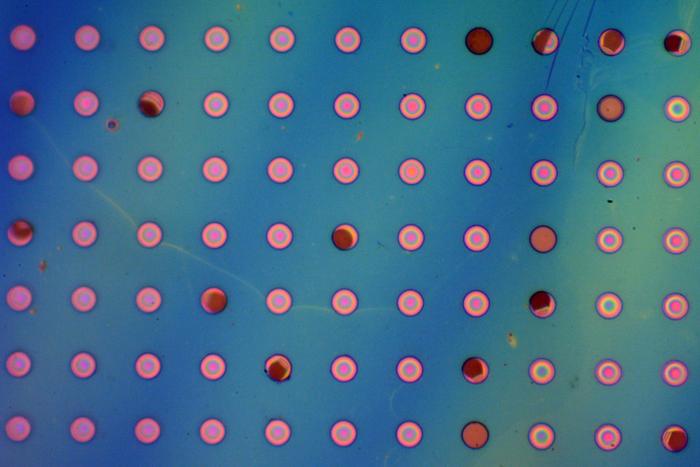
MIT researchers have developed a lightweight polymer film that is nearly impenetrable to gas molecules, raising the possibility that it could be used as a protective coating to prevent solar cells and other infrastructure from corrosion, and to slow the aging of packaged food and medicines. The polymer, which can be applied as a film mere nanometers thick, completely repels nitrogen and other gases, as far as can be detected by laboratory equipment, the researchers found. That degree of imper...

The study found that rectification happens because of the way the electric charges lining the inside of the pore influence ion movement. The charge distribution makes it easier for ions to pass in one direction than the other, like a one-way valve. Gating, on the other hand, occurs when a large flow of ions leads to a charge imbalance that structurally destabilizes the pore, which causes part of the pore to temporarily collapse, blocking the flow of ions.
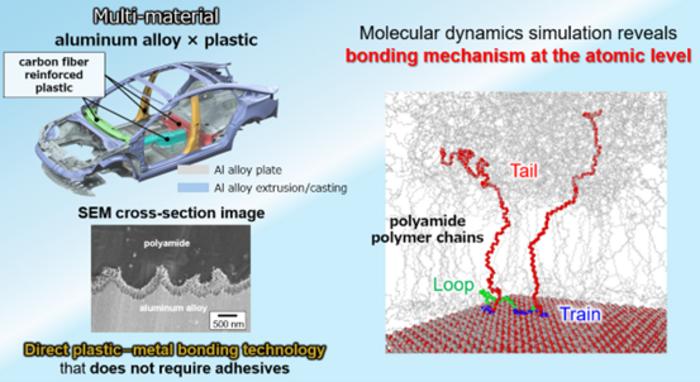
What makes some plastics stick to metal without any glue? Osaka Metropolitan University scientists peered into the invisible adhesive zone that forms between certain plastics and metals — one atom at a time — to uncover how chemistry and molecular structure determine whether such bonds bend or break. Their insights clarify metal–plastic bonding mechanisms and offer guidelines for designing durable, lightweight, and more sustainable hybrid materials for use in transportation. Combining the str...
This week in nanotech
$109M raised
3 funding rounds · 18 deals tracked
New products
 Ti-WCMBN Nanomaterialia Featured
 DLS-1 Mass Spectrometer for Fusion Gas AnalysisHiden Analytical Featured
 GiiiGii
Market insights
Last 30 days: Semiconductors & Electronics drew the most money: $545M.
Money raised per month