Australian National University
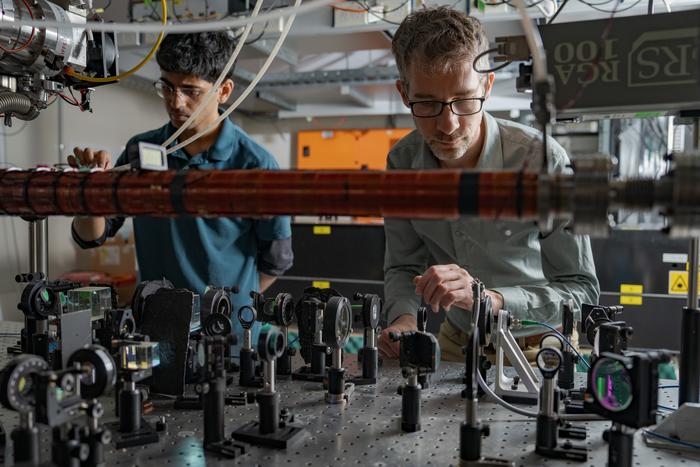
Quantum physicists at ANU have observed atoms entangled in motion.
“It’s really weird for us to think that this is how the Universe works,” says Dr Sean Hodgman from the ANU Research School of Physics. “You can read about it in a textbook, but it’s really weird to think that a particle can be in two places at once.”
Their experiment using helium atoms represents a major advancement on similar experiments using photons, which are particles of light.
But unlike photons, helium atoms have mass and experience gravity.
“Experimentally, it’s extremely hard to demonstrate this,” says lead author and PhD researcher, Yogesh Sridhar. “Several people have tried in the past to show these effects, and they have always come short.”
The development enables new ways to examine one of the biggest unanswered questions about the universe: how does the small-scale physics of quantum mechanics interact with gravity and general relativity at the universal scale?
“This result confirms the predictions of over a century ago that matter can be in two locations at once, and it can interfere with itself even in those locations,” says Dr Sean Hodgman.
By observing quantum entanglement in atoms for the first time, are we one small step closer to finding out whether the “Theory of Everything” is not just hot air?
Reference
Bell correlations between momentum-entangled pairs of ⁴He* atoms
Y. S. Athreya, S. Kannan, X. T. Yan, R. J. Lewis-Swan, K. V. Kheruntsyan, A. G. Truscott & S. S. Hodgman
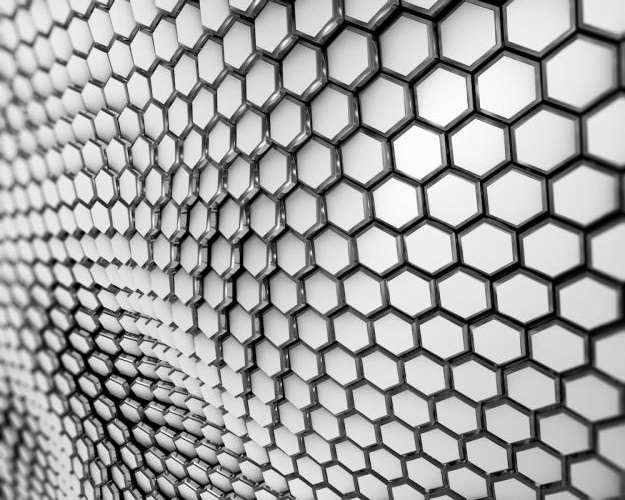
Rhombohedral hexalayer graphene, in which six carbon sheets are stacked with a slight lateral offset like staircase steps, hosts both superconductivity and electrically controllable orbital magnetism, researchers report in Nature Physics. The arrangement yields a rich collection of quantum states in a simple carbon-based material, positioning rhombohedral multilayer graphene as a platform for probing the fundamental mechanisms of superconductivity and magnetism and potentially for new ways of…
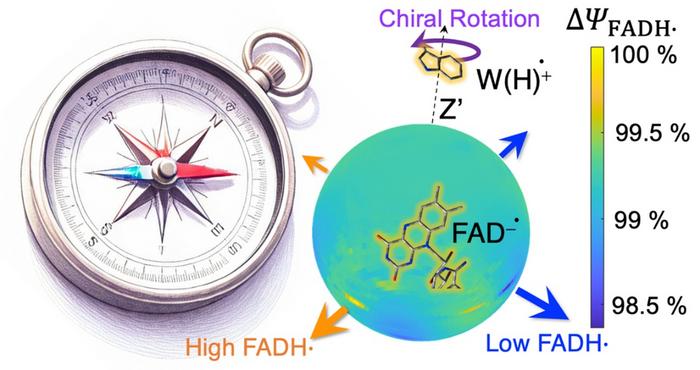
Time-resolved electron paramagnetic resonance spectroscopy of Xenopus cryptochrome-DASH reveals that chiral rotation of an oxidized tryptophan residue can drive chirality-induced spin selectivity, estimated at 8% in one charge-separated state, and shape electron-spin polarization in radical pairs.
Cornell researchers have redrawn the phase diagram of uranium ditelluride, showing the material can host two distinct flavors of superconductivity at once and that the two coexist and interact under pressure. The work settles years of uncertainty and positions uranium ditelluride as the leading candidate for a topological superconductor, a long-sought material that could unlock advances in quantum computing.
This week in nanotech
$10.2M raised
2 funding rounds · 18 deals tracked
New products
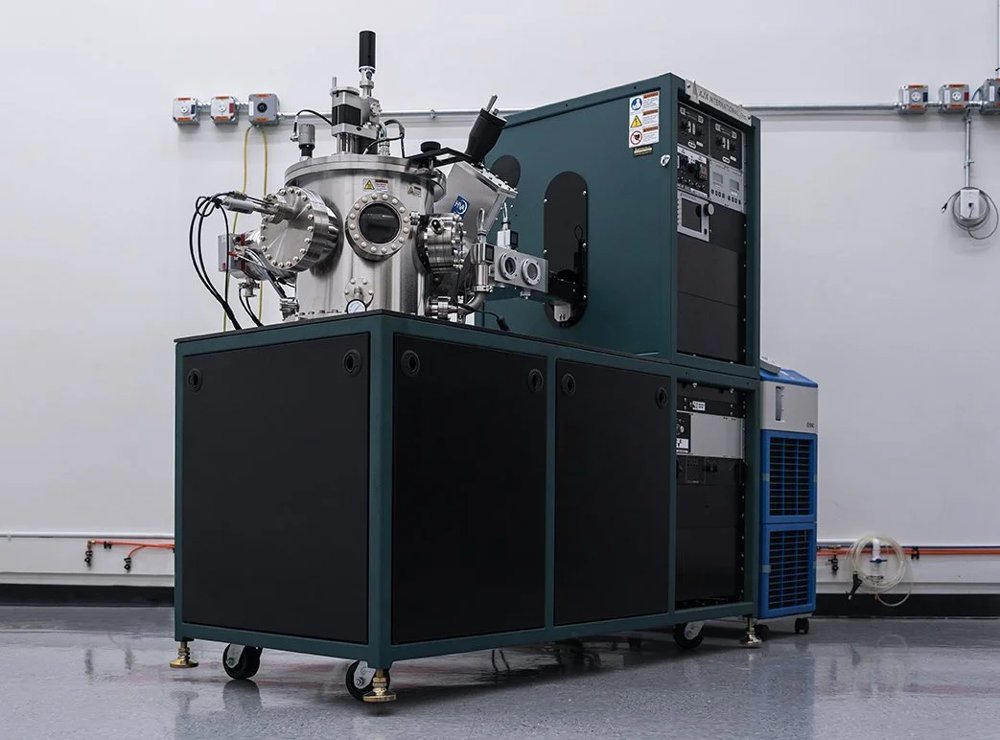 Orion Sputtering Deposition SystemsAJA International Featured
 Ti-WCMBN Nanomaterialia Featured
 GiiiGii
Market insights
Last 30 days: Quantum Technologies was the busiest vertical: 52 of 174 events (30%).
Money raised per month