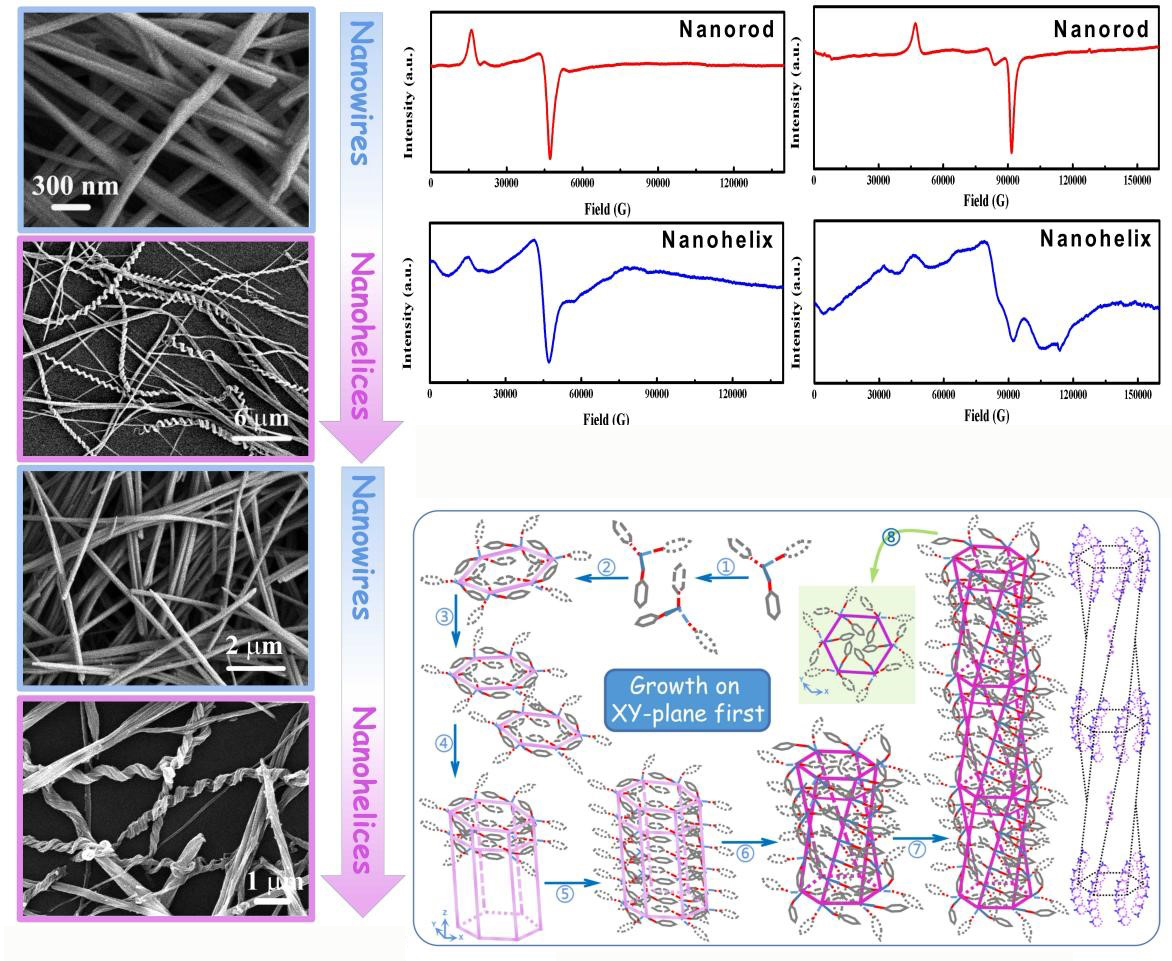
Reversible nanohelix transformation is one of the most exquisite and important phenomena in nature. Nanomaterials rarely form helical crystals. Due to the irreversibility of the twisting forces studied so far, untwisting is more difficult than retwisting crystalline nanohelices. Therefore, many reversible twist transformations between two stable crystalline products are rare and require a sensitive energy balance. This reversible transformation of nanohelices has long been considered difficult to achieve.
Researchers from the Hefei Institutes of Physical Science of the Chinese Academy of Sciences, in collaboration with researchers from Nanjing University and the University of Science and Technology of China, have discovered a subtle competition and cooperation relationship within the crystal structure, establishing a delicate energy balance between the structures of the twisted and untwisted crystalline nanohelices.
For the first time, the researchers have achieved multiple reversible transformations between nanowires and nanohelices.
The study was published in Nature Communications.
Using electron spin resonance (ESR), including high-field ESR, at the Steady-State High Magnetic Field Experimental Facility, the researchers demonstrated changes in the coordination environment of Co(II) and a decrease in symmetry of the nanohelix. Solid-state nuclear magnetic resonance spectroscopy and terahertz spectroscopy revealed that π-π interactions play a crucial role in the helical growth.
These results, combined with theoretical calculations and various validation experiments, suggest that the twist arises from the competitive interaction between condensation reactions and π-π stacking processes. This unique competitive growth mechanism, together with the micro-adjustability of the growth mode, is the key to constructing finely adjustable energy balance systems and achieving reversible helical transformations.
By selectively designing and modifying the intermolecular forces and finely controlling the growth rates in different directions while maintaining the overall structure, the direction of energy balance can be changed, realizing the twisting, untwisting, and retwisting of nanohelices.
This study presents a new approach to design reversible crystal transformations by fine-tuning intermolecular interactions to enable multiple reversible transformations in crystals. This technique offers a new perspective for crystallography, improves crystallographic theory, and enables the realization of various complex reversible processes.
Reference
Twisting, untwisting, and retwisting of elastic Co-based nanohelices
Wei Du, Feng Gao, Peng Cui, Zhiwu Yu, Wei Tong, Jihao Wang, Zhuang Ren, Chuang Song, Jiaying Xu, Haifeng Ma, Liyun Dang, Di Zhang, Qingyou Lu, Jun Jiang, Junfeng Wang, Li Pi, Zhigao Sheng & Qingyi Lu
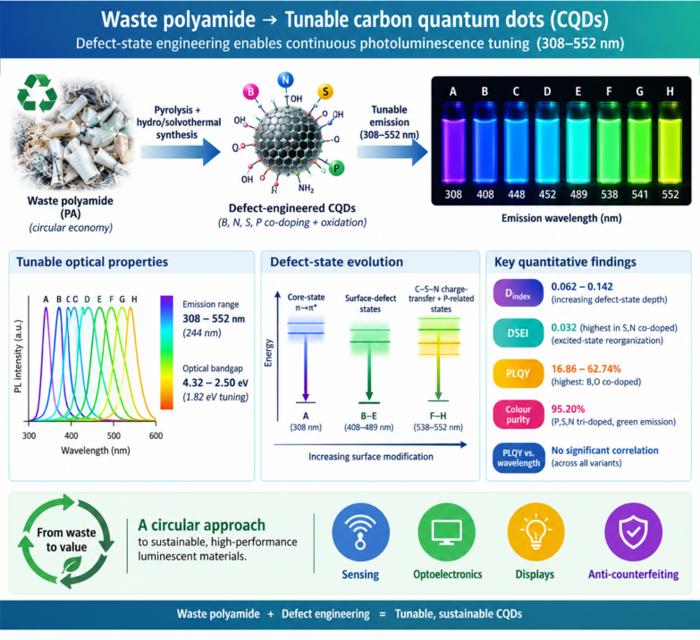
Waste polyamide-derived CQDs show continuous photoluminescence tuning from 308 to 552 nm through sequential defect-state engineering, with optical transition energies decreasing from 4.32 to 2.50 eV. @Christian Ebere Enyoh from Saitama University Carbon quantum dots (CQDs) are fluorescent carbon nanomaterials with potential applications in sensing, optoelectronics, displays, anti-counterfeiting, and environmental technologies. Their optical properties can be adjusted by modifying the carbon...
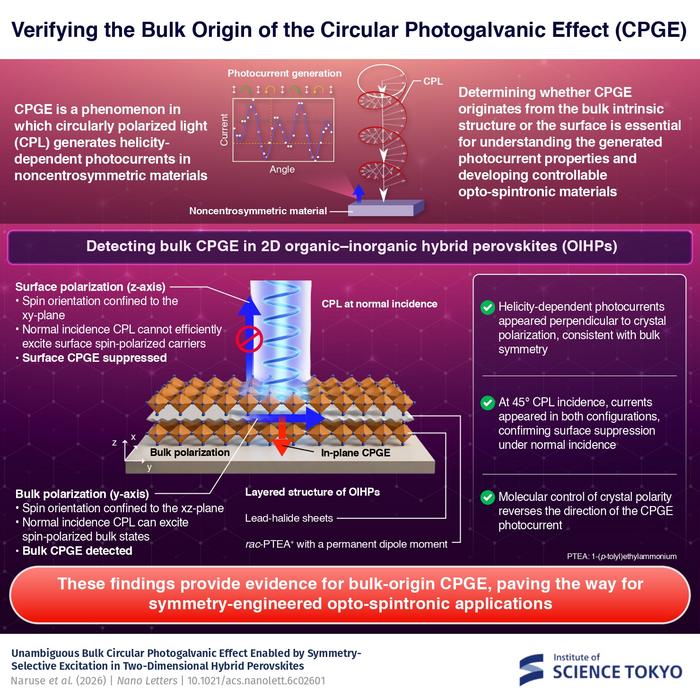
The researchers used circularly polarized light at normal incidence and found that helicity-dependent photocurrents appeared perpendicular to the crystal’s polarization but vanished when measured parallel to it, supporting a bulk origin of CPGE. @Institute of Science Tokyo The circular photogalvanic effect (CPGE), a phenomenon that generates helicity-dependent photocurrents in noncentrosymmetric materials, can originate purely from a crystal's internal structure without contribution from the...
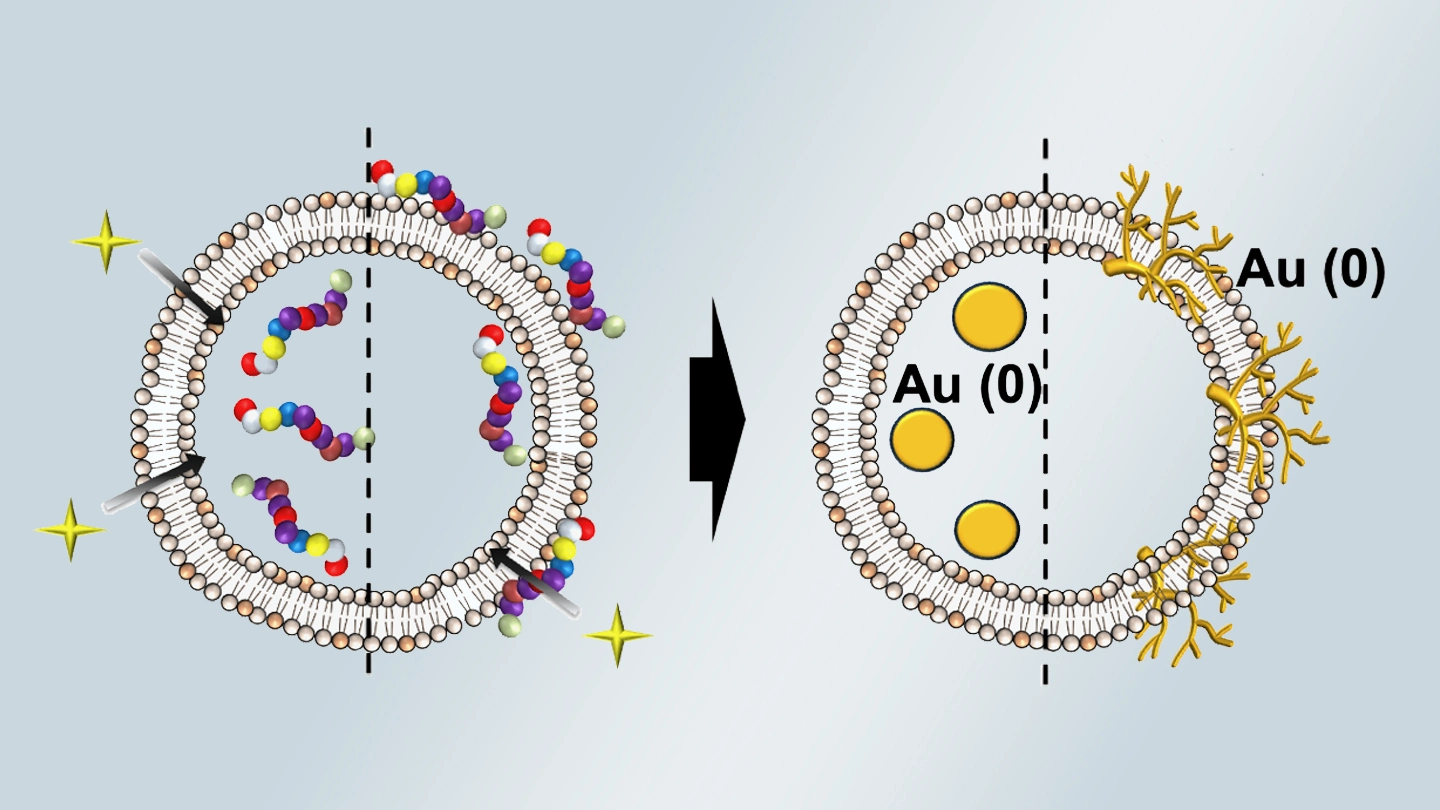
Summary of gold nanoparticle growth programming in liposome based on localization of biomineralization peptide The position of biomineralization peptides within liposomes can influence how gold nanoparticles grow, reports a research team from Institute of Science Tokyo. Peptides localized at the membrane interface promote branched structures, while those confined to the liposome interior favor spherical nanoparticles. The findings offer a new strategy for controlling nanoscale reaction...
