Washington University in St. Louis (WUSTL)

d that energy constraints on a system, coupled with the intrinsic property neurons have to move to the lowest-energy configuration, leads to a dynamic, at-a-distance communication protocol that is both more robust and more energy-efficient than traditional computer processors.
The research, from the lab of Shantanu Chakrabartty, the Clifford W. Murphy Professor in the Preston M. Green Department of Systems & Electrical Engineering, was published last month in the journal Frontiers in Neuroscience.
It's a case of doing more with less.
Ahana Gangopadhyay, a doctoral student in Chakrabartty's lab and a lead author on the paper, has been investigating computer models to study the energy constraints on silicon neurons -- artificially created neurons, connected by wires, that show the same dynamics and behavior as the neurons in our brains.
Like biological neurons, their silicon counterparts also depend on specific electrical conditions to fire, or spike. These spikes are the basis of neuronal communication, zipping back and forth, carrying information from neuron to neuron.
The researchers first looked at the energy constraints on a single neuron. Then a pair. Then, they added more. "We found there's a way to couple them where you can use some of these energy constraints, themselves, to create a virtual communication channel," Chakrabartty said.
A group of neurons operates under a common energy constraint. So, when a single neuron spikes, it necessarily affects the available energy -- not just for the neurons it's directly connected to, but for all others operating under the same energy constraint.
Spiking neurons thus create perturbations in the system, allowing each neuron to "know" which others are spiking, which are responding, and so on. It's as if the neurons were all embedded in a rubber sheet; a single ripple, caused by a spike, would affect them all. And like all physical processes, systems of silicon neurons tend to self-optimize to their least-energetic states while also being affected by the other neurons in the network.
These constraints come together to form a kind of secondary communication network, where additional information can be communicated through the dynamic but synchronized topology of spikes. It's like the rubber sheet vibrating in a synchronized rhythm in response to multiple spikes.
This topology carries with it information that is communicated, not just to the neurons that are physically connected, but to all neurons under the same energy constraint, including ones that are not physically connected.
Under the pressure of these constraints, Chakrabartty said, "They learn to form a network on the fly."
This makes for much more efficient communication than traditional computer processors, which lose most of their energy in the process of linear communication, where neuron A must first send a signal through B in order to communicate with C.
Using these silicon neurons for computer processors gives the best efficiency-to-processing speed tradeoff, Chakrabartty said. It will allow hardware designers to create systems to take advantage of this secondary network, computing not just linearly, but with the ability to perform additional computing on this secondary network of spikes.
The immediate next steps, however, are to create a simulator that can emulate billions of neurons. Then researchers will begin the process of building a physical chip.
A spiking neuron and population model based on the growth transform dynamical system
Ahana Gangopadhyay, Darshit Mehta and Shantanu Chakrabartty
Frontiers in Neuroscience (May 2020)
Contact information:
Shantanu Chakrabartty
WUSTL Professor of Electrical & Systems Engineering
shantanu@wustl.edu
Phone: 314-935-4583
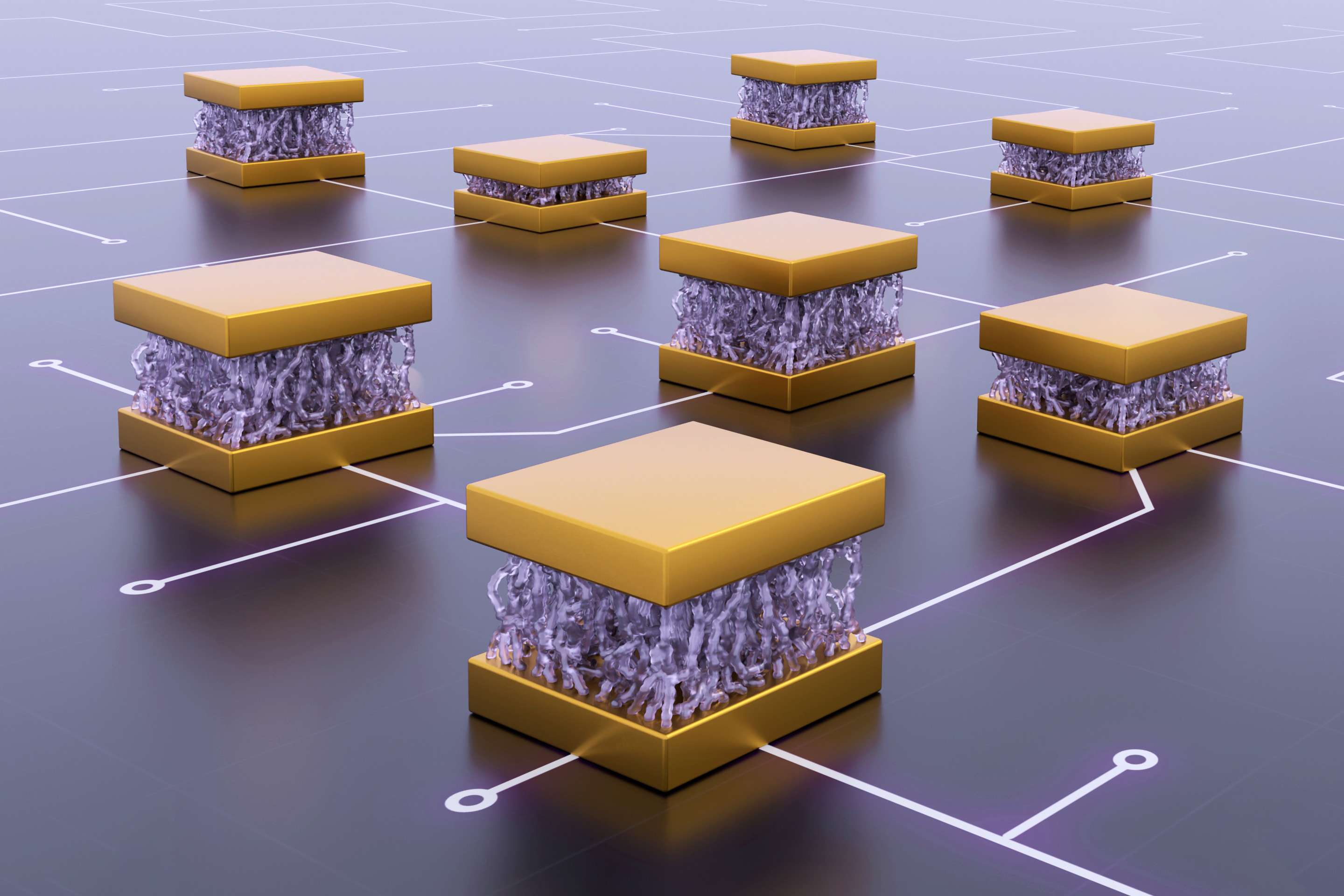
This illustration shows the nano-mechanical devices the researchers developed. Inspired by neurons, they can perform computing tasks with high energy efficiency. Image: Emily Theobald MIT researchers have created a new computing platform that could be used to develop intelligent and adaptive next-generation electronics that can simultaneously perform multiple functions, like computing and memory, all within one extremely compact, energy-efficient device. Such a platform opens opportunities...
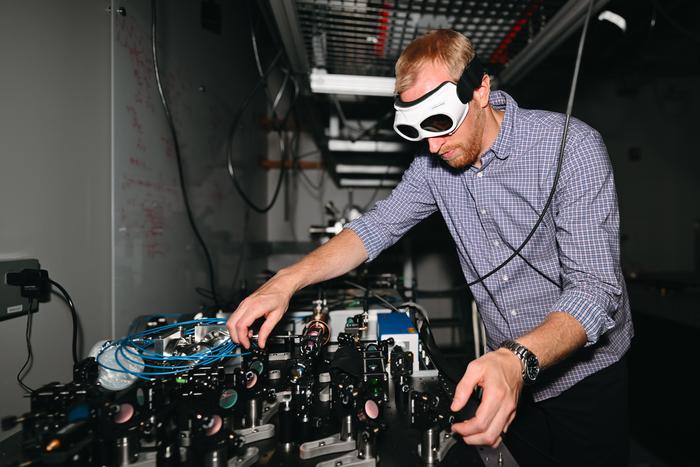
Breakthrough from a team led by Jacob Covey, associate professor in the University of Chicago’s Pritzker School of Molecular Engineering and Department of Physics, turns helium-3’s low mass into a quantum resource
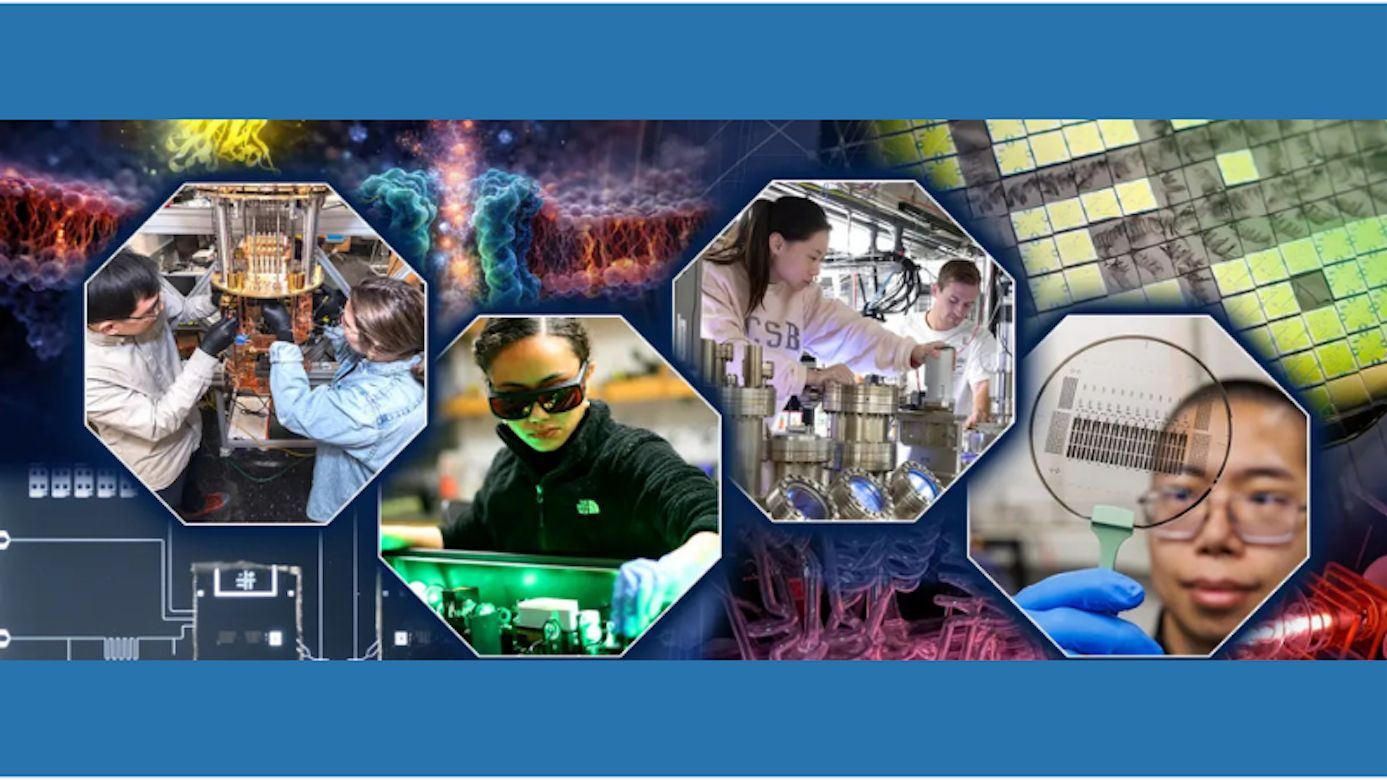
Courtesy of the National Science Foundation The NSF's Quantum Leap Challenge Institutes are taking on some of the hardest scientific hurdles in the global race to create powerful quantum-based technologies. Two UCLA computer scientists will help lead major national efforts to address some of quantum computing’s biggest challenges, serving as co-principal investigators for separate research institutes backed by five-year, $37.5 million grants from the National Science Foundation. The two...