Light Publishing Center, Changchun Institute of Optics, Fine Mechanics And Physics, CAS
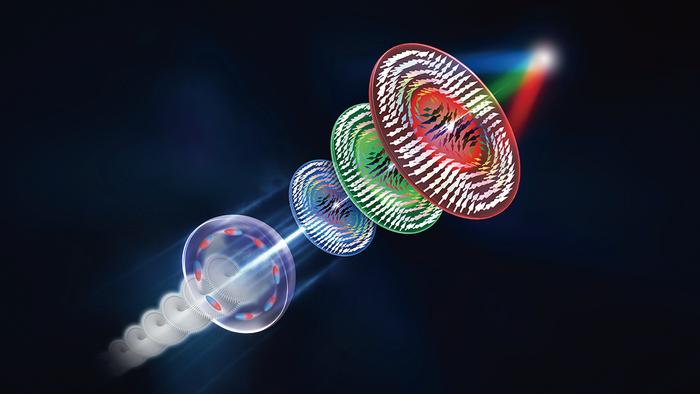
Optical skyrmions, tiny knots of light known for their robustness against noise, are promising candidates for the next generation of information carriers. However, their real-world application has been stalled by a major limitation: they could only be generated in narrow bands of color. Current technologies, like metasurfaces and microcavities, rely on resonant effects that are highly sensitive to specific wavelengths. This has made it nearly impossible to generate broadband skyrmions on a chip—until now.
In a new paper published in eLight, a team of scientists led by Professors Jingbo Sun and Ji Zhou of Tsinghua University, along with Professor Yijie Shen of Nanyang Technological University, has developed a revolutionary solution. They created an on-chip platform using ferroelectric spherulites—dome-shaped microstructures that form naturally through self-assembly.
Unlike traditional methods that require complex nanofabrication, these spherulites act as non-resonant optical elements. The team leveraged the unique properties of these structures to generate stable optical skyrmions across the entire visible spectrum, from blue to red light (450 to 785 nanometers).
“The key advantage is that we avoid the resonance constraints of artificial nanostructures,” the researchers explained. “Our platform uses the natural focusing power of the dome shape. When light hits the structure, it creates a specific texture, or skyrmion, without being picky about the color.”
This mechanism proved remarkably stable, maintaining its topological properties over long distances. Furthermore, the team demonstrated dynamic control over these light patterns. By simply adjusting the input light, they could switch between different types of topological quasiparticles, including skyrmions and biskyrmions.
The discovery also hints at quantum applications. The team observed signs of spontaneous parametric down-conversion within the material, suggesting the potential to generate entangled photon pairs with topological features.
“This breakthrough merges high-capacity data transmission with topological protection,” the scientists forecast. “It opens new avenues for both classical and quantum communication technologies, paving the way for faster and more secure optical networks.”
Reference
Broadband coloured skyrmions generated by on-chip ferroelectric spherulites
Yuanfeng Liu, Liuhao Zhu, Xi Xie, Haoran Zhang, Weibo Gao, Bing Gu, Youcheng Xu, Le Zhou, Yongzheng Wen, Jingbo Sun, Yijie Shen & Ji Zhou
https://link.springer.com/article/10.1186/s43593-026-00132-1
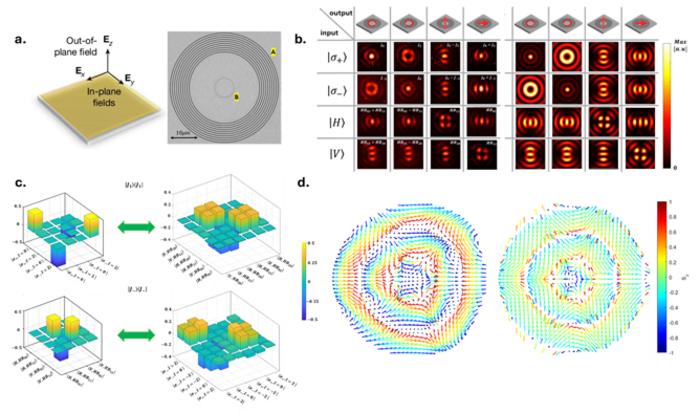
Technion researchers led by Prof. Guy Bartal have created the first on-chip nanophotonic platform that deterministically generates single-photon quantum skyrmions. Using a gold circular grating to control total angular momentum (TAM) of surface plasmons, the device transforms heralded single photons into robust, topologically protected SAM-OAM entangled states with skyrmion number ±2 — without post-selection or multi-photon entanglement. This breakthrough paves the way for scalable, high-dimensi

In nature, the collective motion of some birds and fish, such as flocks of starlings and shoals of sardines, respectively, can generate...
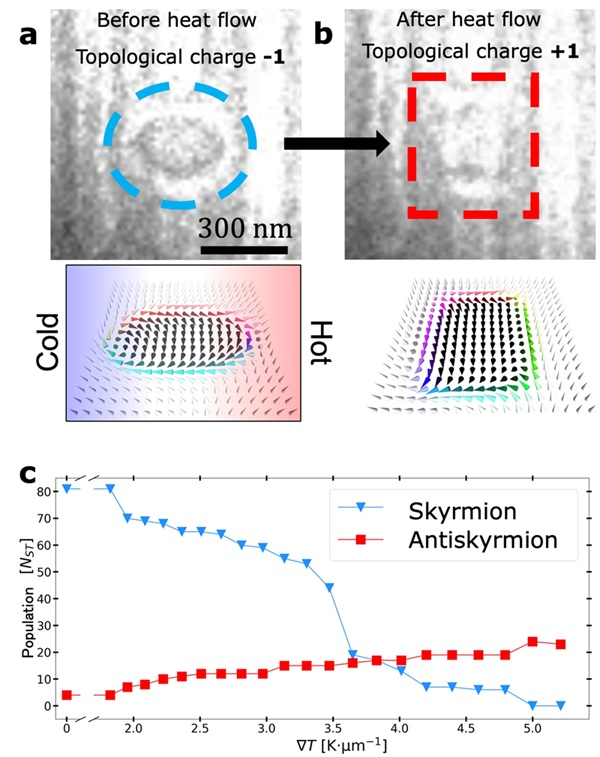
In an experiment that could help the development of new spintronics devices with low energy consumption, researchers from RIKEN and...
This week in nanotech
$10.2M raised
2 funding rounds · 19 deals tracked
New products
 DLS-1 Mass Spectrometer for Fusion Gas AnalysisHiden Analytical Featured
 Nion-compatible In Situ STEM Holders for Electrical BiasingHummingbird Scientific Featured
 NanoFlow® S1-20Levidian
Market insights
Last 30 days: Quantum Technologies was the busiest vertical: 61 of 192 events (32%).
Money raised per month