Light Publishing Center, Changchun Institute of Optics, Fine Mechanics And Physics, CAS
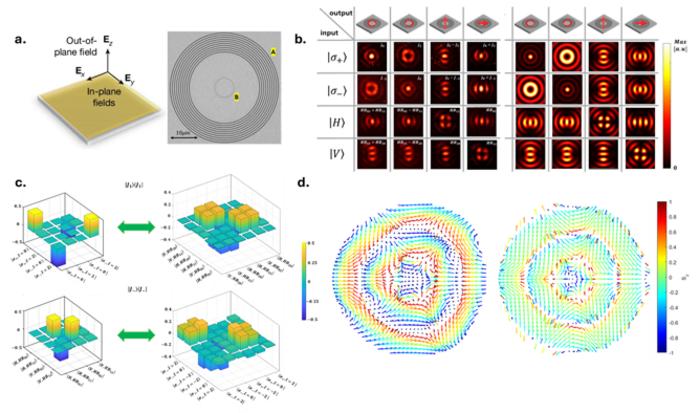
Skyrmions - intricate, topologically protected vector field textures - have emerged as a profoundly robust medium for information processing, fundamentally reshaping our approach to nanoscale data. These topological structures were originally conceptualized in particle physics and widely utilized in condensed matter. Skyrmions were brought into the photonic realm only in 2018, through the pioneering discovery of optical skyrmions by the Technion team. Now, as we enter the quantum era, the demand to translate these topological benefits to the single-photon level has driven the pursuit of quantum skyrmions for high-dimensional quantum computing and secure information processing. However, conventional quantum systems are typically bulky and can hardly be deployed in scalable on-chip settings. Existing methods often require complex dual-beam implementations to synthesize the necessary vector fields, rely on fragile multi-photon entanglement, or necessitate post-selecting a skyrmionic component from a broader quantum state. As such, they lack both the capacity for device miniaturization and the natural, deterministic generation of high-dimensional quantum states.
In a new paper, an experimental team led by Professor Guy Bartal from the Helen Diller Quantum Center and the Viterbi Department of Electrical & Computer Engineering, Technion – Israel Institute of Technology ,have developed an advanced nanophotonic platform for jointly controlling quantum states in the near-field and mapping them into a large free-space Hilbert space. This work builds directly upon the group's foundational experimental demonstration of near-field photon entanglement in total angular momentum (TAM), published last year in Nature. When photons are tightly confined on the sub-wavelength scale, their spin angular momentum (SAM) and orbital angular momentum (OAM) become inseparable, leaving TAM as the good quantum number. Based on this principle, the researchers designed a miniature optical chip that utilizes TAM to realize the robust transformation of heralded single photons into complex, entangled states. Remarkably, the researchers showed that these TAM states naturally form quantum optical Stokes skyrmion with controlled topological invariant of ±2, completely eliminating the need for post-selection. As such, their platform allows us to robustly morph quantum information and map non-trivial topology seamlessly into free-space.
The experimental quantum system is centered around a surface plasmon platform - a gold-air interface patterned with a circular grating meticulously designed to couple light into surface plasmon polariton (SPP) modes that carry this well-defined TAM. “Since the angular momentum of the vector SPP mode is solely characterized by its TAM, the system effectively acts as both a dissipative and entangling non-unitary quantum circuit” say the researchers.
The circularly-symmetric nanophotonic platform combines three purposes in one: (1) to couple incident polarized photons into near-field SPP modes defined purely by their TAM, (2) scatter these propagating TAM modes out to free-space , thereby inherently transform the TAM state into SAM-OAM entanglement; and (3) to perform precise quantum state tomography (QST) using heralded single photons, definitively mapping how the near-field TAM state evolves into a high-dimensional free-space entangled Bell like state."
“This single-photon skyrmion is naturally generated by the nanophotonic platform directly from the TAM states and does not require dual-beam implementations to synthesize the vector field nor multi-photon entanglement” added the authors. “this provides a robust generation of quantum skyrmions, on top of their inherent resilience to perturbations, emanating from their topology”.
"The presented technique can be used to generate novel quantum states of light with SAM and OAM by leveraging nonlinear interactions between a strong free-space pump and quantum surface-confined states. This breakthrough could open a new venue for scalable, high-dimensional quantum information processing, on-chip sources for qudits, and qudit-based quantum key distribution relying on exactly the same device geometry without causing efficiency issues," the scientists forecas.
Reference
Quantum skyrmions and high dimensional entanglement mediated by nanophotonics
Amit Kam, Shai Tsesses, Lior Fridman, Yigal Ilin, Amir Sivan, Guy Sayer, Stav Lotan, Kobi Cohen, Amit Shaham, Liat Nemirovsky-Levy, Larisa Popilevsky, Aviv Karnieli, Meir Orenstein, Mordechai Segev & Guy Bartal
https://link.springer.com/article/10.1186/s43593-026-00124-1

A new nanophotonic material has broken records for high-temperature stability, potentially ushering in more efficient electricity...

Joshua Caldwell, Flowers Family Chancellor’s Faculty Fellow in Engineering and associate professor of mechanical engineering, and Joseph...

The newly developed shape memory polymer resist which allows for high-resolution 4D printing, promises a platform for information hiding...
