SLAC National Accelerator Laboratory
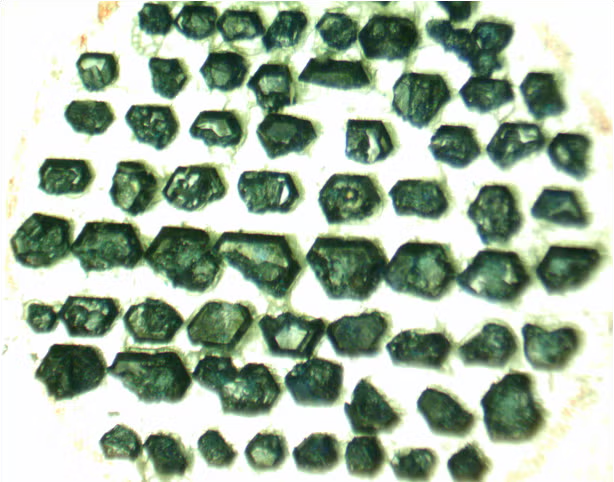
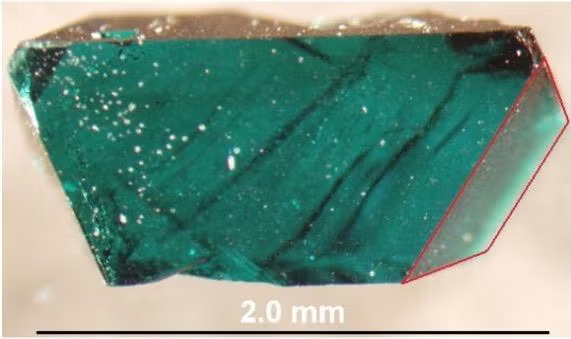
The blue-green lab-grown crystals look like solid rocks, but their atomic states are constantly changing. A team of researchers at the Department of Energy’s SLAC National Accelerator Laboratory and Stanford University recently discovered a new example of a quantum spin liquid – a unique state of matter that may one day be used in qubits, the information-storing quantum computer components analogous to classical computer bits.
Zinc barlowite forms a crystal lattice of ever-fluctuating magnetic spins, even as temperatures approach absolute zero, the team reported in Nature Physics. Those spins also show signs of quantum entanglement across the material. “It’s the marriage of quantum mechanics and strongly interacting microscopic components in a material,” said Stanford Applied Physics Professor Young Lee, the study’s senior author and principal investigator at the Stanford Institute for Materials and Energy Science, a joint SLAC-Stanford institute.
The search for quantum spin liquids
Since the 1980s, physicists have theorized that such a state of matter may exist. They imagined it as the precursor of high-temperature superconductors, materials that can move electricity with no energy loss without needing to be extremely cold. In 2007, Lee and colleagues first found experimental evidence of spin liquid behavior in the mineral herbertsmithite.
“A quantum spin liquid is a new state of magnetism,” explained Aaron Breidenbach, Stanford PhD student in physics and first author of the study. There are normally two states of magnetism: ferromagnetism and antiferromagnetism. In ferromagnets, like refridgerator magnets, the material’s atomic spins all align in one direction, creating attraction and repulsion between other ferromagnets. In antiferromagnets, the atoms’ spins alternate facing up and down, cancelling each other out. In both examples, the magnetic spins can find a direction that energetically suits them and stabilize. But in special configurations of atoms, the magnetism is fidgety, unable to find an ideal direction.
One of these configurations is called a kagome lattice, which consists of rows of hexagons surrounded by triangles that share corners. Every atom at a triangle corner wants its spin to align in the opposite direction of its neighbor – but with an odd number of corners, it’s not possible. So, the atoms’ spins are highly frustrated. On top of that, the lattice structure coupled with the small value for each spin induces quantum entanglement, where spins are correlated with each other across the lattice – if one faces “up,” the other faces “down.”
These two properties together mean that the spins never stop flipping up and down. That’s why physicists call the material a liquid – you can’t pour it in a cup, but at the microscopic level the magnetism never stops “flowing,” even at absolute zero temperature. “You can go as low in temperature as you want,” said co-lead author Arthur Campello, a Stanford PhD student in applied physics. “You never see any evidence that the spins order.”
Currently, there is no consensus that quantum spin liquids exist in real materials. The researchers wanted to identify more strong candidates, in addition to herbertsmithite, to confirm the universal behavior of quantum spin liquid physics. They identified another material that forms a kagome lattice: zinc barlowite, a mineral consisting of magnetic copper atoms sandwiched between layers of non-magnetic zinc.
Growing a spin liquid
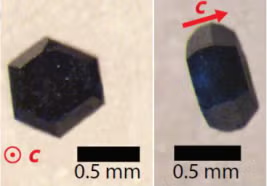
Natural minerals are full of impurities, so the researchers grew zinc barlowite in the lab. However, because barlowite is fluorinated, it would destroy the walls of the quartz test tube it’s grown in. To solve this challenge, Breidenbach pioneered a new growth technique that involved placing Teflon between the barlowite fluid and the test tube. After preparing precise amounts of compounds containing copper, zinc, and other elements in a tube of deuterated water, the researchers heated one side of the tube more than the other, which created a temperature gradient that helped precipitate crystals. After about a year of growing the mineral, they then had to pick apart hundreds of crystal clumps and arrange the crystals so they faced the same direction, gluing the final assembly together.
Next, the team took the zinc barlowite sample to DOE’s Oak Ridge National Laboratory in Tennessee, where they aimed neutrons at the sample using the lab’s Spallation Neutron Source. In a chamber cooled to 2 degrees above absolute zero (negative 456 degrees Fahrenheit), neutrons were scattered off the sample, and the team measured the particles’ energy and momentum coming off the crystal. In an ordered magnet, the neutrons would have produced a sharp peak in energy. Instead, the researchers saw a broad spectrum of neutron energies, which revealed that the magnetic spins in the material are fluctuating in an unusual way. Additionally, the scattering pattern indicated the presence of an exotic type of quasi particle, called a spinon, thought to be a signature of spin liquids.
The experimental results also mirrored a computer simulation of spin liquid behavior, providing further evidence. Together, “we have a better story and more promising evidence” of the material’s spin liquid status, said study co-author Hong-Chen Jiang, a staff scientist at SLAC.
A robust qubit candidate
The findings also suggest that “entanglement information exists over the whole sample,” said Lee. “It’s not just atomic spacings, but over much longer distances.” This greater degree of quantum entanglement means that this material could potentially be used to create more robust qubits. Right now, the candidates for storing information in quantum computers are fickle – local impurities, such as a speck of dirt, can destroy their quantum state and thus information-holding abilities.
In future work, the researchers aim to grow crystals with fewer impurities, which would enhance the information obtained in neutron scattering experiments. Further tests could also reveal how entangled the spins are and whether the material can be modified to become a superconductor. With more research, the applications of this unique state of matter will become visible – perhaps with some surprises. “The most exciting thing is that we still don’t quite know all the potential applications because these materials are a relatively unexplored state of matter,” said Breidenbach.
Reference
Identifying universal spin excitations in candidate spin-1/2 kagome quantum spin liquid materials
Aaron T. Breidenbach, Arthur C. Campello, Jiajia Wen, Hong-Chen Jiang, Daniel M. Pajerowski, Rebecca W. Smaha & Young S. Lee
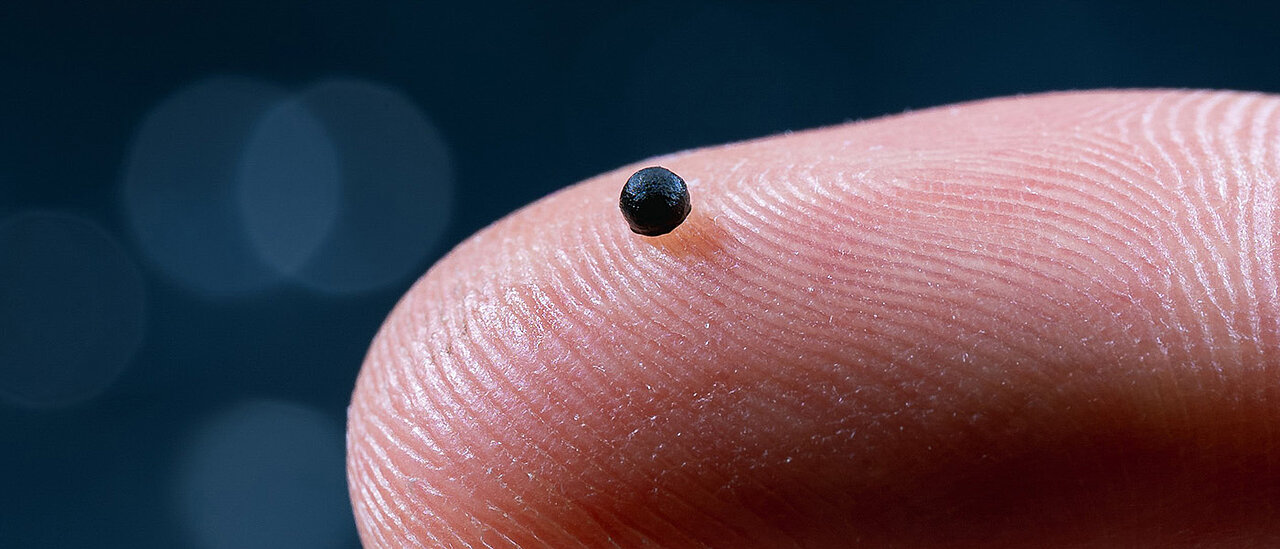
Drugs are often only needed at a specific site in the body. That is why medical research has long been trying to deliver them precisely to where they are needed – in the case of a stroke, directly to the vicinity of the blood clot. A team from ETH Zurich has now achieved decisive breakthroughs on several levels in pursuit of this goal. The results have been published in the prestigious journal Science. The authors of the publication include Professor Tessa Lühmann from the Institute of Pharma...
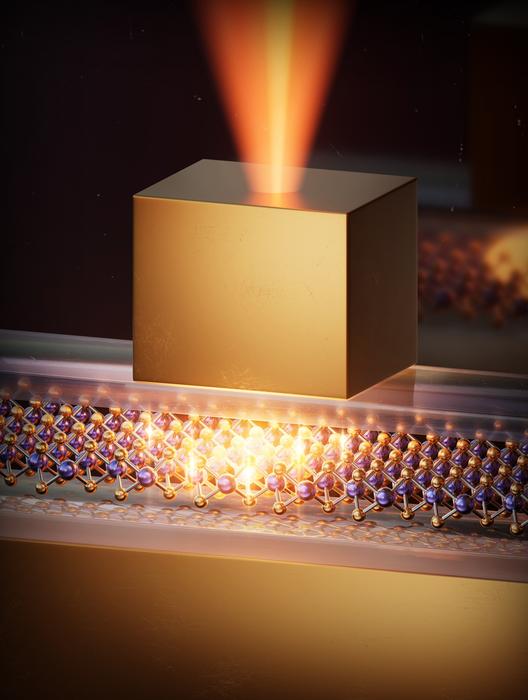
A research team at the City University of New York and the University of Texas at Austin has discovered a way to make previously hidden states of light, known as dark excitons, shine brightly, and control their emission at the nanoscale. Their findings, published today in Nature Photonics, open the door to faster, smaller, and more energy-efficient technologies. Dark excitons are exotic light-matter states in atomically thin semiconductors that typically remain invisible because they emit lig...
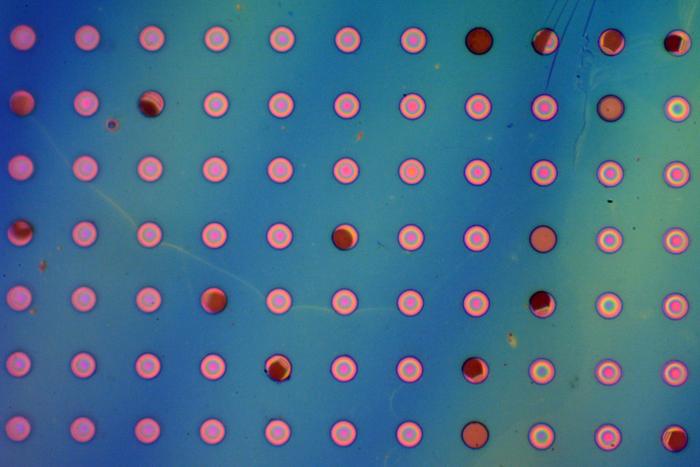
MIT researchers have developed a lightweight polymer film that is nearly impenetrable to gas molecules, raising the possibility that it could be used as a protective coating to prevent solar cells and other infrastructure from corrosion, and to slow the aging of packaged food and medicines. The polymer, which can be applied as a film mere nanometers thick, completely repels nitrogen and other gases, as far as can be detected by laboratory equipment, the researchers found. That degree of imper...