KTH Royal Institute of Technology
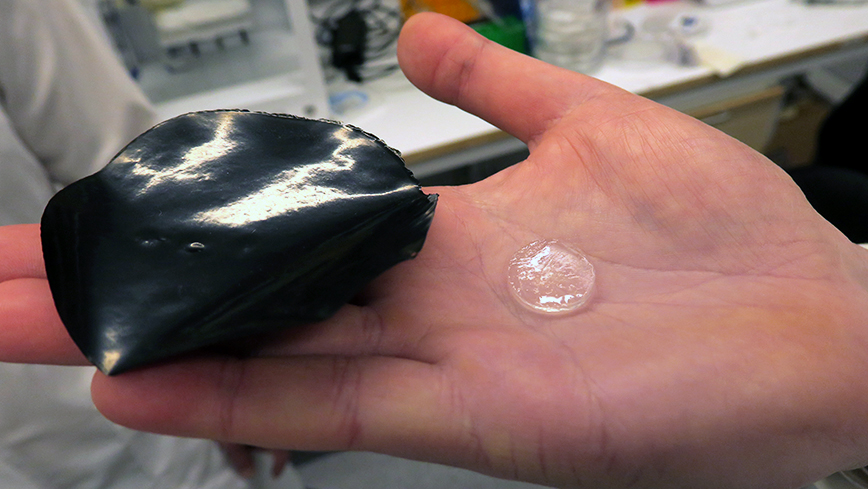
Wood is the source for a brick-breaking mini robotic muscle material developed by researchers at KTH Royal Institute of Technology. The material — a specially-developed hydrogel — can shape-shift, expand and contract on demand when controlled with electronic impulses of less than 1 volt.
Robotics is just one potential use for the material, which is made with cellulose nanofibers (CNFs) derived from wood. The technology also presents possibilities in medicine and biochemical production.
The results were reported in Advanced Materials by researchers at KTH Royal Institute of Technology.
Unlike robotic muscles that expand with the power of pressurized air or liquid, these hydrogels swell due to water movement driven by electrochemical pulses, says Tobias Benselfelt, a researcher at KTH Royal Institute of Technology’s Division of Fibre Technology.
The material’s key components are water, carbon nanotubes as a conductor, and cellulose nanofibers that are sourced from wood pulp. Though the material is a hydrogel, it appears as strips of plastic when it is combined with carbon nanofibers.
Inspired by plants
The material’s strength comes from the orientation of the nanofibers in the same direction, just as in wood grain. “Nanofiber hydrogels swell uniaxially—on a single axis—generating high pressure,” Benselfelt says. “A single 15 x 15cm piece can lift a 2-tonne car.”
The material’s swelling can be controlled electronically as a result of adding conductive carbon nanotubes to the hydrogel, which creates what the researchers call electrochemical osmotic hydrogel actuators.
KTH Professor Max Hamedi, who co-authored the work, says inspiration for the project came from the way that plants grow.
“Think about how strong plants are,” Hamedi says. “Trees can grow up through the pavement by the same forces that we’re applying – we’re just controlling that force electronically.”
Potential uses
One exciting aspect of the research is that the material’s porosity can be controlled electronically, Benselfelt says. Porosity can be increased by up to 400 percent, which makes these hydrogels an ideal material for electrotunable membranes to separate or distribute molecules or drugs in situ.
This precisely-controlled expansion is also what enables the material to exert enough force to break a small brick, which is what the researchers demonstrated in conjunction with their study. Though for now, the researchers envision their use being limited to small devices such as valves or switches in microfluidics. “Currently, they come in thin sheets, which limits their use as artificial muscles for larger robots,” Hamedi says.
Looking farther into the future one possible robotics application could be in underwater robots. Benselfelt says that these can be used at great depths since hydrogels cannot be compressed by water pressure.
“Generally, it is a step towards soft machines that are lifelike. However, this vision is very far in the future,” he says.
Another benefit of the technology is that it is relatively inexpensive to manufacture. The team continues to optimize the material, 3D-print electronic muscles, and study how to scale it for commercial use.
Reference
Electrochemically Controlled Hydrogels with Electrotunable Permeability and Uniaxial Actuation
Tobias Benselfelt, Jyoti Shakya, Philipp Rothemund, Stefan B. Lindström, Andrew Piper, Thomas E. Winkler, Alireza Hajian, Lars Wågberg, Christoph Keplinger, Mahiar Max Hamedi
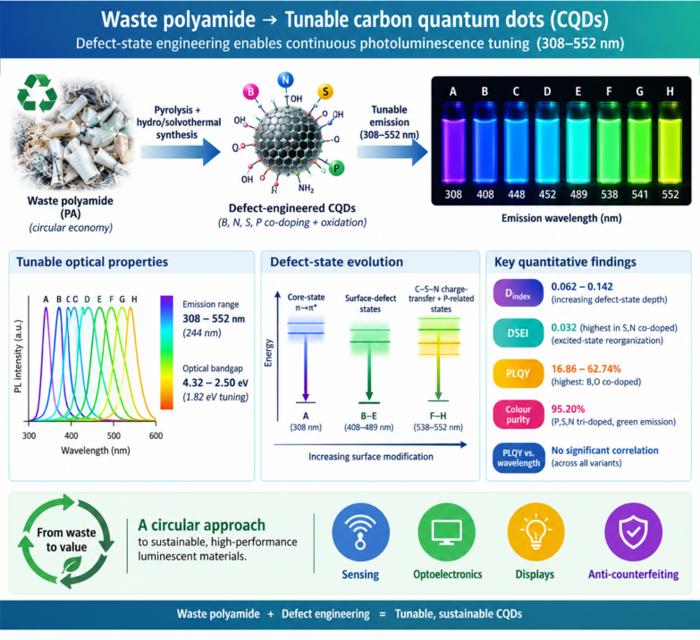
Waste polyamide-derived CQDs show continuous photoluminescence tuning from 308 to 552 nm through sequential defect-state engineering, with optical transition energies decreasing from 4.32 to 2.50 eV. @Christian Ebere Enyoh from Saitama University Carbon quantum dots (CQDs) are fluorescent carbon nanomaterials with potential applications in sensing, optoelectronics, displays, anti-counterfeiting, and environmental technologies. Their optical properties can be adjusted by modifying the carbon...
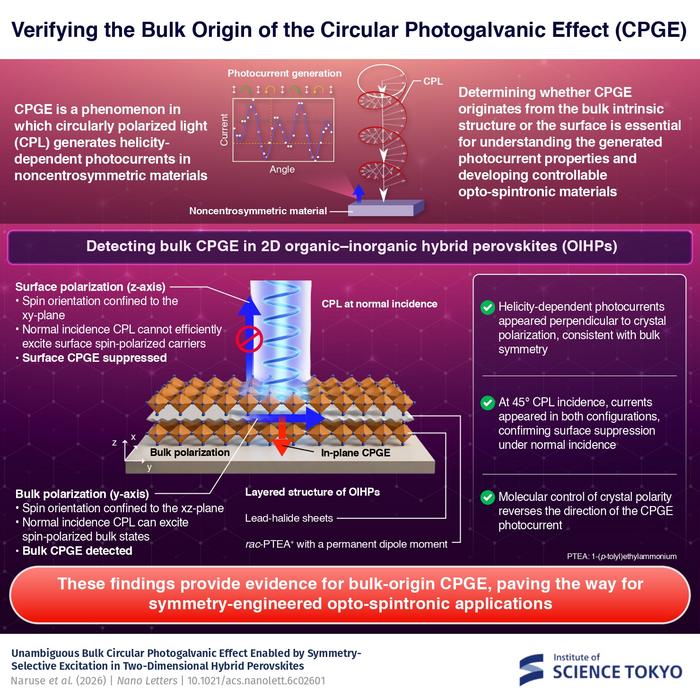
The researchers used circularly polarized light at normal incidence and found that helicity-dependent photocurrents appeared perpendicular to the crystal’s polarization but vanished when measured parallel to it, supporting a bulk origin of CPGE. @Institute of Science Tokyo The circular photogalvanic effect (CPGE), a phenomenon that generates helicity-dependent photocurrents in noncentrosymmetric materials, can originate purely from a crystal's internal structure without contribution from the...
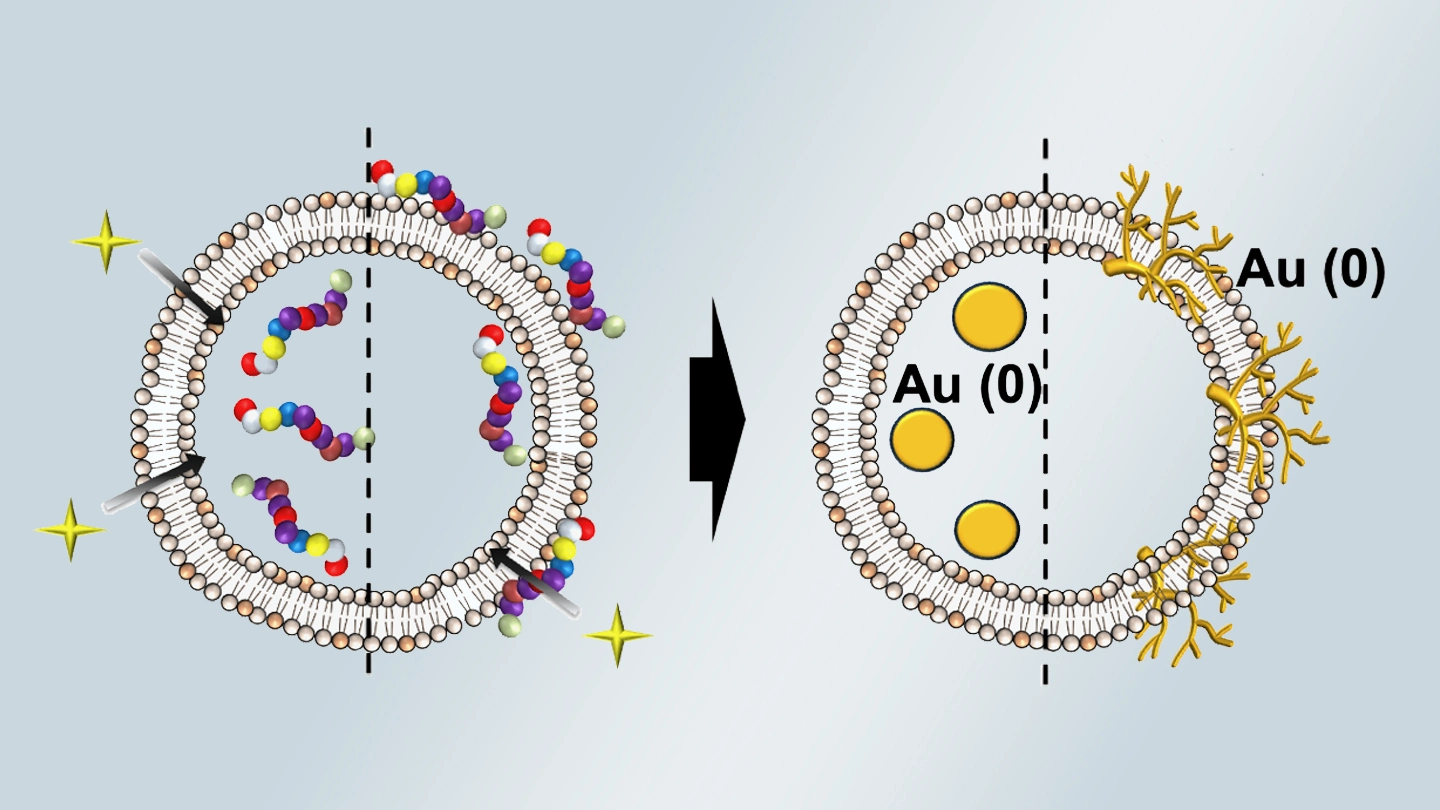
Summary of gold nanoparticle growth programming in liposome based on localization of biomineralization peptide The position of biomineralization peptides within liposomes can influence how gold nanoparticles grow, reports a research team from Institute of Science Tokyo. Peptides localized at the membrane interface promote branched structures, while those confined to the liposome interior favor spherical nanoparticles. The findings offer a new strategy for controlling nanoscale reaction...
