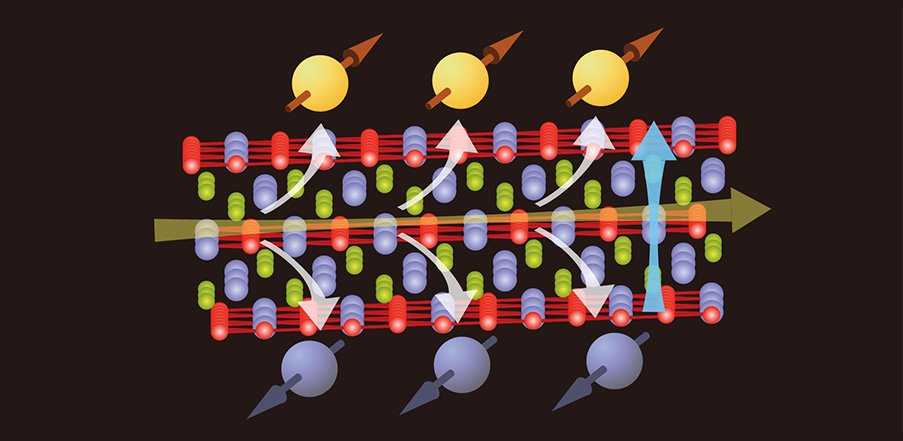
A group of researchers have made a significant breakthrough which could revolutionize next-generation electronics by enabling non-volatility, large-scale integration, low power consumption, high speed, and high reliability in spintronic devices.
Details of their findings were published in the journal Physical Review B on August 25, 2023.
Spintronic devices, represented by magnetic random access memory (MRAM), utilize the magnetization direction of ferromagnetic materials for information storage and rely on spin current, a flow of spin angular momentum, for reading and writing data.
Conventional semiconductor electronics have faced limitations in achieving these qualities.
However, the emergence of three-terminal spintronic devices, which employ separate current paths for writing and reading information, presents a solution with reduced writing errors and increased writing speed. Nevertheless, the challenge of reducing energy consumption during information writing, specifically magnetization switching, remains a critical concern.
A promising method for mitigating energy consumption during information writing is the utilization of the spin Hall effect, where spin angular momentum (spin current) flows transversely to the electric current. The challenge lies in identifying materials that exhibit a significant spin Hall effect, a task that has been clouded by a lack of clear guidelines.
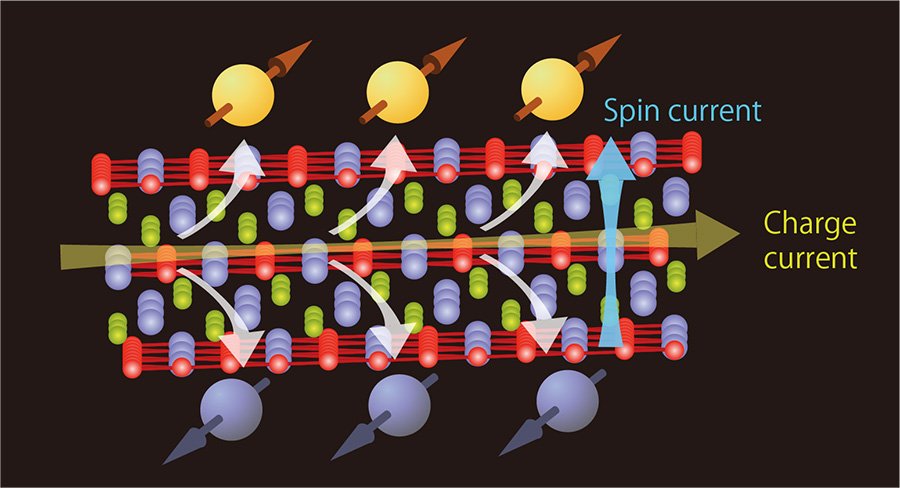
"We turned our attention to a unique compound known as cobalt-tin-sulfur (Co3Sn2S2), which exhibits ferromagnetic properties at low temperatures below 177 K (-96 °C) and paramagnetic behavior at room temperature," explains Yong-Chang Lau and Takeshi Seki, both from the Institute for Materials Research (IMR), Tohoku University and co-authors of the study. "Notably, Co3Sn2S2 is classified as a topological material and exhibits a remarkable anomalous Hall effect when it transitions to a ferromagnetic state due to its distinctive electronic structure."
Lau, Seki and colleagues employed theoretical calculations to explore the electronic states of both ferromagnetic and paramagnetic Co3Sn2S2, revealing that electron-doping enhances the spin Hall effect. To validate this theoretical prediction, thin films of Co3Sn2S2 partially substituted with nickel (Ni) and indium (In) were synthesized. These experiments demonstrated that Co3Sn2S2 exhibited the most significant anomalous Hall effect, while (Co2Ni)Sn2S2 displayed the most substantial spin Hall effect, aligning closely with the theoretical predictions.
"We uncovered the intricate correlation between the Hall effects, providing a clear path to discovering new spin Hall materials by leveraging existing literature as a guide," adds Seki. "This will hopefully accelerate the development of ultralow-power-consumption spintronic devices, marking a pivotal step toward the future of electronics."
Reference
Intercorrelated anomalous Hall and spin Hall effect in kagome-lattice Co3Sn2S2-based shandite films
Yong-Chang Lau, Junya Ikeda, Kohei Fujiwara, Akihiro Ozawa, Jiaxin Zheng, Takeshi Seki, Kentaro Nomura, Liang Du, Quansheng Wu, Atsushi Tsukazaki, and Koki Takanashi
https://journals.aps.org/prb/abstract/10.1103/PhysRevB.108.064429
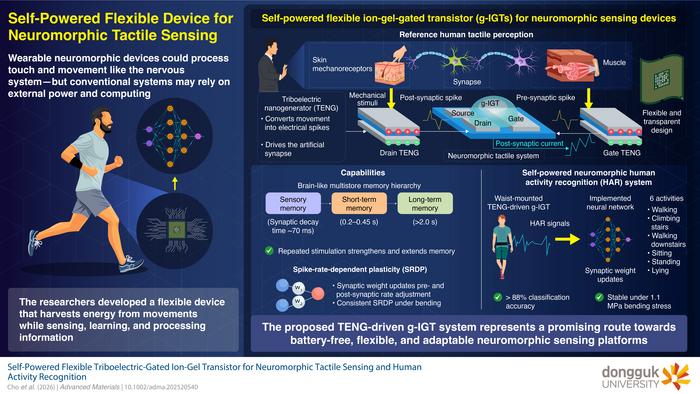
The proposed TENG-driven g-IGT is a flexible, self-powered neuromorphic device capable of reproducing multiple memory states and spike-rate-dependent learning Neuromorphic devices, which are designed to emulate aspects of biological neural networks, are promising candidates for developing low-power and intelligent sensing technologies, including wearable applications. Among the device architectures explored for neuromorphic computing, graphene-channel ion-gel-gated transistors (g-IGTs) are...
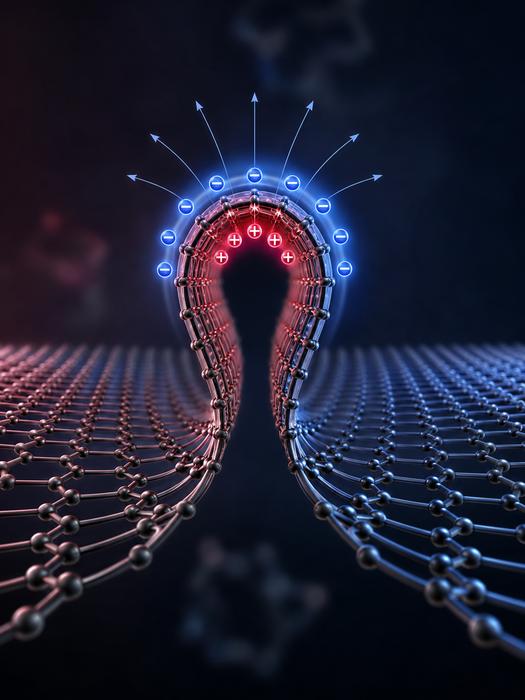
Rice University researchers have shown that sub-nanometer wrinkles in graphene generate flexoelectric charge separation, reshaping local electrical behavior through curvature alone. Extreme bending produces polarization far stronger than in larger systems and may enable geometry-controlled electronics without chemical doping. Published in Advanced Materials.
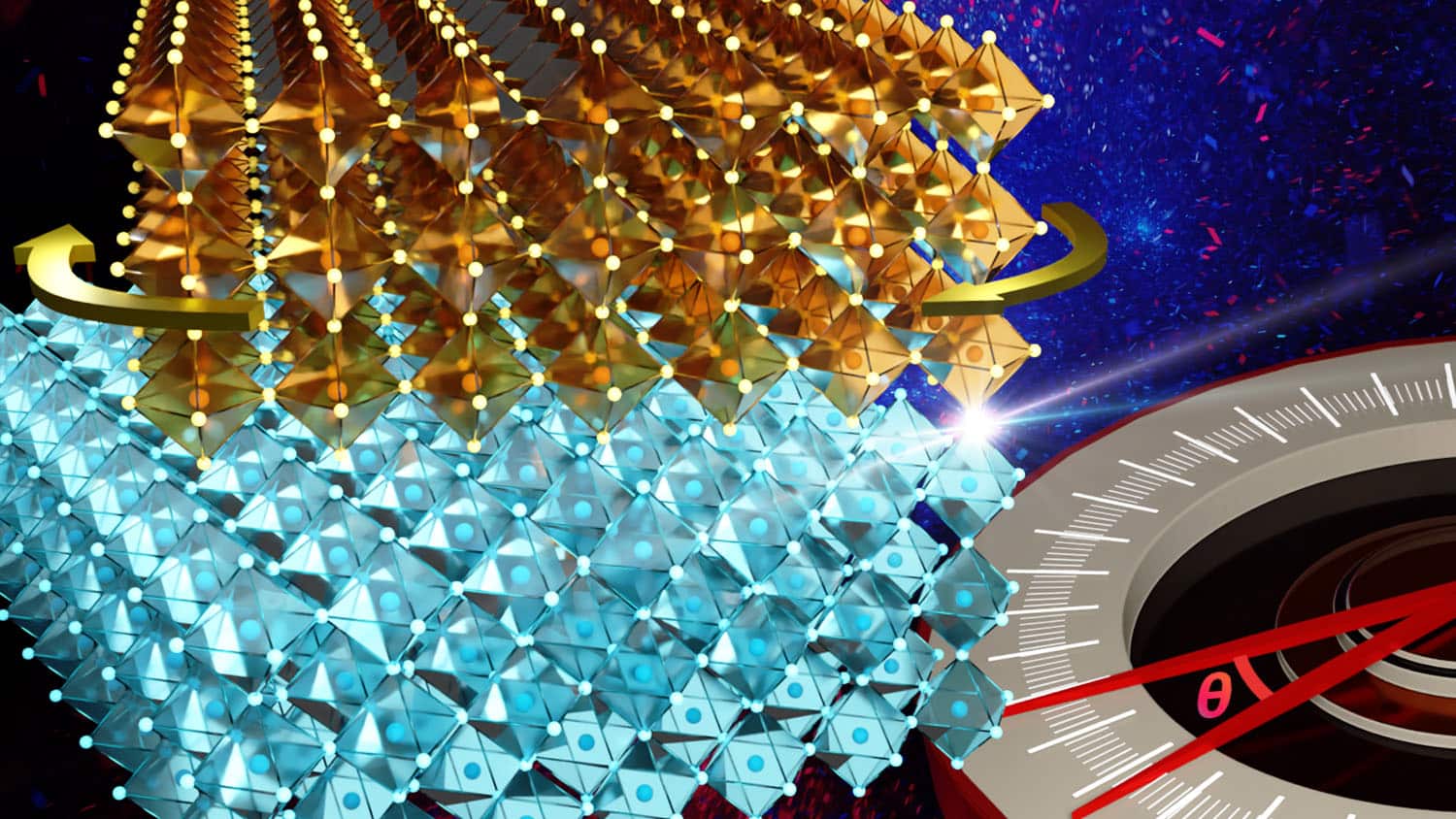
Researchers at NC State have extended twistronics beyond van der Waals materials into strongly bonded crystalline oxides. By stacking sodium niobate membranes with twist angles controlled down to 0.1 degrees, and confirming results via synchrotron X-ray diffraction, the team found interlayer bonds distort the atomic lattice, shifting phase structure and domain configuration. The technique works at near-millimeter scale, far larger than typical twistronic devices, marking a real step toward pract
