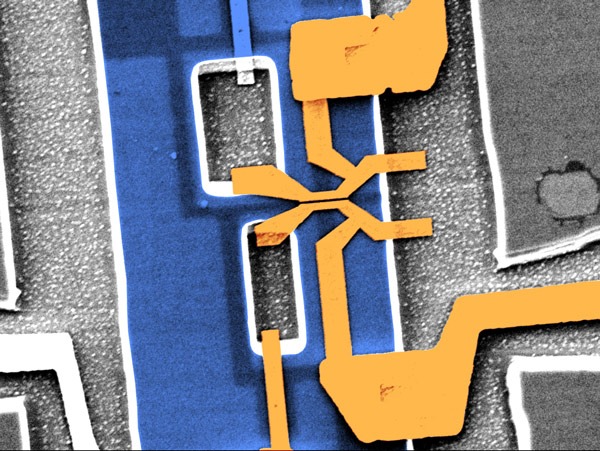
RIKEN physicists have created a superconducting diode—a device that allows a supercurrent to flow in one direction but not the other. While not the first time that such a device has been realized, this demonstration presents a new method for achieving it.
Superconductors, which allow electrical currents to flow without resistance, hold out exciting possibilities for electronics. That’s because superconducting circuits and devices promise to harness a wide range of exotic phenomenon that aren’t possible in conventional semiconductor-based devices. For example, they could be used as the basic building blocks of quantum computers.
One of the most important components in conventional silicon-based electronics is the diode—a device that lets current flow in one direction but not in the other.
An analogous concept, the superconducting diode effect also exists where the electrical resistance depends on which way the current is flowing. This effect was first demonstrated in 2020 by a group at Kyoto University and has subsequently been realized by many other groups.
Now, Sadashige Matsuo of the RIKEN Center for Emergent Matter Science and his co-workers have demonstrated the superconducting diode effect in a new way—by using two devices known as Josephson junctions (Fig. 1). In particular, they were able to use one junction to control the flow of a supercurrent in the other.
Josephson junctions consist of a thin film of a non-superconducting material sandwiched between two superconductors. Up to some critical current, electrons can cross the barrier without resistance in what is known as a supercurrent. Above the critical current, a conventional current can flow.
The key to realizing the superconducting diode effect was breaking symmetries in the device. “Symmetries, both those in space and time, in a superconducting device require that the critical currents in the two flow directions be the same,” explains Matsuo. “By breaking these symmetries, the critical current in one direction can be different from one in the other direction.” This is the superconducting diode effect.
Matsuo and team started by covering a thin but high-quality layer, known as a quantum well, of the semiconductor indium arsenide with a film of aluminum. On this platform, they then constructed two Josephson junctions that shared one superconducting electrode.
At a very low temperature, the team showed that phase control of one of the coupled junctions can break the time-reversal and spatial-inversion symmetries in the other junction.
The results provide a practical method for harnessing superconducting on a scalable electronic platform. “The next step is to use our coupled Josephson junctions to explore other exotic superconducting phenomena,” says Matsuo.
Reference
Josephson diode effect derived from short-range coherent coupling
Sadashige Matsuo, Takaya Imoto, Tomohiro Yokoyama, Yosuke Sato, Tyler Lindemann, Sergei Gronin, Geoffrey C. Gardner, Michael J. Manfra & Seigo Tarucha
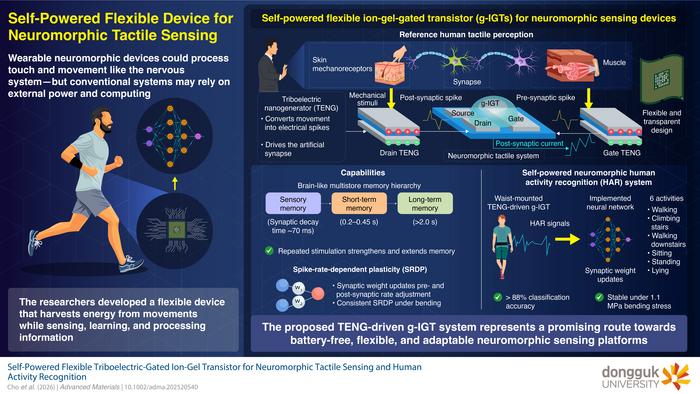
The proposed TENG-driven g-IGT is a flexible, self-powered neuromorphic device capable of reproducing multiple memory states and spike-rate-dependent learning Neuromorphic devices, which are designed to emulate aspects of biological neural networks, are promising candidates for developing low-power and intelligent sensing technologies, including wearable applications. Among the device architectures explored for neuromorphic computing, graphene-channel ion-gel-gated transistors (g-IGTs) are...
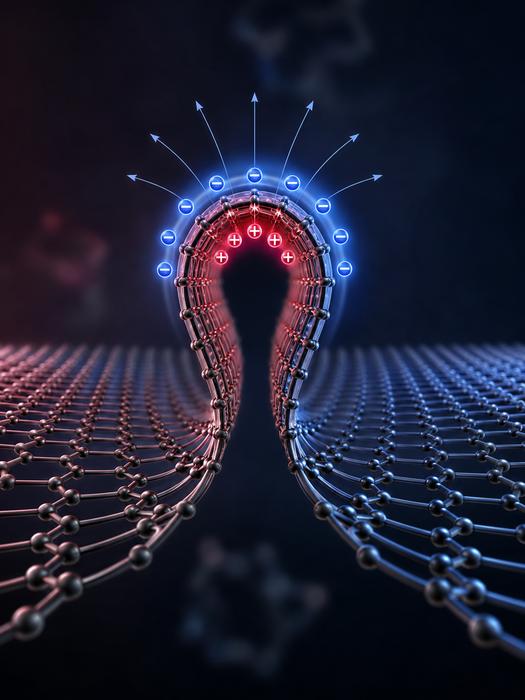
Rice University researchers have shown that sub-nanometer wrinkles in graphene generate flexoelectric charge separation, reshaping local electrical behavior through curvature alone. Extreme bending produces polarization far stronger than in larger systems and may enable geometry-controlled electronics without chemical doping. Published in Advanced Materials.
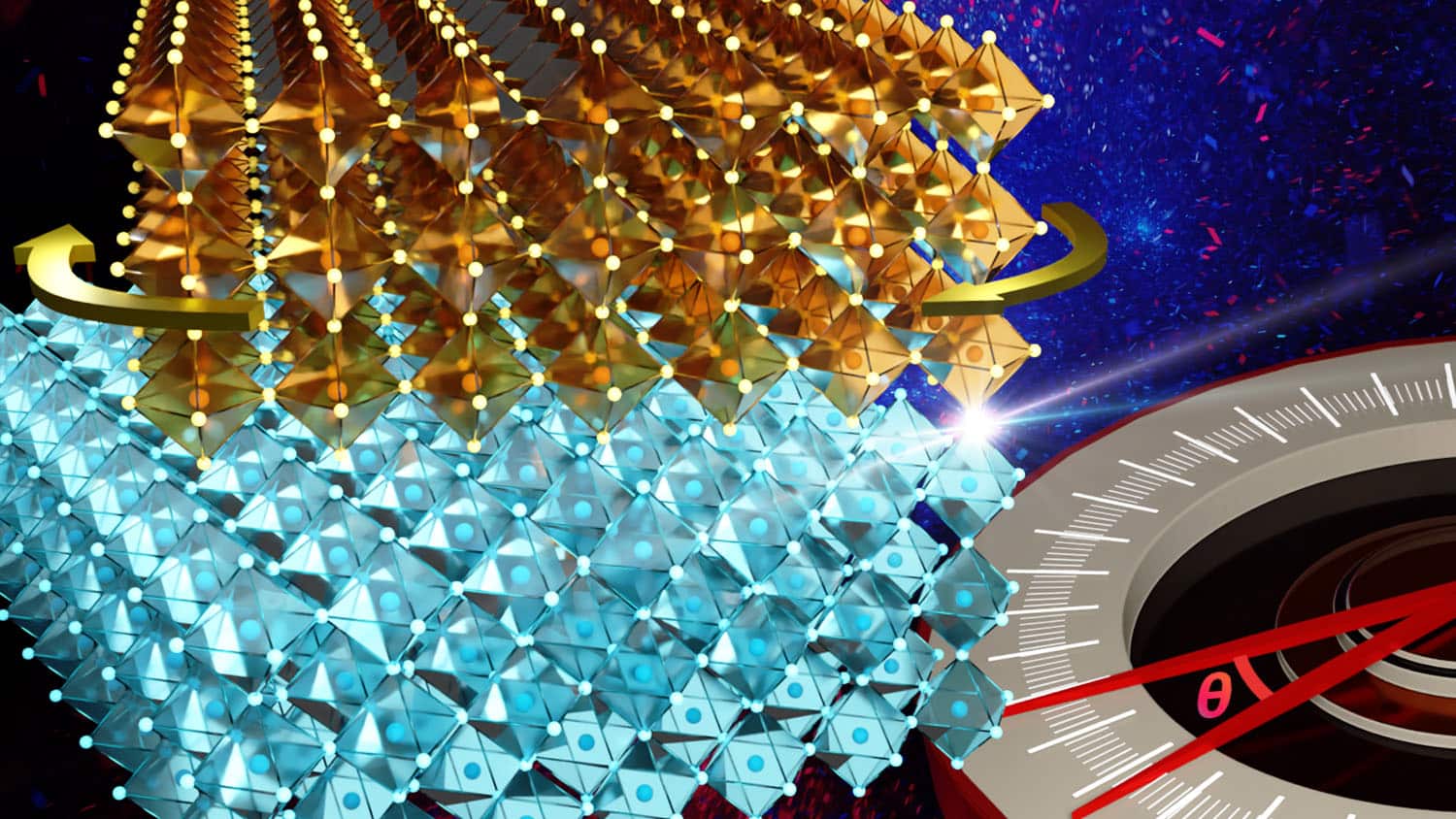
Researchers at NC State have extended twistronics beyond van der Waals materials into strongly bonded crystalline oxides. By stacking sodium niobate membranes with twist angles controlled down to 0.1 degrees, and confirming results via synchrotron X-ray diffraction, the team found interlayer bonds distort the atomic lattice, shifting phase structure and domain configuration. The technique works at near-millimeter scale, far larger than typical twistronic devices, marking a real step toward pract
